What Generator Monitoring Is, and Why UAE Sites Started Caring in 2026
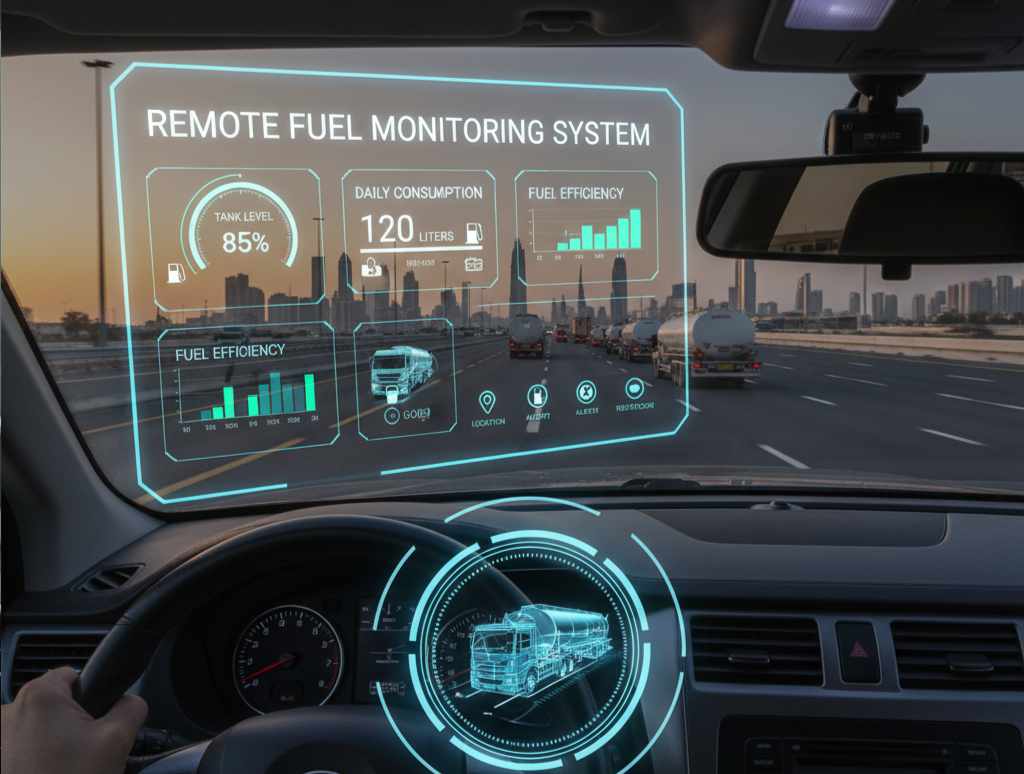
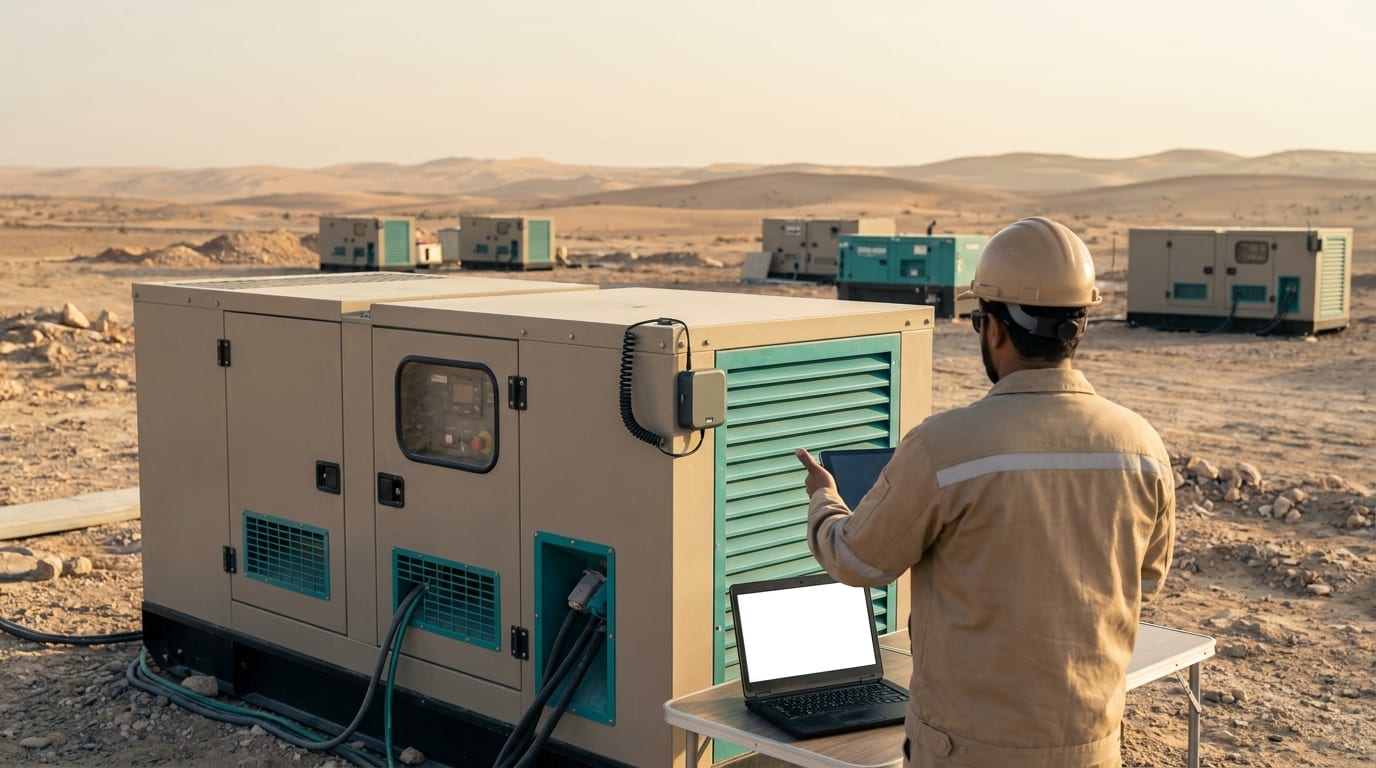
A generator monitoring system is a sensor and telemetry kit fitted to a diesel genset. It streams fuel level, engine run-hours, start and stop events, load, battery voltage and fault codes to a cloud dashboard, usually over a cellular SIM. You go from a machine you visit once a week to one that tells you what it did every minute.
Why has this stopped being a nice-to-have? Arithmetic. UAE diesel was announced at AED 4.30 a litre for September 2026, up from AED 3.80 in August. That's a 13% jump in one month, on top of a rise of more than 60% since late February. A site burning 60,000 litres a month just saw its fuel bill move by AED 30,000, and nobody changed a single operating habit.
When diesel was cheap, losing 5% was an annoyance. At AED 4.30 it's a line item somebody has to explain. That's why the people asking about remote generator monitoring in the UAE this year have changed. It used to be telecom operators, who always measured. Now it's contractors and facilities teams who never did.
Where the Diesel Actually Goes
Theft: The Loss Everyone Suspects and Nobody Can Prove
Generator fuel theft in the UAE is rarely a big event. It's small and regular, and unless someone watches the tank in real time it looks just like consumption. Twenty litres gone from a 500-litre day tank on a Thursday night reads exactly like a slightly heavier load. Do that weekly across nine gensets and a site loses a few thousand litres a year with no evidence trail whatsoever.
Organised theft happens too. In April 2026 Dubai Police arrested a gang running diesel heists around Jebel Ali. They used four-wheel drives fitted with pumps, hoses and storage tanks to siphon fuel from vehicles parked in isolated spots, and police urged operators to keep assets in monitored areas. Now think about a generator in an unfenced corner of a site at 2am. It's an easier target than a truck, and it's left alone for far longer.
Then there's theft on paper. A Dubai driver and petrol station staff were jailed over a AED 73,000 fuel fraud. On generator sites, this is the kind that hurts most. The delivery note says 1,000 litres, the tank went up by 840, and nobody was standing there with a dipstick to notice.
The Quieter Losses: Ghost Hours, Bad Records and Over-Sized Sets
Theft grabs the headlines. In most audits we run, it isn't the biggest number.
No-load running usually is. The set stays on through the lunch break, the prayer break and overnight, because nobody wants to be the one who restarted it. A 250 kVA genset idling at low load still drinks 8 to 12 litres an hour.
Hand-logged run-hours come next. Service intervals slip because the logbook says 4,200 hours and the counter says 5,100. Eventually an oil change gets missed and a AED 90,000 engine learns an expensive lesson.
Wrong-sized sets are harder to spot. A 400 kVA unit carrying a 90 kW load burns far more fuel per useful kilowatt-hour than a machine of the right size, and it wet-stacks itself into a maintenance problem. Without load data you'll never see it.
And then there's refuelling blind. Someone drives a bowser around topping up whatever looks low. That means extra trips, extra labour, and no reconciliation between what left the bulk tank and what went into the gensets.
None of these are about dishonesty. They're measurement problems, which is why sites that install monitoring purely to catch a thief often find the savings came from somewhere else entirely.
What a Generator Monitoring System Actually Measures
Fuel Level: The Number Every Other Number Depends On
Fuel level is the core signal, and the sensor and its calibration decide how accurate it is. The dashboard doesn't. A capacitive or ultrasonic sensor in the day tank reports depth, and the platform turns depth into litres using a calibration table built from the real tank. Generator tanks are rarely simple rectangles. Base-mounted ones almost never are.
Get calibration right and the picture is clear: refuelling shows as a step up, consumption as a slope down, and theft as a slope that's far too steep. Get it wrong and every alert that follows is noise. The sensors we use for vehicle fuel tracking work on gensets as well, but each tank model needs its own calibration. If someone quotes you for a generator install without asking about tank geometry, they haven't done this before.
Bulk site tanks get a sensor of their own. You catch losses in the middle by reconciling what the bulk tank gave out against the sum of what the genset tanks took in. It's the same idea behind a proper fuel control system at a depot.
Run-Hours, Start Events and the Maintenance Clock
Run-hours are to a generator what mileage is to a truck: the unit money is counted in. An automatic run-hour counter settles three arguments at once. When did the set actually run? When is service due? What does the rental customer owe?
Start and stop times matter more than the total. Eleven starts in an hour tells you something's wrong with the load or the controller. A set that started at 19:40 and stopped at 05:20 on a site that shut at 18:00 tells you something else. Hour-based service schedules then go straight into fleet and asset maintenance workflows instead of onto a wall calendar. For engines that might run 400 hours one month and 40 the next, hours are the right thing to measure.
Load, Battery, Coolant and Fault Codes
Fuel tells you what the set costs. The electrical and engine channels tell you whether it'll survive the summer.
- Load percentage and kW output, which show over-sizing, under-sizing and wet-stacking risk
- Battery voltage: the most common reason a genset won't start when the grid drops, and the easiest to catch weeks ahead
- Coolant temperature and oil pressure, the two alarms that come before expensive failures in a UAE summer
- Controller fault and shutdown codes, read straight from the genset controller so a shutdown reaches you as an alert instead of a phone call
- Mains and genset status: how long the site really ran on generator versus utility power
Battery voltage is worth dwelling on. Telecom and standby sets may only run a few minutes a week. On those, a dying start battery stays invisible until the exact moment you need it.
Location: Irrelevant Until It Suddenly Isn't
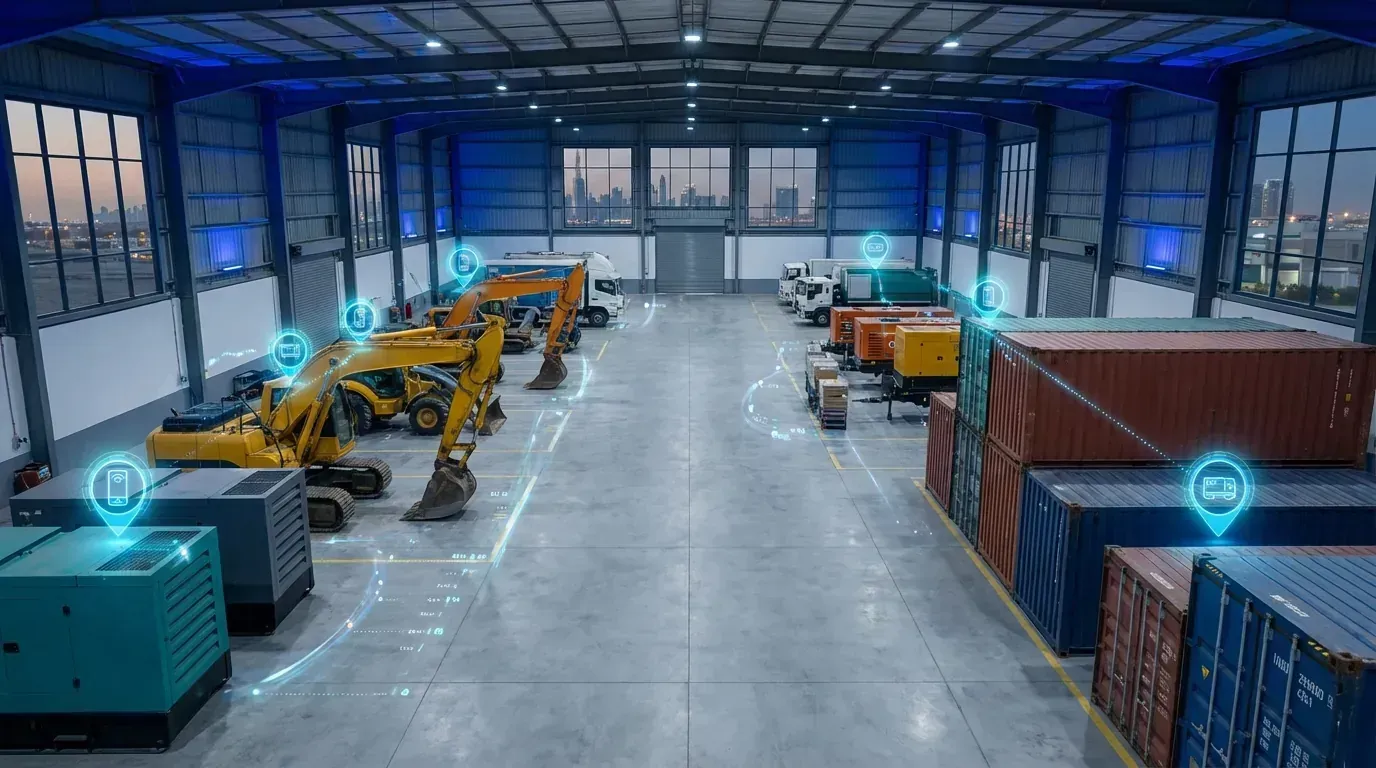
GPS on a fixed genset looks like a wasted feature. Then the set moves. Mobile and rental units move all the time, and even bolted-down sets get shifted between site phases, borrowed by a subcontractor, or loaded onto a low-loader at night.
For rental fleets, location is the whole point: where each unit is, which site it's on, and whether it left without paperwork. Add geofencing and an unauthorised move becomes an alert instead of a nasty surprise. For smaller or unpowered site equipment, standalone asset tracking does the same job for less money.
The Five UAE Site Types That Need This Most
Construction Sites Running Gensets as Prime Power
On most UAE construction projects the generator isn't backup. For months, it's the only power there is. Tower cranes, hoists, site accommodation, welding and dewatering all run on diesel until permanent supply is energised. Run-hours reach the hundreds each month, and fuel use dwarfs the vehicle fleet on the same site.
Controls are also at their loosest here. Several subcontractors, a rotating workforce, an open perimeter at night and a bowser doing rounds with a paper log. Contractors who already track their plant through construction transport and equipment tracking gain the most from adding gensets, because it closes the last unmetered energy line on site. Our construction fleet management guide shows how generators fit alongside the other five asset categories, and our guide to fuel monitoring for excavators, bowsers and site tanks covers the rest of the site diesel.
Telecom Towers and Remote Infrastructure
Telecom towers were the original use case, and they're still the cleanest. They're unmanned, often a long way from the nearest road, and a dry tank means an outage with an SLA attached.
The worry here is different from construction. Nobody cares much about idle hours. They care about refuelling logistics. Sending a bowser to twelve towers when only four need fuel is the cost. Sending it to none of them when one is sitting at 8% is the disaster. Predicting low fuel from the consumption rate, instead of a fixed threshold, is what makes the difference. Connectivity has to be reliable through the mountain and desert stretches of RAK, Fujairah and the Western Region, so these installs run on multi-network M2M SIM cards with Etisalat and du failover.
Data Centres and Critical Facilities
UAE data centre power demand only goes one way. Wood Mackenzie puts it at around 3 TWh in 2025, roughly 2% of national electricity demand, and projects it to more than double to over 6 TWh by 2030. Every one of those halls sits behind banks of standby diesel generators that have to start on demand and hardly ever run.
Standby sets fail differently from running sets. They fail quietly, between tests. So monitoring here is less about fuel economy and more about proving readiness: battery health, fuel polishing intervals, weekly test logs, and a record that holds up at the next audit. Hospitals, cold stores and pharmaceutical warehouses in the UAE have the same profile, often with temperature monitoring on the load side as well.
Generator Rental Fleets
For a rental company, the monitoring system doubles as the invoicing system. Run-hours turn into billable hours. The fuel reading settles an off-hire dispute in thirty seconds. GPS handles recovery.
The commercial case is usually easier to make than the operational one. Hire agreements priced on estimated hours leak money both ways, and customers argue about the fuel level at return because the only record is two people's memories. A timestamped tank reading at off-hire ends that argument for good.
Events, Film Production and Temporary Power
Short, high-profile events at Expo City, Dubai Festival City, Yas Island and the desert camp circuit have one thing in common. The generator absolutely can't stop, and nobody on site is a power engineer.
Monitoring gives the production team a phone alert at 20% fuel instead of a dead stage. It's the least glamorous line on the build sheet, and it's the one that quietly saves the evening.
Find out where your diesel is actually going
IOTee fits fuel level sensors, run-hour counters, controller integration and GPS to diesel gensets across the UAE, with one dashboard for all your sites and instant theft alerts.
How the Hardware Goes On a Genset
Reading the Controller Beats Reading the Wires
If the genset has a modern controller, such as a Deep Sea, ComAp or Woodward unit, the cleanest install reads it directly over Modbus or CAN. There's no need to tap sensors one by one. You get the manufacturer's own factory-calibrated figures for run-hours, load, voltage, frequency, coolant temperature and fault codes.
Older sets and basic canopied units don't offer that, so the same data gets pieced together from separate inputs: a run signal from the alternator or oil pressure switch, a current clamp, a voltage tap on the battery. It works. It's how most site gensets in the UAE end up wired. It just takes more labour and there's more to check at commissioning.
Either way, fuel level almost always needs its own sensor. The factory float gauge on a genset is a convenience for the operator. It's typically accurate to about a quarter of a tank, which makes it useless for theft detection.
Surviving 50 °C, Dust and a Vibrating Canopy
Inside a generator canopy in a UAE summer is a tougher place than a truck cab. Ambient temperature above 50 °C, radiator discharge air well above that, constant vibration, and airborne sand that gets into every unsealed connector.
Our standard spec:
- Telemetry unit rated to at least 85 °C, mounted away from the exhaust and radiator discharge
- IP67 minimum on the enclosure, IP68 on in-tank sensor heads
- Shielded cable runs, routed clear of the alternator and any welding work on site
- Anti-vibration mounting for the unit, and strain relief at every connector
- Independent power with its own fuse, plus a backup battery, so a flat genset battery doesn't leave you blind right when you need to see
Don't skip that last one. A monitoring unit powered only by the machine it's watching goes dark at exactly the moment something interesting happens.
Fuel Theft Alerts That Aren't Just Noise
Alert on Drop Rate, Not Drop Amount
Most fuel-theft alerting fails because of how the thresholds are set. A fixed rule like "alert if level drops 40 litres" fires every working day, and within a week somebody mutes it. What you want is the rate of change, read against whether the engine is running.
Three rules cover almost everything.
First, fuel level falling while the engine is off. There's no innocent explanation for that. It's the alert that matters, and it should hit a phone straight away.
Second, fuel falling faster than the machine could physically burn it. A 250 kVA set can't consume 90 litres in eleven minutes at any load. Anything above the maximum burn rate is siphoning.
Third, consumption per run-hour creeping up against the set's own baseline. It's slower and quieter, and it usually points to small habitual losses instead of one big event.
That third rule is the dullest and the most valuable. It finds the losses that never set off a loud alarm.
Reconcile Deliveries Against Tank Rise, Every Time
Every refuelling should give you two numbers: what the delivery note says, and how many litres the tank really rose. A gap that keeps showing up between the two is the most common form of fuel loss on UAE sites, and you'll never see it if you only read invoices.
Allow a couple of percent for temperature and measurement error. A steady 8% shortfall from one supplier, or on one driver's runs, is something else. We take the same approach in our fuel theft prevention guide for vehicle fleets, and if you already run remote fuel monitoring on your bulk tanks, you're halfway there.
What It Costs and What It Gives Back
2026 UAE Pricing per Generator
These are typical installed prices we quote in 2026. Tank geometry, controller type and site access all shift them, so read them as bands.
- Fuel level sensor, run-hour input and telemetry unit, installed and calibrated: AED 1,900–3,400 per generator
- With controller integration over Modbus or CAN (load, fault codes, full engine data): AED 3,200–5,500 per generator
- Bulk site tank sensor with reconciliation: AED 1,200–2,200 per tank
- GPS and movement alerts for mobile or rental sets: usually included in the telemetry unit
- Platform and connectivity: AED 35–75 per generator per month
We normally install during a scheduled shutdown or service window. On a live site, only the fuel sensor needs the tank opened. For a team that's done it before, that takes 30 to 60 minutes per set.
A Worked Payback Example for a 12-Genset Site
Assumptions first, because a payback figure without them is just marketing. Take twelve site generators averaging 22 litres an hour, running 10 hours a day, 26 days a month. That's about 68,600 litres a month, or 823,000 litres a year. At AED 4.30, the fuel bill comes to nearly AED 3.54 million a year.
- Investment: 12 sets at AED 2,800 installed is AED 33,600 one-time, plus 12 at AED 55 a month, which is AED 7,920 a year
- Loss recovery: say monitoring finds and stops losses worth 3% of consumption. That's 24,700 litres, or AED 106,200 a year
- No-load running: assume a modest 2% cut once idle hours are visible, or 16,500 litres and AED 70,800 a year
- Avoided run-dry shutdowns: three emergency callouts avoided at AED 2,500 each, so AED 7,500 a year
Add it up and you get roughly AED 184,500 against a first-year cost of AED 41,520. The hardware pays for itself in about ten weeks. Drop the loss assumption to 1% and it still pays back inside a year.
To be fair about it, if your site really has no losses and no idle running, the system saves you nothing. Even so, finding that out after one quarter beats suspecting it forever. If you want to model the vehicle side of the same question, try the fleet savings calculator.
Compliance, Emissions and Where This Is Heading
Run-Hour Records Are Quietly Becoming Audit Evidence
More and more, people ask for generator run-hours and fuel consumption instead of assuming them. Main contractors want them for project emissions. Clients want them for ESG reporting. Free zone authorities ask, and so does any government tender where fuel consumption goes into the submission.
A spreadsheet pieced together from delivery notes is a weak answer. A timestamped machine record is a strong one, and once the system is running it costs nothing extra. If you already put this kind of documentation together for tenders, you'll recognise the pattern from our government fleet tender and audit guide.
Net Zero 2050 and the Case for Measuring Before Replacing
The UAE Net Zero by 2050 strategy commits the country to net-zero emissions by 2050, and power is one of the main sectors it covers. Diesel gensets sit right in the middle of that, and hybrid battery-plus-genset and solar-hybrid systems are already turning up on UAE sites.
The practical problem is this. You can't size a battery hybrid, a solar assist or a smaller replacement set without a real load and run-hour profile, and almost nobody has one. Monitoring is the cheapest first step toward lower generator emissions. It shows you which sets are oversized, which sit at 20% load all day, and which hardly run. Sites that replace equipment before measuring it end up with an expensive hybrid on the one genset that was already efficient.
Choosing a Vendor and Getting Deployed
Nine Questions Worth Asking Before You Sign
On paper, generator monitoring quotes look alike. At commissioning they turn out very different. Ask each vendor:
- How do you calibrate the fuel sensor to my tank's shape, and do I get a calibration record?
- Do you read my genset controller directly, and which protocols and brands do you support?
- What's the telemetry unit's rated operating temperature, and where will you mount it?
- Does the unit have its own backup power if the genset battery dies?
- How do you define theft alerts: a fixed threshold, or a rate against engine state?
- Can the platform reconcile bulk tank drawdown against genset tank rises?
- What happens to data when the site loses cellular coverage? Is it buffered or lost?
- Who owns the data, and can I export raw readings instead of PDF reports?
- Is the interface available in Arabic as well as English for site teams?
People get caught out by the buffering question. A remote site with patchy signal needs a unit that stores readings locally and backfills them later. Otherwise the gaps land exactly where the interesting events happened.
A Realistic Rollout, Not a Big Bang
Fit monitoring to two or three generators first. Run them for a full month and study what comes back before you order the rest. That month tells you three things you can't know in advance: your real consumption per run-hour, whether your losses come from theft or idle running, and whether your alert thresholds are well tuned or noisy.
After that, the full rollout goes quickly. An experienced team fits four to six gensets a day, and the platform side is configuration work, with nothing to develop. Leave a week at the end for tuning, when alerts get adjusted to how the site really behaves. Bigger operations usually bring generator data into the same platform as their vehicles and fuel through fleet management. Then the monthly diesel figure finally covers everything that burns it, which is the approach set out in our complete UAE fuel management guide.
Start with two gensets and one month of data
IOTee installs and calibrates generator monitoring across Dubai, Abu Dhabi, Sharjah and the Northern Emirates, on construction sites, telecom towers, data centres and rental fleets.