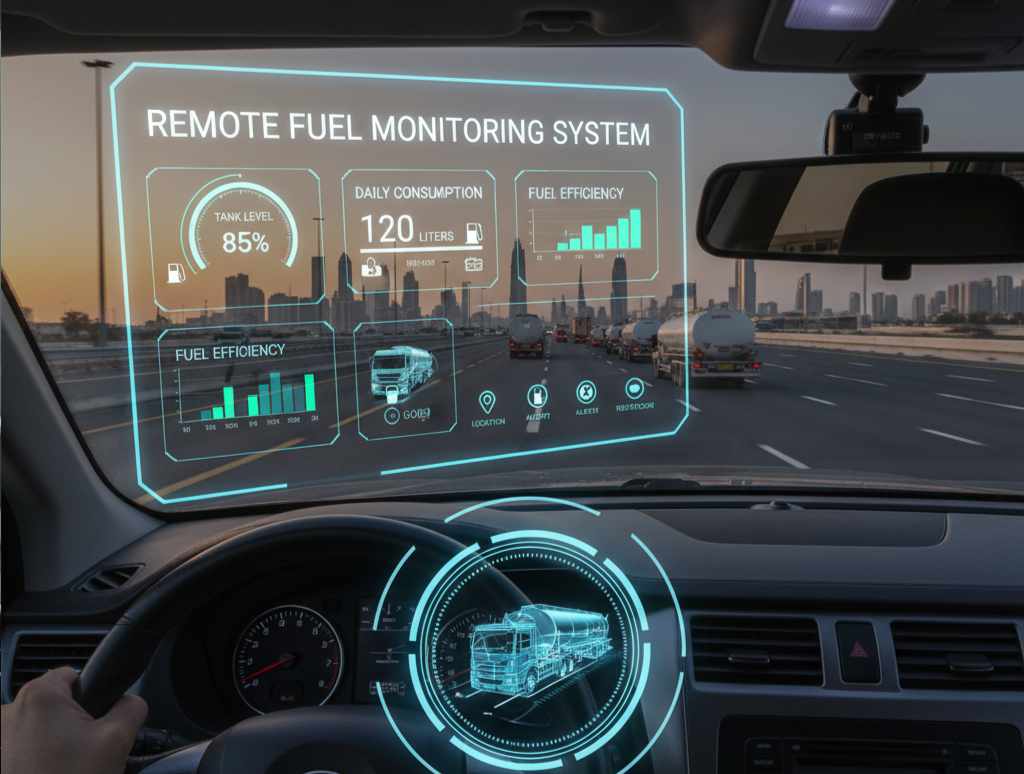
Why UAE Fleets Need a Fuel Management System in 2026
If you run a fleet in the UAE, fuel is probably your biggest running cost. In September 2026 diesel cost AED 4.30 per liter and petrol between AED 3.61 and AED 3.80 per liter, and fuel takes 30-40% of total fleet operating expenses for businesses in Dubai, Abu Dhabi, Sharjah and the Northern Emirates.
The pump price isn't what should worry you most. The leak you can't see is. Industry data from UAE logistics operators shows 15-30% of fleet fuel spend disappearing without anyone noticing, through theft, false receipts, too much idling, poor routes and bad driving habits. On a 30-vehicle fleet that's AED 150,000 to AED 400,000 a year gone with nothing to show for it.
A modern fuel management system in UAE is how you stop it, and in 2026 any serious fleet operator should have one. These platforms combine IoT fuel sensors, GPS tracking, cloud dashboards and AI-driven analytics, and they typically deliver:
- 25-35% reduction in total fuel costs
- 90-95% elimination of fuel theft incidents
- 40-60% reduction in unnecessary idling (the engine idling reduction guide explains how to measure it)
- 15-25% improvement in fuel efficiency per kilometer
- ROI of 3-8 months for most UAE fleets
Picking the right system is where most UAE fleets trip up. This guide goes through every type of fuel management solution and what to look for in UAE conditions: 50°C heat, Dubai traffic, operations spread across several emirates. It shows how IOTee's fuel tracking, fuel control and fleet fuel management products fit different kinds of fleet, and how to build your business case before you buy anything.
What Is a Fuel Management System? (And How It Differs from Basic Fuel Monitoring)
The Anatomy of a Modern Fuel Management System
A fuel management system is an integrated platform (hardware, connectivity, software and analytics) that shows fleet managers every liter of fuel their operation uses and gives them control over it. Measuring fuel is only the start. The system also governs how it gets used.
There are four layers.
The hardware layer is the sensors:
- Ultrasonic or capacitive fuel level sensors installed in the tank (±1–2% accuracy on tanks from 40L passenger cars to 1,000L heavy trucks)
- A GPS tracker providing position, speed and route data synchronized with fuel events
- A CAN bus / OBD-II interface reading engine RPM, ignition state and onboard diagnostics
- A driver ID / iButton reader tying every fuel event to a specific driver
- RFID / fuel nozzle sensors (optional) for dispensing control at the depot
The connectivity layer is the network. M2M cellular SIM cards send data continuously over 4G/LTE-M across the UAE, with low-latency connections to cloud servers so alerts arrive in real time, and failover between Etisalat and du so there are no coverage gaps. IOTee's M2M SIM cards are built for exactly this. Consumer SIMs won't carry a serious fuel management system.
The software layer is the platform itself: a cloud dashboard for fleet managers on web and mobile, role-based access for operations, finance and HR, automated reports and scheduled exports, and API integration with ERP, accounting and fuel card providers.
The intelligence layer is the analytics. AI-powered theft detection tells a refuel apart from siphoning. The system also scores driver behavior, analyzes route efficiency, triggers predictive maintenance when fuel consumption looks wrong, and benchmarks vehicles, drivers, routes and emirates against each other.
A basic fuel monitoring tool stops after the first two layers. It tells you what happened. A proper fuel management system covers all four, so you also learn why it happened, who caused it, what it cost and what to do about it.
Fuel Monitoring vs Fuel Tracking vs Fuel Control vs Fleet Fuel Management: Clearing Up the Terminology
UAE buyers often see these four terms used as if they meant the same thing. They don't. Each is a different level of capability, and getting the words right is the first step to buying the right system.
Fuel monitoring is the entry level. It measures fuel levels and consumption passively, alerts you to big events like a refuel or a sudden drop, and keeps historical reports. It has no link to vehicle or driver data. It suits very small fleets and owners with a single vehicle.
Fuel tracking is the core operational tier. You get everything monitoring does, plus GPS correlation. Each refuel is checked against the station location and time, consumption is worked out per kilometer, per route and per trip, and theft alerts come with the location, driver and amount. This fits 5-50 vehicles, delivery fleets and service fleets. IOTee's fuel tracking system page has the full list of capabilities.
Fuel control adds enforcement on top of tracking. Nobody dispenses fuel without authorization (driver ID matched to vehicle). Limits are pre-set per vehicle, per driver and per shift, RFID controls the nozzle at depot dispensers, and exceptions go through an approval workflow. It's for fleets with on-site fuel storage, places where theft risk is high, and sensitive industries. See fuel control system for how the enforcement works.
Fleet fuel management is the enterprise platform. It covers everything above and plugs into the wider fleet platform. It handles several emirates, depots and departments at once, reconciles fuel cards automatically, allocates cost and chargebacks to departments, forecasts budgets and analyzes variance, and connects with maintenance, compliance and HR systems. It's built for fleets of 50+ vehicles, enterprise operations and government contracts. The fleet fuel management platform page covers the enterprise features.
A simple rule: the more drivers, vehicles, depots and stakeholders you have, the higher up this ladder you'll need to go. Outgrowing a tier costs a lot. Buying one tier too high wastes money. The sizing advice further down should help you get it right first time.
The Four Categories of Fuel Loss Every UAE Fleet Must Plug
Where Your Fuel Budget Actually Goes (And How a Fuel Management System Stops It)
Before you pick a system, be clear about which problems you're trying to fix. Research from UAE fleets shows fuel losses fall into four categories, and each one needs different features.
Fuel theft (10-20% of fuel budget)
This is the biggest loss, and the one you can most easily reverse. In UAE fleets it usually takes one of four forms:
- Siphoning during overnight parking or long stops (10-50L per incident)
- False fuel receipts, with inflated amounts or old receipts used again
- Fuel card fraud, where personal vehicles are filled on company accounts
- Depot dispensing fraud, with fuel given out to vehicles outside the fleet
To stop it you need real-time fuel level sensors, GPS correlation and AI anomaly detection, plus RFID nozzle control if you have an on-site depot.
Operational waste (5-15% of fuel budget)
This covers too much idling (Dubai traffic adds 30-60 minutes of idle per vehicle per day), long spells of AC with the engine running, warm-up idling in 50°C summer heat (which achieves nothing and costs money), and drivers leaving the engine on during personal stops. You need idle time tracking with thresholds you can set, automatic driver alerts and escalation to a manager.
Route and distance inefficiency (5-10% of fuel budget)
Poor routing can add 15-30% extra kilometers. Add drivers ignoring real-time traffic data (RTA Dubai, Abu Dhabi Integrated Transport), unauthorized detours and personal trips, and badly ordered multi-stop runs. The fix is GPS route tracking, AI route optimization, geofencing and alerts for unauthorized use. You'll need a real-time GPS tracking platform connected for this part.
Driver behavior (10-25% swing in efficiency)
Harsh acceleration and braking add 15-25% to fuel use. Highway speeding above 120 km/h adds 20-35%. High-RPM driving adds more. Put a lead-foot driver and an eco-driver in identical vehicles and you can see up to a 60% gap in efficiency. Here you need driver behavior scoring, fuel efficiency reports for each driver, coaching workflows, and support for gamification or incentives.
Our complete guide on reducing fuel consumption in UAE goes through each category in detail, with specific strategies and UAE cost examples. Read it alongside this buyer's guide and you'll have the whole picture.
UAE-Specific Requirements: Why Generic Fuel Systems Fail Here
What to Demand from a Fuel Management System in the UAE Environment
A fuel management system that runs perfectly in Europe or South Asia can easily fail here. The UAE puts demands on hardware and software that generic platforms seldom meet straight out of the box.
Heat-rated hardware (50°C+ tolerance)
In a Dubai summer, cabin temperatures go past 75°C and fuel tanks regularly pass 55°C. Sensors built for a 40°C ceiling die within one summer. Look for:
- IP67 or IP68-rated enclosures
- An operating range of at least -20°C to +85°C
- UV-stable cable insulation
- MTBF (mean time between failures) documented at high ambient temperatures
Cellular coverage on two networks
No one UAE carrier covers every meter of every route. On cross-emirate runs like Dubai–Al Ain, Abu Dhabi–Liwa and the coastal parts of RAK, you need automatic failover between Etisalat and du. IOTee's M2M SIM cards come with multi-network access as standard, which in 2026 should be the minimum.
Arabic and English dashboards
RTA-compliant reporting, apps for drivers and government tender submissions all need Arabic. An English-only system will lose you contracts.
UAE tax, VAT and fuel card integration
The 5% VAT on petrol and diesel on fuel invoices has to flow into accounting automatically. You'll want Etisalat/ENOC/EPPCO/ADNOC fuel card APIs for receipt reconciliation, with each card transaction matched automatically to the refuel the sensor actually saw.
RTA and government compliance reporting
If your fleet runs under RTA permits or bids for government tenders, the system has to produce:
- Consumption logs ready for audit, with timestamps that can't be tampered with
- Driver hour and fuel efficiency reports in the formats RTA, Abu Dhabi DoT and Sharjah RTA require
- Environmental impact reports (CO₂ per kilometer) for green fleet programmes
Dust and sand protection
UAE micro-dust is finer than ordinary desert dust. Connectors and sensor housings need sealing beyond the normal IP ratings. Field data from fleets in Sharjah and Al Ain shows generic hardware failing within 18 months from dust getting in, and nothing else.
One view across all the emirates
If you operate in several emirates, you need a single dashboard that adds up consumption by emirate, region or depot, evens out fuel prices (which vary slightly from station to station), puts VAT in the right jurisdiction, and lets you set geofenced rules per emirate for things like different shift rules and overnight-parking policies.
These are the things that separate a system that looks good in a demo from one that keeps working in UAE conditions for five years and more.
The Five Core Features Every UAE Fuel Management System Must Have
Feature 1: Real-Time Fuel Level Measurement (±1–2% Accuracy)
Everything else rests on this. You need to know how much fuel is in every tank at every moment, to within 1–2%.
When you evaluate a vendor, check:
- The sensor accuracy claim, backed by an independent calibration certificate
- Sampling frequency (10-60 seconds, real time)
- How tanks are calibrated. Every tank has its own curve, and generic calibration can't be trusted
- How the sensor copes with fuel sloshing at speed and on slopes (IOTee's fuel tracking system uses motion-compensated filtering)
- What happens during refueling, and whether refill pattern recognition can tell a genuine refill from theft
Walk away from any vendor who talks about 'approximate' readings or 'percentage of tank' and can't give accuracy in liters. On a 500L truck tank, 1% error is 5 liters on every reading. That's plenty of room to hide a theft.
Feature 2: GPS + Fuel Event Correlation
Fuel sensor data on its own doesn't tell you much. Link it to GPS position, time, ignition state and driver ID and it starts catching theft, false receipts and unauthorized use.
Ask for these correlation features:
- Every refuel pinned to a GPS coordinate, so you know whether the vehicle was really at a fuel station
- Station names resolved automatically (ENOC, ADNOC, EPPCO, Emarat)
- Timestamps compared with the fuel card transaction time
- A driver ID (via iButton or RFID) on every fuel event
- An odometer reading taken at each refuel to calculate consumption
Connect it to a full real-time GPS tracking platform and fuel events sit alongside route, speed and driver behavior. That's how you spot the subtle patterns that separate systems never see.
Feature 3: AI-Powered Theft Detection and Instant Alerts
If a driver siphons 40 liters overnight, a report next week is no use to you.
For UAE fleets, real-time alerting should meet these standards:
- Detection time: under 3 minutes from a sudden drop to the alert
- False positive rate: under 2%. The AI has to tell sloshing, temperature-driven volume change and genuine refuels apart from actual theft
- Alert channels: SMS, email, push notification and webhook, all configurable
- Evidence: each alert should carry the GPS location, timestamp, amount of fuel lost, estimated loss in AED and the driver on duty
- Escalation: if nobody acknowledges within X minutes, it goes to the operations manager, then to security
With well-tuned systems, UAE fleets consistently report 90-95% of theft incidents gone within the first 60 days. The sensors don't physically stop anyone. Instant alerts with evidence attached make people accountable, and that's what does it.
Feature 4: Driver Behavior Scoring and Fuel Efficiency Attribution
Put two drivers in identical vehicles on identical routes and you can see a 30-60% difference in fuel efficiency. A good fuel management system measures that difference and pins it on the right person.
Driver attribution should include:
- Liters per 100 km for each driver (normalized for route and load)
- Idle time as a percentage of each shift
- Harsh acceleration, braking and speeding events per 100 km
- A combined fuel efficiency score (0-100) for each driver
- Leaderboards (UAE fleets that use gamified scoring report 15-25% efficiency gains within 6 months)
Without it, you'll end up blaming vehicles or routes when the problem is how people drive. Coaching your worst 10% of drivers usually saves more fuel than anything else you can do.
Feature 5: Financial Dashboards and ROI Reporting
The platform has to talk to finance in terms finance cares about, as well as serving operations.
It should produce:
- Fuel cost per kilometer by vehicle, driver and route
- Cost per delivery or per job, for pricing and bids
- Monthly variance analysis (budget against actual, with automated explanations)
- Allocation by department or cost center for enterprise chargebacks
- VAT-compliant fuel expense exports to QuickBooks, Zoho Books, Oracle and SAP
- Theft losses in hard numbers, so you can put an exact AED figure on what the system saves you
This is what moves fuel management out of the operations office and into board meetings. When finance teams see their own reports coming out of the platform, they become its loudest supporters inside the company, and that's how you get budget to expand it.
Fuel Management Solutions Mapped to Fleet Size and Industry
Which IOTee Solution Fits Your Fleet?
No one product suits every UAE fleet. This is how IOTee's fuel management range lines up with different fleet sizes and types.
Small fleets (1-15 vehicles): start with fuel tracking
These are usually local delivery firms, service van operators, small logistics companies and SME transport. We'd recommend the fuel tracking system with basic GPS tracking. Theft detection, consumption tracking and driver attribution get you 80% of the value for 40% of the cost of an enterprise platform, and most small fleets see ROI in 4-6 months. Add fuel control later if theft carries on or you start fueling from your own depot.
Mid-size fleets (15-50 vehicles): move to integrated fleet and fuel
Think regional logistics, construction support, corporate fleets, and rental and leasing companies. Here we'd put in a fleet management platform with fuel tracking built in, plus fuel control if you store fuel on site. At this size fuel, maintenance and driver management all affect each other. Stopping theft is only part of the saving. The rest comes from better routes, tighter maintenance (bad injectors push fuel consumption up sharply) and driver coaching. One joined-up platform does that better than three separate tools.
Large fleets (50-200+ vehicles): go to the full fleet fuel management platform
This means enterprise logistics, waste management, oil and gas transport, big corporate fleets and government contractors. The right fit is the fleet fuel management platform with the full enterprise feature set. Multi-depot operations, departmental chargebacks, tender compliance, VAT-accurate accounting integration and board-level financial reporting all become must-haves. Savings are only part of the ROI case at this point. Lower risk, audit readiness and winning bids count too.
Specialized industries: add fuel control on top
- Construction fleets: fuel control at site fuel bowsers, plus consumption tracking for each excavator, loader and generator. Site gensets are often the biggest diesel cost nobody meters, and our generator monitoring system guide covers tank sensors, run-hours and theft alerts.
- Oil and gas: depot dispensing control, tamper-proof hardware, intrinsically safe sensors for hazardous zones.
- Cold chain logistics: fuel tracking tied into reefer fuel consumption, which is often under-tracked and a high-theft category.
- Government and municipality: a full audit trail, reporting that meets tender requirements, per-department chargebacks.
- Transport and logistics: long-haul routes (Dubai–Oman, Abu Dhabi–Saudi), fuel management across border crossings, SIM coverage on several carriers.
The real decision is seldom which product to buy. It's which combination, set up how, rolled out in what order. Talk that through with our team before you commit, because the first 90 days of a rollout set the tone for years.
Cut Your Fleet's Fuel Bill by 25–35%
IOTee fuel monitoring catches theft as it happens, tracks consumption for each vehicle, and usually pays for itself in 4–6 months.
The ROI Case: What UAE Fleets Actually Save
A Concrete 30-Vehicle Fleet Model (Dubai-Based Delivery Operation)
Let's model a typical Dubai delivery fleet: 30 light commercial vehicles, each averaging 100 km/day, 26 working days a month, 12 km/L average consumption, running on diesel at September 2026's AED 4.30 per litre.
Before a fuel management system:
- Daily fuel per vehicle: 100 km ÷ 12 km/L = 8.33 L
- Monthly fleet consumption: 30 × 8.33 × 26 = 6,497 liters
- Monthly fuel cost: 6,497 × AED 4.30 = AED 27,937
- Annual fuel cost: AED 335,245
- Estimated hidden losses (20% of budget): AED 67,049 per year
After a fuel management system (year 1, conservative estimates):
- Fuel theft elimination: 12% saved, ~AED 40,229/year
- Idle reduction: 5% saved, ~AED 16,762/year
- Route optimization: 6% saved, ~AED 20,115/year
- Driver behavior coaching: 7% saved, ~AED 23,467/year
- Total fuel savings: ~30%, ~AED 100,574/year
There are other savings that aren't in that headline figure. Vehicle maintenance costs drop 15-20%, which is AED 8,000-12,000/year on a 30-vehicle fleet. Coaching drivers cuts accidents, and insurance premiums can fall 10-15%. Automated reporting saves 40-60 hours of admin a month over doing it by hand. Optimized routes can also lift capacity by 25%, and that brings in revenue.
What the system costs (typical UAE pricing):
- Hardware + installation: AED 1,200-1,800 per vehicle = AED 36,000-54,000 one-time
- Software + connectivity: AED 50-90 per vehicle per month = AED 18,000-32,400 annual
Where you stand after year 1:
- Total savings: ~AED 100,574 (fuel) + ~AED 10,000 (maintenance) = ~AED 110,574
- Total investment: ~AED 54,000 (hardware) + ~AED 25,000 (software year 1) = ~AED 79,000
- Break-even: around month 9 at these numbers, sooner with a higher theft baseline
From year 2 the hardware is paid for. Savings of AED 95,000-115,000/year end up mostly as profit, against only AED 25,000 in software and connectivity. That leaves a net annual benefit of AED 70,000-90,000, every year.
So UAE fleets don't really ask whether they should buy a fuel management system. They ask why they haven't bought one already.
How to Choose the Right Fuel Management Provider in UAE
The 12-Point Vendor Evaluation Checklist
Use this checklist on any fuel management vendor in the UAE. A single 'no' on any of the first six items should rule a vendor out.
Hardware and accuracy
- 1. Sensor accuracy of ±1–2% with an independent calibration certificate
- 2. Hardware rated for -20°C to +85°C operation, IP67 minimum
- 3. Reference customers in the UAE with 3+ years of field data
Connectivity and coverage
- 4. Dual-network (Etisalat + du) cellular with automatic failover
- 5. A documented uptime SLA of 99.5% or higher
- 6. Real-time data with latency under 60 seconds
Software and analytics
- 7. AI-powered theft detection with a false positive rate under 2%
- 8. Dashboard and driver app in both Arabic and English
- 9. Driver behavior scoring with leaderboards and coaching workflows
- 10. VAT-compliant financial exports to the accounting platforms UAE companies commonly use
Service and support
- 11. A local UAE installation and support team, and not only remote support
- 12. 24/7 support in Arabic and English
When you negotiate the contract, stay away from multi-year hardware lock-ins with early termination penalties. Insist on data portability: it's your data, and you should be able to export it in standard formats. Ask for a pilot (5-10 vehicles, 60-90 days) before you commit fully. Get clear on who owns the hardware when the contract ends, and look at the upgrade path for sensor replacements and major software versions.
Warning signs:
- Hardware that only works with proprietary software you can never replace
- Pricing that isn't clear and changes feature by feature
- 'Lifetime' licenses that quietly expire
- Vendors who can't name three UAE reference customers at your scale
- Installation teams that subcontract without any traceability
Implementation: The 90-Day Rollout Playbook for UAE Fleets
From Signed Contract to Full Value in 12 Weeks
The biggest mistake UAE fleets make is treating fuel management as a hardware install. It's a change management project that happens to involve hardware. This 90-day plan works:
Weeks 1-2: baseline and design
Collect 30 days of consumption data from before the system goes in (fuel card statements, odometer logs, driver records). Write down your current 'dark spots', the places you suspect theft or waste. Decide how you'll measure success: theft events per month, an L/100km target, an idle time target. Then configure the tenant, users, roles and who receives alerts.
Weeks 3-5: pilot installation (5-10 vehicles)
Install sensors on a mix of vehicles that represents the fleet. Calibrate the tank curve on every vehicle one by one, and don't skip it. Check sensor accuracy with controlled drain tests. Tune the alert thresholds to your fleet's normal variation, and train the operations team on the dashboard and on how to respond to alerts.
Weeks 6-8: full fleet rollout
Stagger the installs, at most 5 vehicles a day for one installation team, and check each vehicle before it goes back into service. Brief the drivers and be open with them. Hidden monitoring backfires, and announcing it is what changes behavior. A Day 1 'amnesty' policy helps too: announce that monitoring starts on date X and that anything before that date is forgotten.
Weeks 9-11: coaching and tuning
The first driver behavior reports come out. Your bottom 10% of drivers get one-to-one coaching, the top 10% get recognition, and the gamification goes live. Refine the alert thresholds using the noise you're actually seeing in the field.
Week 12: business review and scale
Run the first full month-on-month comparison against the baseline and produce an ROI report for finance. Then decide what's next: expand to the remaining depots, add fuel control, bring in maintenance, or fit dash cameras.
UAE fleets that follow this plan consistently reach 20%+ fuel savings by month 4 and 30%+ by month 9. Fleets that skip the change management and run the rollout as a pure hardware job usually get about half those savings for the same money.
Related: see how GPS tracking for vehicles works in the UAE, with device types, pricing from AED 500/year and coverage across all seven emirates.
Frequently Asked Questions: Fuel Management System UAE
How much does a fuel management system cost in UAE?
It depends on fleet size, solution tier and service level. Typical 2026 pricing for UAE fleets looks like this:
- Hardware + installation per vehicle: AED 1,200-1,800 (one-time) at tracking level, or AED 2,000-3,500 for fuel control with depot hardware
- Software + connectivity per vehicle per month: AED 50-90 for tracking, or AED 90-150 for the full fleet fuel management platform
- Enterprise platform setup fees: AED 10,000-40,000, depending on the integrations you need
For a 30-vehicle fleet, budget AED 65,000-100,000 in year one and AED 18,000-35,000 a year after that. Most fleets earn the investment back in 6-13 months from fuel savings alone.
How accurate are fuel sensors in UAE heat conditions?
Good fuel sensors that are installed and calibrated properly hold ±1–2% accuracy in UAE operating conditions. Three things keep them accurate in 50°C+ heat.
The first is temperature-compensated sensing, where the sensor corrects for fuel expanding as it heats up. The second is motion filtering, which strips out sloshing and road vibration in software. The third is calibration for each tank: its shape is mapped during installation, because generic calibration can't be relied on.
Miss any one of the three and the sensor will drift by 2-5% over a UAE summer, which makes theft detection unreliable. Ask every vendor to walk you through their UAE-specific calibration procedure.
Can a fuel management system integrate with ADNOC, ENOC, EPPCO, and Emarat fuel cards?
Yes. Modern fuel management systems pull in fuel card transaction feeds via API from all the major UAE fuel card issuers (ADNOC, ENOC, EPPCO, Emarat, Euromax and corporate providers). The system then reconciles each card transaction automatically with the refuel the on-vehicle sensor actually detected. If a card is charged for 60L and the sensor only saw 48L go in, that's flagged as possible receipt fraud.
This one integration usually wipes out 50-80% of fuel card abuse in the first quarter.
Is it legal to monitor driver behavior and fuel consumption in UAE?
Yes. Monitoring company vehicles, fuel use and driving behavior is legal in the UAE and plenty of companies do it. To stay on the right side of good practice you should have:
- Written disclosure in the employee handbook or employment contract
- Signed consent confirming what's monitored
- Purpose limitation, so monitoring data is used only for operations and safety and never for watching people outside work hours
- Data protection compliance, handling personal data under UAE Federal Decree-Law No. 45 of 2021 on personal data protection
IOTee platforms come with data retention controls, driver privacy zones (data from personal use outside working hours can be masked automatically) and role-based access, so compliance is set up properly from day one.
How long does installation take for a 30-vehicle fleet?
A standard 30-vehicle rollout takes 3-5 working days of actual installation (usually 5-8 vehicles a day per installation team), spread over 2-3 weeks so operations aren't disrupted. The whole project, from baseline to pilot to rollout and coaching, fits comfortably into 90 days for a fleet that size. Bigger fleets of 100+ vehicles usually run 4-6 month rollouts in phases, depot by depot or region by region.
Can I start with fuel tracking and upgrade to full fleet fuel management later?
Yes, and for a growing fleet it's often the smartest way to do it. IOTee's platform is modular. Start with the fuel tracking system, add fuel control when you open depot fueling, then move up to the fleet fuel management platform once you need multi-depot and enterprise reporting. The hardware and the data stay the same. Only the software and analytics tiers grow. Your first investment is protected, and you add capability without ripping anything out.
What happens to the data if we change providers?
Settle this before anything else commercial. Your fuel and driving data is an operational asset, so treat it like one. Before you sign, get written confirmation that:
- All historical data can be exported at any time in standard formats (CSV, JSON, SQL dump)
- Exporting data is free and unlimited
- No lock-in clauses stop you moving to another vendor
- The procedure for releasing the hardware from the vendor is documented
Reputable UAE providers, IOTee included, treat data portability as standard. If a vendor dodges this conversation, leave them off your shortlist.
Next Steps: Building Your Business Case
From Reading to Rolling Out
If you've read this far, you've already decided you need a fuel management system. What's left is building the case inside your company and choosing the right solution for your fleet.
We'd suggest three steps.
First, work out how much fuel you're losing now. Pull 90 days of fuel card statements, compare them with what the odometer readings say you should have used, and calculate the gap. Most UAE fleets find 15-25% they can't explain. That's the pool your savings come from.
Second, read the companion articles. The complete guide to reducing fuel consumption in UAE goes through each savings lever in fine detail with UAE-specific data. The remote fuel monitoring system guide explains the technology for your technical people.
Third, run a structured pilot. Choose 5-10 vehicles, run them for 60-90 days on the same routes with the same drivers, measure the difference, and then scale up knowing it works. Any vendor that's serious about the UAE market will back a structured pilot on clear terms.
IOTee is built for fleets in Dubai, Abu Dhabi, Sharjah, Ajman, Ras Al Khaimah, Fujairah and Umm Al Quwain, from 5-vehicle SMEs up to enterprise operators with 500+ vehicles and government contract fleets. Every project starts with a scoping conversation about your fleet. We don't open with a pre-packaged product and a sales pitch. You might need fuel tracking, fuel control, fleet fuel management, or a unified fleet management platform with fuel at the center. Either way, the solution should fit around your operation, and your operation shouldn't have to bend to fit the product.
Over the next five years, the UAE fleets that do well will be the ones that stop seeing fuel as a cost they just pay and start treating it as something they measure, control and optimize. You've got the map now. The next move is yours.