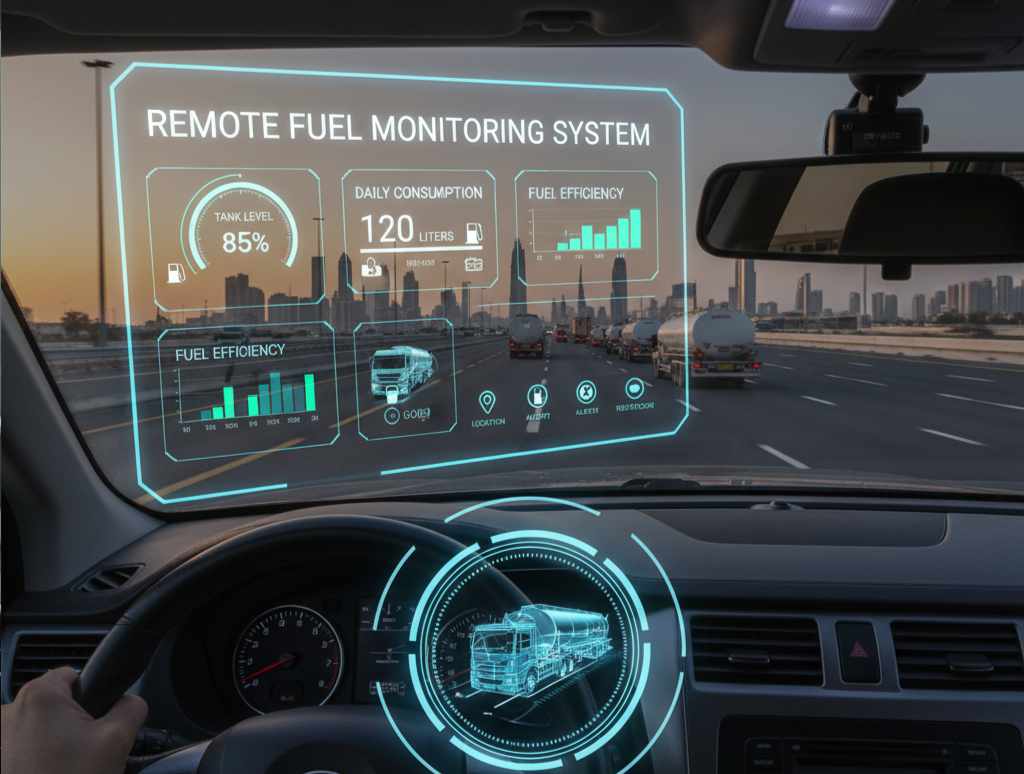
Introduction: Why UAE Businesses Need Remote Fuel Monitoring Systems in 2025
For most UAE fleets, fuel is 30–40% of total operating cost. Diesel was set at AED 4.30 a litre for September 2026, prices move every month, and fleet managers in Dubai, Abu Dhabi and everywhere else feel it in the budget.
The price per litre gets the attention. The bigger problem is quieter. Somewhere between 15% and 30% of the fuel budget disappears through theft, waste and plain inefficiency, and nobody sees it happen. A typical 30-vehicle fleet in Dubai loses AED 50,000–150,000 a year to fuel problems a remote fuel monitoring system could prevent.
This guide covers what you need to know about fuel monitoring systems for trucks and vehicles: GPS fuel monitoring, fuel expense trackers, fleet fuel tracking, and how to pick the right fuel tracking system for your business. If you're weighing up the whole stack, from basic tracking up to full enterprise fleet fuel platforms, our Fuel Management System UAE: 2026 Buyer's Guide is the main reference for selection, ROI modelling and rollout.
What is a Remote Fuel Monitoring System?
Understanding Remote Fuel Monitoring Technology
A remote fuel monitoring system for vehicles puts hardware sensors in the fuel tank, pairs them with GPS tracking, and sends everything to cloud software so you can see consumption, tank levels, refuelling and possible theft as it happens.
The pieces are fairly simple. An ultrasonic or capacitive fuel level sensor measures the tank to ±1–2% accuracy. A GPS tracking device supplies location data that's synchronised with every fuel event. A cellular M2M SIM card sends the readings from the vehicle to the cloud platform. On top of that you get a web and mobile dashboard for monitoring and reports, an alert system that pings you about theft, abnormal drainage and refuelling, and an analytics engine that works out fuel efficiency, consumption patterns and cost.
Compare that with the old way: manual fuel logs and a drawer full of receipts. A remote fuel monitoring system tracks fuel continuously and automatically, 24/7, across the whole fleet, and it's far harder to tamper with.
How GPS Fuel Monitoring Works: The Technology Explained
The Science Behind Accurate Fuel Tracking
GPS fuel monitoring ties fuel level readings to GPS data, so you can match consumption against where the vehicle was, which route it took and how it was driven. The process runs in five steps.
It starts in the tank. Ultrasonic sensors measure the fuel level every 10–30 seconds to ±1–2% accuracy, which works out to 5–10 litres on a 500-litre tank.
Each reading is then tagged with the vehicle's GPS location, speed, engine status and a timestamp.
Next, M2M cellular connections push the fuel and GPS data to cloud servers in real time over 4G/3G networks across the UAE.
The fourth step is where it gets useful. Machine learning algorithms look for patterns in the data so the system can tell a refuel from a theft, spot abnormal drainage that points to a theft attempt, calculate fuel efficiency per route and per driver, flag excessive idling and waste, and check fuel receipts against what actually went into the tank.
Finally, fleet managers get alerts by SMS or email. Typical triggers:
- Sudden fuel level drops (possible theft)
- Refuelling events, with location verification
- Excessive idling
- Unusual consumption
- Daily and weekly consumption reports
A standalone fuel sensor can tell you the level dropped. Only the combination with location tells you where, when and who was driving.
Types of Fuel Monitoring Systems: Choosing the Right Solution
1. Fuel Monitoring System for Trucks (Heavy-Duty Commercial)
This category suits logistics companies, construction fleets and transport operators running trucks above 3.5 tons.
The sensors are heavy-duty units rated for tanks from 200L to 1,000L and beyond, and built to cope with vibration on rough terrain. You can monitor more than one tank on trucks with auxiliary tanks, track fuel burned through the PTO (Power Take-Off), and link the data to trailer tracking. The ±1–2% accuracy matters most here, because a small percentage of a big tank is a lot of diesel.
In Dubai and Abu Dhabi, the typical users are construction companies running dumper trucks and concrete mixers, long-haul logistics operators on Dubai–Abu Dhabi–Oman routes, port and cargo transport fleets, and waste management and municipal services.
As an ROI example, a 20-truck fleet in Dubai burning 25,000 litres a month saves AED 15,000–20,000 a month by stopping fuel theft and improving efficiency.
2. Fuel Monitoring System for Vehicles (Light Commercial & Passenger)
These are for delivery vans, service vehicles, company cars, taxi fleets and rental car companies.
The sensors are compact, sized for 40L–100L tanks, and there's an OBD-II integration option on modern vehicles. Installation costs less and goes faster than on a truck. It works well for urban delivery and service fleets, and it can hook into your customer delivery tracking.
Typical users in Dubai and Abu Dhabi:
- E-commerce and last-mile delivery companies
- Food delivery aggregators and their rider fleets
- Corporate fleets at banks, insurers and sales teams
- Taxi and ride-hailing operators
- Facility management and field service companies
For example, a 50-vehicle delivery fleet in Abu Dhabi saves AED 25,000 a month by shutting down false fuel receipt claims and cutting idling.
3. Fleet Fuel Tracking System (Enterprise Multi-Vehicle)
This is the option for large enterprises running a mix of cars, vans and trucks.
Everything sits on one platform, whatever the vehicle type, and you can monitor several sites at once (say, Dubai, Abu Dhabi and Sharjah operations). You get advanced analytics and custom reports, role-based access for different departments, API links to ERP and accounting systems, and a fuel expense tracker that allocates costs automatically.
For a big organisation, the payoff is mostly administrative. Fuel spend is tracked centrally across every location and allocated and billed by department. Fuel cards and receipts get checked automatically. You can produce compliance reports for the RTA and for government tenders, and fuel consumption patterns feed predictive maintenance.
One ROI example: a 200-vehicle enterprise fleet saves AED 150,000–200,000 a month by managing fuel properly across the whole operation.
Key Features of Modern Remote Fuel Monitoring Systems
Essential Capabilities for UAE Businesses
Seven features do most of the work in a good fuel tracking system.
The first is a live fuel expense tracker. You see current fuel levels across the whole fleet on one dashboard, costs are calculated automatically from current UAE fuel prices, and you get daily, weekly and monthly expense summaries. It tracks budget against actual consumption, breaks cost down per kilometre, per delivery or per job, and exports to accounting software such as QuickBooks, Zoho and SAP.
Second, theft detection and alerts. AI algorithms pick up abnormal drainage and send SMS or email alerts the moment a level drops suddenly, with the location of the suspected theft attached. Over time, pattern analysis points to repeat offenders. The claimed detection rate is 98% within 2–3 minutes, and if you've got dash cams integrated you can add photo evidence.
Third, refuelling verification. The system spots each refuel on its own, checks the GPS location against the station, and logs the time. You can then compare the litres that actually went in with what the receipt claims, catch false receipts, and keep an eye on preferred stations for corporate accounts.
Fourth is idling. An idling engine burns 0.6–1.0 litres an hour. You get idling reports per driver, a list of vehicles that went over your threshold (30 minutes, for example), daily and monthly waste in litres and dirhams, and coaching triggers based on each driver's idling habits.
Fifth, efficiency analytics. Litres per kilometre is calculated by vehicle, driver and route. You can compare similar vehicles, find the ones that need maintenance, compare routes (Dubai–Sharjah against Dubai–Abu Dhabi, say), link aggressive driving to higher consumption, and see seasonal and traffic patterns.
Sixth, driver performance. Each driver gets a fuel efficiency score, and you can compare drivers on the same vehicle type, find the ones who need fuel-efficient driving training, and run incentive schemes based on fuel saved. Speeding and harsh acceleration show up here too.
Seventh, multi-location management. You can watch vehicles in Dubai, Abu Dhabi, Sharjah and RAK at the same time, compare fuel use by region, track expenses by location, set geofences with per-zone consumption, and optimise routes across emirates.
Benefits of Remote Fuel Monitoring Systems for UAE Businesses
Quantified ROI and Business Impact
The savings come from several places at once, so it's worth taking them one at a time.
Theft is the big one, typically 10–20% of the budget. UAE fleet operators report that this much fuel goes missing through drivers siphoning for personal use or resale, false fuel receipts, and vehicles used after hours without permission. Take a 30-vehicle fleet using 30,000 litres a month. At 15% theft, that's 4,500 litres stolen every month. At September 2026's AED 4.30 a litre, that's AED 19,350 a month, or AED 232,200 a year. With fuel monitoring in place, theft drops to near zero within the first month.
Waste accounts for another 5–15%. The usual culprits are excessive idling (two hours or more a day per vehicle), routes that add unnecessary distance, aggressive acceleration, and neglected maintenance like clogged filters or low tyre pressure. On a 50-vehicle fleet, a 10% cut in waste saves 5,000 litres a month. That's AED 21,500 a month at AED 4.30 a litre, and AED 258,000 a year.
Routes are worth 5–10%. GPS fuel monitoring shows which routes burn the most fuel, so you can fix delivery sequences, dodge congestion hotspots and cut total kilometres. On a fleet using 90,000 litres a month, an 8% route improvement saves 7,200 litres. At AED 4.30 a litre, that's AED 30,960 a month, or AED 371,520 a year.
Then there are the benefits that don't come straight off the fuel bill.
Budgeting gets easier. You can forecast monthly fuel spend to within ±3%, plan for price swings, put accurate fuel costs into customer quotes, allocate costs by department, and see seasonal patterns coming.
Vehicles last longer. A sudden jump in consumption usually means an engine problem. A slow decline in efficiency points to filters or injectors. Catching these early prevents expensive breakdowns and cuts unplanned downtime by 20–30%.
Drivers become more accountable. Consumption per driver is visible to everyone, so you can pay performance incentives, coach the inefficient ones, cut unauthorised use and build a more professional driving culture.
And it can win you work. Many RTA tenders and large enterprise contracts in the UAE now require real-time fuel monitoring, detailed consumption reports, audit transparency and environmental impact tracking. Businesses without fuel tracking systems can't compete for these contracts.
Add it all up and UAE fleet operators typically cut total fuel cost by 25–35%. A worked example for a 50-vehicle fleet:
- Monthly fuel consumption: 50,000L
- Monthly fuel cost: AED 215,000 (at AED 4.30/L)
- 30% savings: AED 64,500 per month
- Annual savings: AED 774,000
- System cost: AED 37,500 (50 vehicles × AED 750)
- Payback: under one month (about 0.6)
How to Choose the Right Fuel Monitoring System in UAE
Critical Selection Criteria for Dubai & Abu Dhabi Businesses
Seven things to check before you sign.
Start with sensor accuracy and reliability. You want ±1–2% or better, which matters most on large tanks. The sensors should be rated for UAE conditions (50°C and above), resistant to vibration on rough ground, and at least IP67 against water and dust. Ask for UAE customer references to prove they hold up.
Then look at how well the GPS side is integrated. Fuel and GPS data should be synchronised on one system, updated every 10–30 seconds, and linked to routes. Geofencing should be built in, and route playback should show fuel on the same timeline.
Connectivity is next. You need reliable 4G/3G coverage on Etisalat and du, ideally multi-network M2M SIM cards for redundancy, and coverage in remote areas like RAK, Fujairah and the Oman border. Keep data costs low so monthly fees don't creep up, and ask for static IP and VPN access for security.
The software should be easy to use on web and mobile, send alerts by SMS, email and push notification, export custom reports to Excel and PDF, support multiple users with role-based permissions, connect to ERP and accounting systems by API, and work in both Arabic and English.
Installation and support matter more than people expect. Look for a professional installation team in Dubai, Abu Dhabi and Sharjah that comes to your premises, a two-year warranty at minimum, 24/7 technical support from a local UAE team, training for fleet managers and staff, and fast replacement and repair.
Think about scale and total cost too. Adding vehicles as the fleet grows should be easy. Expect volume discounts on bigger fleets, transparent pricing with no hidden fees, a choice between subscription and purchase, and no long-term lock-in.
First-year costs per vehicle, all included in the price:
- GPS and fuel monitoring device
- Professional installation
- M2M SIM card and data
- Cloud platform access
- Mobile and web apps
- Two-year warranty
- 24/7 support
That comes to AED 750 per vehicle for the first year, and AED 600 per vehicle per year on renewal.
Last, compliance. Check for RTA-compliant tracking for government contracts, data security in line with ISO 27001, GDPR readiness if you operate internationally, an audit trail with tamper detection, and at least a year of stored history.
Cut Your Fleet's Fuel Bill by 25–35%
IOTee fuel monitoring catches theft as it happens, tracks consumption per vehicle, and usually pays for itself in 4–6 months.
Implementation: How to Deploy Remote Fuel Monitoring in Your Fleet
Step-by-Step Deployment Process
A rollout usually runs in five phases.
Week 1 is assessment and planning. You audit current fuel use and cost, find the vehicles that burn the most, set baselines (litres per kilometre, monthly spend), agree what success and ROI look like, and pick 5–10 vehicles for a pilot.
Week 2 is the pilot install. Each vehicle takes about 90 minutes: the fuel sensor goes into the tank, the GPS device is fitted and wired, and the M2M SIM is activated and tested. The platform is set up, user accounts are created, and drivers and managers are trained.
Weeks 3 and 4 are for testing the pilot. Watch those vehicles closely. Check sensor accuracy, make sure the alerts fire, get staff comfortable with the dashboard and reports, listen to what drivers say, and work out your first savings figures.
Weeks 5 to 8 are the full rollout. Installation runs at 10–20 vehicles a day at your premises to keep downtime low, with weekend and after-hours slots available. Every vehicle is tested and verified individually, and the whole fleet gets trained.
After that, it's ongoing optimisation: weekly consumption reviews, monthly savings analysis, driver coaching, route changes, steady efficiency gains and quarterly ROI reports.
From decision to full deployment typically takes 6–8 weeks.
Illustrative Scenarios: How UAE Fleets Save with Fuel Monitoring
Example: Dubai Delivery Fleet, AED 336,000 Annual Savings
The scenario (illustrative, not a named customer): a 50-vehicle delivery fleet running across Dubai, Sharjah and Ajman.
The problem was a AED 150,000 monthly fuel bill, suspected theft and false receipt claims, no real visibility into consumption, and inefficient deliveries adding to waste.
The company installed a remote fuel monitoring system on all 50 vehicles, integrated it with its existing GPS tracking platform, and trained drivers in fuel-efficient driving.
Results after three months:
- AED 28,000 a month in fuel theft identified (drivers siphoning)
- Idling waste down 12% (AED 8,000 a month)
- Route optimisation saving 8% (AED 12,000 a month)
- Total monthly savings: AED 48,000
- Annual savings: AED 336,000
- System cost: AED 37,500
- ROI: 0.94 months (28-day payback)
The data led to action. Three drivers were identified as responsible for the theft and terminated. The company brought in a no-idling policy with a 30-minute maximum, re-planned delivery routes from the fuel data, and started an incentive scheme for its most fuel-efficient drivers.
Example: Abu Dhabi Construction Fleet, 32% Fuel Cost Reduction
The scenario (illustrative): a 30-truck fleet of dump trucks, concrete mixers and cranes.
These were heavy machines with big tanks (200L–800L), spread over job sites in Abu Dhabi, Al Ain and Dubai. Fuel was costing more than AED 200,000 a month, and the company suspected siphoning and unauthorised use of equipment.
It fitted a fuel monitoring system for trucks with heavy-duty sensors, monitored the auxiliary tanks as well as the main ones, and put geofences around the authorised job sites.
Results after six months:
- AED 40,000 a month in theft eliminated (night-time siphoning)
- PTO fuel waste down 15% (equipment running when it didn't need to)
- Two underperforming trucks identified for maintenance
- Total fuel cost down 32%
- Monthly savings: AED 64,000
- Annual savings: AED 768,000
On the ground, that meant security measures to stop night-time tank access, operator training on efficient PTO use, maintenance triggered by consumption anomalies, and fuel allocated and tracked per job site.
Common Fuel Monitoring Mistakes to Avoid
Pitfalls UAE Fleet Managers Should Know
Six mistakes come up again and again.
The first is buying cheap, low-accuracy sensors. Saving money up front on ±2–3% sensors backfires. On a 500L truck tank, ±3% is a 15-litre error. Across 30 trucks, that's 450 litres of uncertainty every day, and theft detection becomes impossible. Pay for ±1–2% sensors. The extra accuracy pays for itself because it makes theft detection reliable.
The second is fitting fuel sensors without GPS. You'll see the level change, but you can't tie it to a place, a route or a driving style, so there's little you can do with it. Always go with GPS fuel monitoring so consumption is linked to location.
Third, not training drivers. Put monitoring in without explaining why, and you get resistance, sabotage attempts, low adoption and poor results. Be open about what's in it for drivers: safety, fair evaluation and incentives. Present it as a coaching tool. Don't let it look like punishment.
Fourth, collecting data and doing nothing with it. If theft alerts and efficiency reports go unanswered, drivers work out quickly that there are no consequences, and the system stops working. Set clear policies and consequences, act on theft alerts straight away, and reward the efficient drivers.
Fifth, forgetting sensor maintenance. Sensors drift over time if nobody calibrates or checks them, accuracy slips, and false alerts wear down trust in the whole system. Calibrate and verify every year, and replace sensors that are degrading.
Sixth, no link to accounting or ERP. Copying fuel data into the accounting system by hand is slow, error-prone and delays expense tracking. Use an API integration or automated exports to keep the two in sync.
Future Trends: What's Next in Fuel Monitoring Technology
Emerging Technologies for UAE Fleets
A few trends are coming.
AI predictive analytics is the obvious next step. The next generation of systems will predict fuel use on upcoming routes from traffic AI, suggest the best places and times to refuel, flag maintenance before efficiency drops, and spot driver behaviour trends early enough to step in.
Electric vehicles will change what's being monitored. As the UAE pushes EV adoption, energy monitoring will replace fuel monitoring on those vehicles, with battery state-of-charge tracking, smarter use of charging stations, and total cost of ownership comparisons between fuel and electricity. Hybrid fleet platforms will show fuel vehicles and EVs in one interface.
Blockchain is expected to provide immutable fuel transaction records, automated smart contracts for fuel reimbursement, fuel card fraud prevention and supply chain transparency on where fuel comes from.
Fuel monitoring will also plug more deeply into vehicle diagnostics: engine control unit (ECU) data, live vehicle health, predictive maintenance scheduling and total cost of ownership.
And with UAE environmental regulations tightening, expect carbon emissions to be calculated from fuel use, sustainability reporting for ESG compliance, carbon credit optimisation and support for green fleet certification.
Getting Started with Remote Fuel Monitoring in UAE
Your Next Steps to Save 35% on Fuel Costs
If you want to stop fuel theft, cut waste and see exactly where your fuel money goes with a fleet fuel management system, this is how to start.
Step 1 is working out what fuel costs you now. Pull the last three months: total litres, total fuel spend, number of vehicles, average consumption per vehicle, and how much you suspect is lost to theft or waste.
Step 2 is estimating the saving. A conservative estimate is 10% from stopping theft, 8% from cutting waste and 7% from better efficiency, so 25% in total. On a AED 100,000 monthly fuel bill, that's AED 25,000 a month, or AED 300,000 a year.
Step 3: contact our UAE team for a free fleet fuel audit, a customised ROI calculation, a system demo, a pilot proposal and transparent pricing.
Step 4 is a pilot on 5–10 vehicles. The upfront cost is small, you prove the ROI before committing the whole fleet, your team gets hands-on time with the system, and you judge the results after 30 days.
Step 5 is the full rollout once the pilot has proved itself, with bulk installation scheduled to keep downtime low, weekend installs available, full training and ongoing support.
We install and support the system in all seven emirates: Dubai, Abu Dhabi, Sharjah, Ajman, Ras Al Khaimah, Fujairah and Umm Al Quwain.
Professional installation includes:
- Heavy-duty fuel sensors (±1–2% accuracy)
- GPS tracking device
- M2M SIM card with data
- Cloud platform access
- Mobile and web apps
- Two-year warranty
- 24/7 support
Pricing is AED 750 per vehicle for the first year, all-inclusive, and AED 600 per vehicle on renewal. There are volume discounts from 10 vehicles, no hidden fees, and no long-term lock-in.
Related: see how GPS tracking for vehicles works in the UAE, with device types, pricing from AED 500/year, and coverage across all seven emirates.
Conclusion: The Cost of Not Monitoring Fuel
Every day you run without a remote fuel monitoring system, money leaks out in five places: fuel theft (10–20% of budget), idling (5–10%), inefficient routes (5–8%), poor driving (3–5%) and false receipt claims (2–5%). Together that's an invisible 25–35% of your fuel budget.
Take a modest 30-vehicle fleet spending AED 100,000 a month on fuel. It's losing AED 25,000–35,000 a month, AED 300,000–420,000 a year, and AED 1.5M–2.1M over five years.
Meanwhile, competitors using GPS fuel monitoring and fleet fuel tracking systems are winning the contracts you lose. Their fuel costs run 25–35% lower. They give customers better service with accurate ETAs, and they're growing faster because of it.
So the real question is how much longer you can afford to wait.
Payback takes one to two months and five-year ROI runs past 1,000%. Few things a UAE fleet operator can spend money on return more than remote fuel monitoring.
Want to save up to 35% on fuel? Get a free fleet fuel audit and ROI calculation today.
IOTee is a Fuel Monitoring System provider in Dubai, Abu Dhabi and across the UAE, with more than 100 UAE businesses as customers. Our sensors are accurate to ±1–2%, the theft detection rate is 98%, and you get 24/7 UAE support, a two-year warranty and a free consultation.