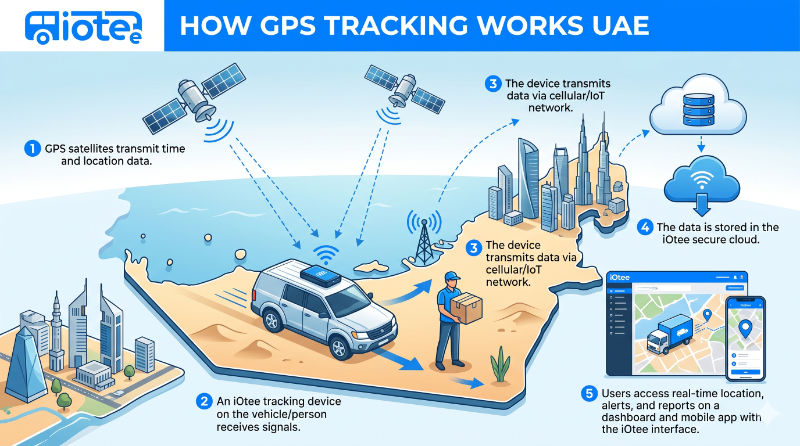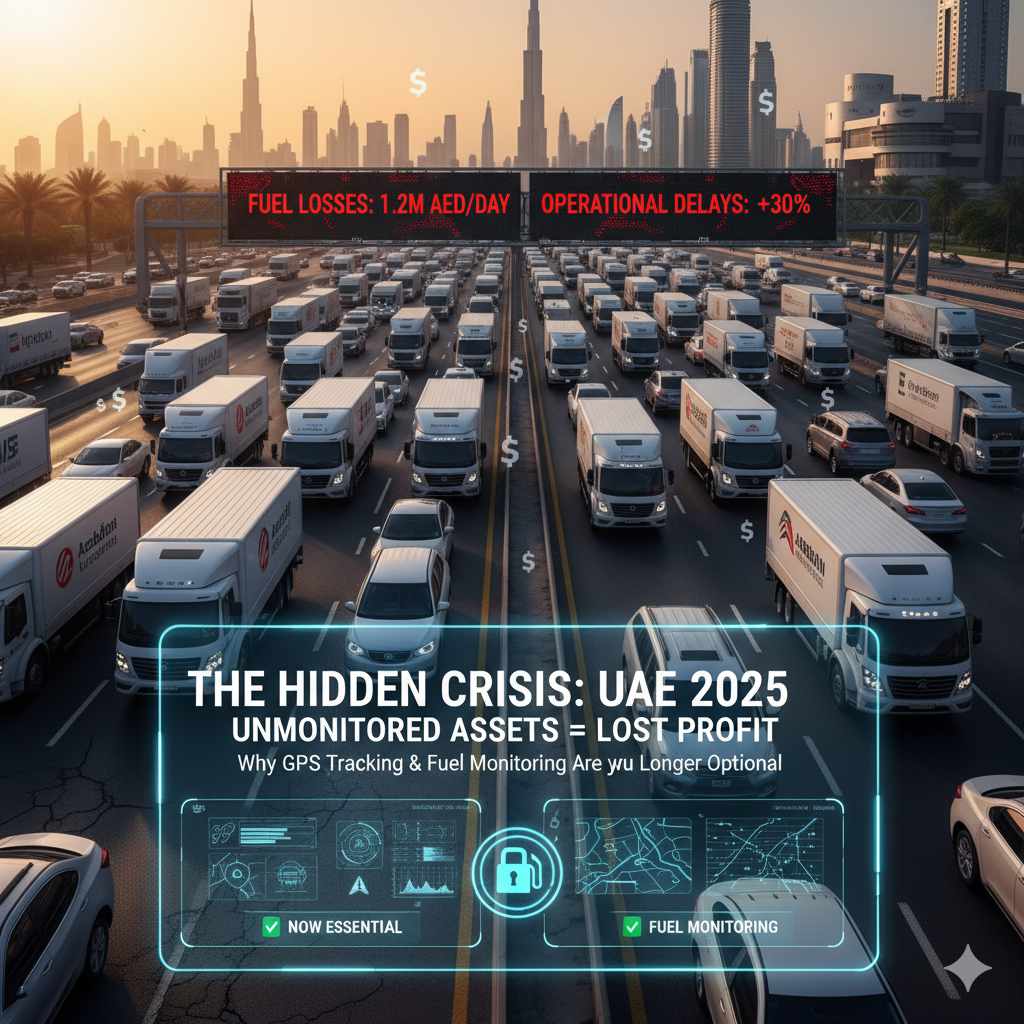
Introduction: UAE Fleet Operators Face a Perfect Storm in 2025
Running a commercial fleet in the UAE has become more expensive in ways that don't always show up clearly on the P&L. The recent data isn't pretty. Congestion gets worse every year, road accidents are rising, fuel prices swing from month to month, and vehicle fraud is getting cleverer.
If you manage a fleet without modern GPS tracking and fuel monitoring, each of those problems turns into lost revenue, unhappy customers and ground lost to competitors. Below we go through what the recent news and statistics actually say, then how GPS tracking and fuel monitoring help. If you're ready to evaluate and buy a system, read this alongside our Best GPS Tracking Systems UAE 2026 buyer's guide for device types and pricing, and our SecurePath, SIRA & Asateel UAE GPS compliance guide for the regulations.
PART 1: THE CRISIS - What's Really Happening on UAE Roads
Problem #1: Traffic Congestion Reaches Crisis Levels
Dubai Drivers Lost 35 Hours to Traffic in 2024 - And It's Getting Worse
According to the Inrix 2024 Global Traffic Scorecard reported by Khaleej Times, Dubai motorists lost about 35 hours to congestion in 2024. That's 2 hours more than in 2023, and a 45% rise in lost hours compared with 2022.
The underlying numbers keep heading the wrong way:
- Rush-hour traffic speeds fell from 35 mph in 2019 to 32 mph in 2024
- The last mile into downtown Dubai crawls at 22 mph on the morning commute
- Dubai's population grew by 134,000+ in 2024, reaching 3.8 million
- Registered vehicles rose 8.7% year on year to 4.3 million
- Daytime vehicle circulation reached 3.5 million vehicles
For a fleet, this shows up as lost productivity. A delivery van that should manage 12 drops a day now gets through 8 or 9 because of traffic, which is a 25-33% loss. To keep service levels up, businesses have to add vehicles and drivers, and operating costs climb steeply.
Relief is coming, slowly. Gulf News reports that Dubai approved a Dh3.7 billion five-year plan (2025-2029) covering 634 kilometres of new roads across 21 projects. Those roads will take years to finish, though.
In the meantime, a fleet manager without GPS tracking and route optimisation is working blind. You can't see which routes congestion hits hardest, reroute vehicles around hotspots as they build, give customers an accurate ETA, measure what congestion really costs you in productivity, or plan schedules around traffic patterns.
Fleet operators report delays of 30-45 minutes per delivery at peak hours. That means missed delivery windows, customer complaints and, eventually, lost contracts.
Problem #2: Road Safety Crisis - 384 Deaths and Rising Accidents
UAE Road Deaths and Accidents Increased in 2024
Khaleej Times reported grim road safety figures for 2024:
- 384 road deaths recorded in 2024
- 4,748 major accidents, up 8% (357 cases) on 2023
- 6,032 injuries of varying severity, 464 more than the 5,568 in 2023
- Light vehicles, the backbone of most commercial fleets, involved in 68% of major crashes
- 158 fatalities in Dubai and 123 in Abu Dhabi
- 67 motorcyclist deaths (17.45% of the total)
The main causes listed were distracted driving (among the top five), sudden swerving, tailgating and not keeping a safe distance, speeding, and carelessness, which accounted for over 38% of incidents.
Age matters too. Road users aged 19-29 made up 40% of fatalities, up from 38% in 2023, and plenty of fleet operators hire younger drivers for delivery work.
For a fleet operator, every accident costs in several directions at once. The vehicle is typically off the road for 5-15 days for repairs. Insurance premiums go up 15-30% after a claim. There are legal liability and compensation costs, damaged cargo and strained customer relationships, driver injury costs and the expense of hiring a replacement, and reputational damage that follows you into future bids.
Without GPS tracking and driver behaviour monitoring, you have no view of how your vehicles are actually being driven. You only find out about safety problems after the crash, when it's too late to do anything about them.
Dubai Police Crack Down on Mobile Phone Use
The National reported in October 2024 that drivers caught using a mobile phone in Dubai can have their vehicle seized for 30 days under a new crackdown. That tells you how seriously the authorities now take distracted driving.
A fleet with no driver monitoring won't know who's on the phone at the wheel until a fine lands or an accident happens.
Problem #3: Fuel Price Volatility Wreaks Budget Havoc
Unpredictable Fuel Costs Create Planning Chaos
UAE fuel prices moved around a lot through 2024 and 2025, according to multiple industry reports. In March 2024, petrol went up 15-16 fils per litre and diesel 17 fils. By December 2024 prices had dropped to their lowest in a year, then in February 2025 they rose again, above January's level. As of November 2025, diesel was AED 2.67 per litre. By September 2026 it had reached AED 4.30. With adjustments every month, budgeting never really settles.
Take a modest 30-vehicle fleet using 1,000 litres of diesel per vehicle each month. A 17 fils/litre rise adds AED 5,100 a month, or AED 61,200 a year. Fuel is already 30-40% of total fleet operating costs. When it moves this much you can't quote customers accurately, and every increase eats into your margin.
It works in reverse too, but the effect is smaller than people hope. JobXDubai reported that fleet managers using 1,000 litres a month saved roughly AED 40 when prices dropped, and those savings disappear again in the months prices rise.
The domestic fuel market is deregulated, so local prices follow international crude benchmarks directly. Operators with no monitoring just absorb the cost and hope for a good month.
Problem #4: The Hidden Fuel Theft Epidemic
15-30% of Fuel Budget Disappears Without Monitoring
Official pump prices get plenty of attention. What fleet managers often miss is that theft and waste add another 15-30% on top of the fuel bill.
It happens in several ways. Drivers siphon fuel for their own cars or to sell. Fake fuel receipts get submitted for reimbursement. Vehicles idle for long stretches during working hours, wasting 0.6-1.0 litres an hour. Company vehicles get used for personal trips, aggressive acceleration and speeding burn extra fuel, and route deviations add kilometres nobody asked for.
Picture a Dubai logistics fleet losing AED 28,000 a month to fuel theft that nobody spots until fuel sensors go in. That's AED 336,000 a year gone.
Idling on its own adds up quickly. A 30-vehicle fleet idling 2 hours a day wastes:
- 60-90 litres a day
- 1,800-2,700 litres a month
- AED 7,740-11,610 a month at AED 4.30/litre (September 2026)
- AED 92,880-139,320 a year
Without fuel monitoring, that leak carries on unnoticed, month after month.
Problem #5: Sophisticated Vehicle Fraud and Theft
Dubai Police Dismantle Vehicle Fraud Syndicate
JobXDubai reported in April 2025 that Dubai Police broke up a fraud syndicate that paid car sellers with fake cheques and then exported the vehicles quickly.
The gang used elaborate schemes to get hold of expensive vehicles with forged cheques and moved them out of the country fast. According to Dubai Police, it operated both inside and outside the UAE and went mainly after high-value cars.
That case involved private sales, but commercial fleets face similar risks. Company vehicles get used without permission after hours. Some drivers "rent out" company vehicles to third parties. Vehicles vanish during what's supposed to be a delivery route, cross borders without authorisation, or get stripped of equipment and cargo while nobody's watching.
Without GPS tracking you have no live view of where your vehicles are. You can't spot unauthorised use or theft until a vehicle fails to come back, and by then it's often too late to recover it.
International Theft Networks Target UAE
There's an international angle too. CBC News reported that a Toronto man used Apple AirTags to follow his stolen 2022 GMC Yukon XL all the way to the UAE, which shows the country can end up as a destination for vehicles stolen abroad.
For fleet operators the lesson is simple: without tracking, getting a vehicle back is close to impossible. In the UAE, vehicles stolen without GPS tracking take 45-60 days on average to recover, and many are never found.
Problem #6: Customer Expectations Create Competitive Pressure
Modern Customers Demand Real-Time Tracking
In 2025, UAE customers expect Amazon-level visibility on every delivery. The big logistics and e-commerce companies in Dubai and Abu Dhabi already give them live tracking links, ETAs that update with traffic, delay warnings before anyone has to ask, digital proof of delivery with photos and timestamps, and self-service tracking portals.
That has changed tendering. Businesses without GPS tracking can't compete for contracts that require it, and fleet operators say they lose 30-40% of RFPs (Requests for Proposals) because they can't offer real-time tracking.
Customer service teams at companies without tracking tell the same story. Somewhere between 40% and 50% of their calls are "where is my delivery?" questions, and they can't give accurate answers. Customers get frustrated and cancel contracts, business goes to competitors who do have GPS, and brand reputation and trust take a hit.
Your competitors with GPS tracking are winning those contracts, and the gap gets wider every day you go without it.
Track Your Vehicles from AED 500/Year
Real-time GPS tracking for cars, vans, trucks and whole fleets across the UAE. Device, professional installation, mobile app and 24/7 support included.
PART 2: THE SOLUTION - GPS Tracking & Fuel Monitoring Systems
Solution #1: GPS Tracking Conquers Traffic Congestion
AI-Powered Route Optimization Transforms Productivity
Modern GPS fleet tracking systems are the most practical answer you have to Dubai's traffic problem.
They pull in live traffic data from RTA and Google Maps and recalculate routes when delays appear. You can study historical traffic patterns for planning, optimise multi-stop routes to cut total travel time, reroute automatically around accidents and road closures, and set delivery time slots around the traffic you know is coming.
Businesses in Dubai that use GPS-based route optimisation report:
- 25-40% more deliveries per day without adding vehicles
- Average delivery times down by 30-45 minutes
- On-time delivery rates up by 20-30%
- Fuel savings of 15-25% from better routes
- 60-80% fewer "where is my order?" calls
As an illustration, a 35-vehicle Dubai delivery fleet that goes from 280 to 385 deliveries a day after bringing in GPS route optimisation has gained 37.5% in productivity without a single extra vehicle.
The live dashboard does the day-to-day work. It shows exact vehicle positions updated every 10-30 seconds, current traffic on every route, predicted arrival times for each delivery, the nearest available vehicle for dispatch, and full trip history with route playback.
Your fleet still faces the same traffic that cost Dubai drivers 35 hours last year. The difference is that it gets routed around the worst of it, and that becomes an edge over competitors who are sitting in the queue.
Solution #2: GPS Tracking Prevents Accidents and Saves Lives
Comprehensive Driver Behavior Monitoring
GPS fleet management tackles road safety head-on by monitoring drivers in real time.
The system watches speed against limits and sends instant alerts when drivers break them. It detects harsh braking, aggressive acceleration, sharp cornering, erratic driving and rapid lane changes. It can flag mobile phone use at the wheel, check seatbelt use, spot fatigue based on driving hours, and alert you when a vehicle enters a restricted area.
Adding video telematics takes it further. AI dashcams pick up distraction and drowsiness, phone use, unfastened seatbelts, forward collision risk and lane departures, and they keep full video evidence for accident investigations.
All of this feeds driver improvement. Drivers get an automated safety score and individual performance reports. Managers can target coaching at high-risk behaviour, use gamification and rewards for safe driving, apply progressive discipline for repeat offenders, and spot who needs training from their driving patterns.
UAE fleets using full driver monitoring report:
- 40-60% fewer accidents within the first year
- 50-70% fewer speeding incidents
- 45-55% fewer harsh braking events
- Insurance premiums 15-30% lower
- An 80-90% drop in phone use while driving
- A much stronger safety culture among drivers
Take a hypothetical 60-vehicle Abu Dhabi construction fleet. Cutting accidents from 18 a year to 7 with GPS-based driver monitoring is a 61% improvement, worth more than AED 420,000 a year in accident-related costs.
It goes after every major cause in the 2024 accident statistics: distracted driving, speeding, tailgating and carelessness.
Solution #3: Fuel Monitoring Systems Stop the Revenue Leak
Advanced Fuel Management Technology
Pair GPS tracking with wireless fuel sensors and you get a far clearer view of fuel use and theft than most fleets have ever had.
The sensors measure fuel level continuously, updating every 10-60 seconds. You get instant alerts on sudden drops that point to siphoning, detection and verification of every fill-up, and consumption compared with distance travelled. Idle time is tracked with alerts when it runs too long, fuel efficiency is scored by vehicle and driver, and the system watches tank capacity for anomalies and picks out theft patterns over time.
When someone tries to steal fuel, it shows. Siphoning is detected within minutes. Historical data reveals patterns of suspicious drops, and alerts go straight to fleet managers. Drivers are held accountable for discrepancies, and you have investigation tools with location and time stamps, plus evidence for disciplinary action.
Idling wastes a surprising amount of fuel, and this is one of the easier wins. GPS picks out the patterns, alerts you when idle time passes your threshold, and reports it by vehicle and driver. With coaching on top, fleets measure idle time reductions of 40-60%.
The data also helps you use fuel more efficiently in general. You can see how route choice affects consumption, link driving behaviour to fuel waste, get recommendations on where to refuel, and forecast your fuel budget from actual data. Fuel receipts can be checked against actual fill-ups, which catches false receipt claims.
UAE businesses using GPS-based fuel monitoring report:
- 20-35% lower total fuel costs
- 15-20% less unauthorised fuel use
- 40-60% less idling time
- 25-30% better fuel efficiency per kilometre
- 90-95% of fuel theft incidents eliminated
- Payback within 6-8 months
Illustrative Fuel Savings Example
Worked example: a hypothetical Dubai delivery fleet.
The fleet runs 45 vehicles and spends AED 87,000 a month on fuel. Here's how the numbers can look once GPS tracking with fuel sensors goes in:
- AED 18,500 a month in fuel theft found (21% of the budget)
- Idling down from 3.2 hours to 0.8 hours per vehicle per day
- Fuel consumption down 23% from better routes
- Total fuel costs down to AED 63,200 a month
- Annual savings of AED 285,600
- Payback in about 4.2 months
The figures are illustrative, but the pattern is common: a fleet finds and closes a leak it didn't know it had.
Managing Fuel Price Volatility
GPS tracking can't control fuel prices. What it can do is give you the tools to live with the swings.
On the budget side, you can forecast fuel use accurately from historical data and plan for different price scenarios. Efficiency gains offset price rises. You'll negotiate with fuel suppliers using real data, know which routes and practices use the least fuel, benchmark against industry standards and calculate cost per kilometre so your customer pricing is accurate.
Good fuel data also lets you price more flexibly. You can set fuel surcharges based on actual consumption, adjust customer prices monthly as fuel costs move, show customers the efficiency improvements you've made, back up your pricing with transparent fuel figures, and see which customer routes make the most and least money.
Once waste is gone and consumption is as tight as it'll get, price swings stop being frightening. You'll still feel them, but you'll be ready for them.
Solution #4: GPS Tracking for Vehicle Security and Recovery
Multi-Layer Asset Protection
Modern GPS tracking systems give you solid protection against vehicle theft.
On prevention, you get live location every 10-30 seconds, geofence alerts when a vehicle leaves its authorised area, notifications for any movement after hours, and detection of use outside working hours. Driver verification and vehicle assignment tracking show who has which vehicle. Tamper alerts fire if someone tries to remove the device, and the system can link to vehicle immobilisers.
If a vehicle is taken, recovery is fast. You can track it live and respond immediately, play back its location history for the investigation, and coordinate with police through system integration. Remote immobilisation, hidden installation for covert tracking and 24/7 monitoring and alert services all help.
The recovery numbers speak for themselves. Fleets with GPS tracking recover 95%+ of stolen vehicles, usually within 24-48 hours. Without GPS, recovery takes 45-60 days, if the vehicle turns up at all.
Now put a dirham figure on it. A 30-vehicle fleet with an average vehicle value of AED 150,000 is worth AED 4,500,000 in total. Losing 2 vehicles a year without GPS costs AED 300,000. GPS tracking costs AED 45,000-75,000, which gives a protection ROI of 400-667%.
Tracking also shows up unauthorised use: personal use of company vehicles, unauthorised route deviations, drivers "renting out" vehicles to third parties, cross-border trips nobody approved, weekend or after-hours use, and too many personal kilometres.
It adds up fast. If 7 drivers in a 25-driver fleet regularly take company vehicles for personal trips at weekends, that can mean more than 12,000 unauthorised kilometres a month, plus the liability that comes with them.
Solution #5: Customer Tracking Wins Contracts
World-Class Customer Experience
GPS fleet tracking gives customers the visibility they now expect.
You can offer branded tracking portals and share a vehicle's live location with the customer. Automated SMS and email updates go out at pickup, en route and on delivery, with ETAs that adjust for traffic. Proof of delivery is digital, with photos and signatures, and you can collect feedback the moment the job is done. It all links into e-commerce and order management systems, customers can watch the delivery vehicle approach on a live map, and they can pick a delivery window based on real-time availability.
Businesses in Dubai and Abu Dhabi that offer customer tracking report:
- 60-80% fewer customer service enquiries
- Net Promoter Scores (NPS) up by 45-55%
- Higher win rates on RFPs that require tracking
- Better customer retention and more repeat business
- Premium pricing, justified by better service
So instead of losing 30-40% of RFPs to competitors, you start winning contracts on the strength of the customer experience GPS tracking makes possible.
Implementation: ROI and Getting Started
Investment and Expected Returns
Typical costs in the UAE market look like this.
GPS tracking hardware:
- Basic GPS device: AED 400-800 per vehicle
- Advanced device with driver monitoring: AED 800-1,500 per vehicle
- Installation: AED 200-400 per vehicle
Fuel monitoring hardware:
- Wireless fuel sensor: AED 600-1,200 per vehicle
- Installation: AED 300-500 per vehicle
Monthly service fees:
- GPS tracking platform: AED 80-150 per vehicle per month
- Fuel monitoring platform: AED 30-60 per vehicle per month
- Combined packages: AED 100-180 per vehicle per month
For a 30-vehicle fleet, that means an initial investment of AED 45,000-75,000, monthly fees of AED 3,000-5,400 and an annual operating cost of AED 81,000-139,800.
Based on actual UAE fleet results, the expected annual returns are:
- Fuel savings (20-28%): AED 180,000-280,000
- Productivity gains (25-35%): AED 150,000-300,000 in value
- Fewer accidents (40-60%): AED 80,000-200,000
- Better maintenance (20-25%): AED 40,000-80,000
- Theft prevention: AED 100,000-300,000 in risk reduced
That adds up to AED 500,000-1,160,000 in total annual benefits against an annual investment of AED 81,000-139,800. The net benefit is AED 468,200-1,020,200, an ROI of 335-730%, with payback in 3-6 months.
We've kept these numbers conservative, and they're based on actual UAE fleet results.
Choosing the Right Solution
When you choose a GPS fleet tracking and fuel monitoring system in the UAE, check for these.
GPS features you'll need:
- Real-time tracking with 10-30 second updates
- Mobile apps for iOS and Android
- Route optimisation with UAE traffic integration
- Driver behaviour monitoring (speed, braking, acceleration)
- Geofencing with unlimited zones
- Customer tracking and ETA sharing
- Thorough reporting and analytics
Fuel monitoring features you'll need:
- Wireless fuel level sensors with 99%+ accuracy
- Real-time fuel consumption monitoring
- Fuel theft detection with instant alerts
- Idle time tracking and reporting
- Fill-up verification
- Fuel efficiency analysis by vehicle and driver
UAE-specific requirements:
- RTA (Dubai) and DoT (Abu Dhabi) compliance certification
- Arabic and English language support
- A support team and offices based in the UAE
- Knowledge of UAE roads and traffic patterns
- Integration with UAE government systems
- Support for the Etisalat and du mobile networks
Conclusion: Every Day Without GPS Tracking Costs Money
The Evidence Is Overwhelming
The problems are real, and they're documented. Dubai drivers lost 35 hours to congestion in 2024 and it's getting worse. The UAE recorded 384 road deaths and 4,748 major accidents in 2024, an 8% rise. Fuel prices still move every month. Vehicle fraud and theft methods keep getting smarter. Customers want real-time tracking or they go elsewhere. Fleet operators lose 15-30% of revenue to fuel theft and waste, and without route optimisation, traffic cuts productivity by 25-33%.
Businesses that do have GPS tracking and fuel monitoring report 20-35% lower total operating costs, 40-60% fewer accidents, 25-40% more delivery capacity, a return on investment of 335-730% and payback within 3-6 months.
Every week without tracking costs you. Thousands of dirhams go on fuel theft and inefficiency. Deliveries sit in traffic you can't route around. Accidents happen that could have been prevented, customers move to competitors who offer tracking, and revenue drains out of parts of the operation you can't measure or fix.
Meanwhile, your competitors with GPS are running leaner, serving customers better and taking market share. The gap widens the longer you wait.
Ready to stop losing money? IOTee provides GPS fleet tracking and fuel monitoring built specifically for UAE businesses:
- RTA and DoT compliant
- Installed and supported by local UAE teams
- Used by 100+ UAE businesses
- Delivering 335-730% ROI within the first year
- 24/7 support in Arabic and English
Ask for a free fleet analysis and we'll show you how much you're losing and how much you could save. Email info@iotee.ae, visit www.iotee.ae, or come and see us at our offices in Dubai and Abu Dhabi.
Don't let another month of profit disappear into traffic jams, fuel theft and accidents you could have prevented. Hundreds of UAE fleet operators have already changed how they run.
GPS tracking costs very little. Going without it costs a great deal more, and every month you wait is market share your competitors get to keep.