What Is GPS Tracking? A Plain-English Definition
GPS tracking uses satellite signals to work out where a vehicle, asset or person is, then sends that location over a mobile network to software where you can see it, record it and analyse it in real time.
That's the whole idea in one sentence. The clever part is how three separate technologies fit together: a constellation of satellites orbiting about 20,200 km above the Earth, a small tracking device fitted in or on your vehicle, and the mobile network that carries the data to a map on your phone.
GPS stands for Global Positioning System, a satellite network the United States originally built and still operates. In everyday speech "GPS tracking" now means any satellite vehicle tracking, even though modern trackers listen to several satellite systems at once (we'll come to that).
You see GPS tracking everywhere in the UAE. It's legally mandatory for rental cars, taxis, school buses and many commercial fleets, and for a fleet operator or a private owner it's among the investments that pay back fastest. This guide explains how the technology works, accurately, without turning into a physics lecture.
How Does GPS Tracking Work? The Four-Step Process
An Overview Before the Detail
Every GPS tracking system follows the same four steps. That's as true of a AED 350 plug-in tracker in a family car in Sharjah as it is of a 500-vehicle enterprise platform running across the Emirates.
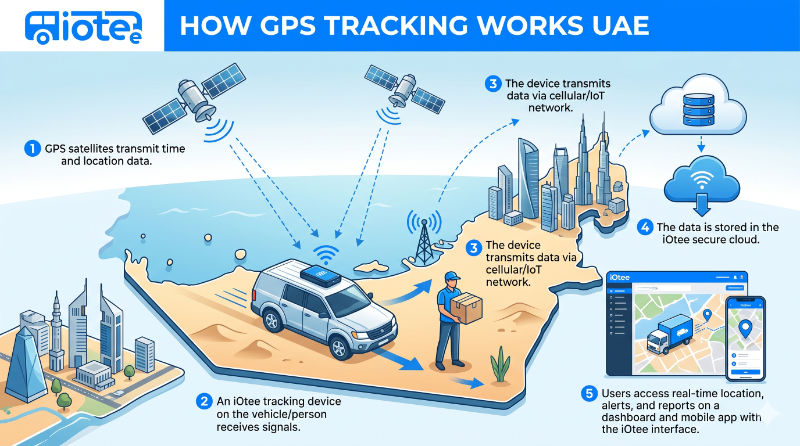
First, it locates: satellites let the device calculate where it is. Then it captures, recording that position along with data from the vehicle such as speed, ignition, fuel and harsh braking. Next it transmits, with a SIM card sending the data over the mobile network to a server in the cloud. Finally, software displays it, turning raw numbers into a live map, reports and alerts you can act on.
On a commercial-grade tracker the whole loop runs again every 10–30 seconds. This is what happens at each step.
Step 1: Satellites Fix the Position (Trilateration)
About 30 positioning satellites are broadcasting all the time. Each one sends two things: its exact position and the precise time the signal left (every satellite carries an atomic clock).
Your tracker only receives. It never transmits anything to the satellites. It just listens. When it picks up a signal, it measures how long the signal took to arrive, and since radio waves travel at the speed of light, that delay tells the receiver exactly how far away the satellite is.
Knowing your distance from one satellite puts you somewhere on a huge sphere. Two satellites narrow that to a circle. Three narrow it to two points, and one of those is usually out in space, so it gets thrown away. A fourth satellite pins the position down in 3D and corrects the receiver's clock. The geometry is called trilateration, and it's why a tracker needs a clear view of at least four satellites to get an accurate fix.
It's also why GPS struggles in underground car parks and long tunnels. If the device can't "see" enough sky, it can't see enough satellites to work out where it is.
Step 2: The Tracker Captures Location and Vehicle Data
Once the device has a fix, it records a lot more than latitude and longitude. A modern vehicle tracker logs:
- Location: coordinates, plus speed and direction of travel
- Time: a precise timestamp on every data point
- Ignition status: engine on or off
- Vehicle data: on hardwired trackers connected to the CAN bus, this covers fuel level, RPM, odometer, engine fault codes and more
- Driver behaviour: built-in accelerometers pick up harsh acceleration, hard braking and sharp cornering
- Sensor inputs: doors opening and closing, temperature (for cold chain), panic buttons, tamper alerts
That's what separates simple location tracking from full telematics. A good tracker tells you where the vehicle is, and also *how* it's being driven and *what condition* it's in.
Step 3: Cellular Networks Send the Data to the Cloud
Now the tracker has to get its data to you. It does that the same way a mobile phone does, with a SIM card and the cellular network (2G/3G/4G LTE, and more and more often NB-IoT and LTE-M for low-power devices).
At a set interval, usually every 10–30 seconds while the vehicle is moving, the device bundles up its data and sends it over the mobile network to a cloud server. In the UAE that means the Etisalat and du networks. Good fleet trackers use dual-carrier (multi-network) M2M SIMs, so if one network drops out somewhere remote, the device switches to the other on its own. That matters on desert routes between emirates and on the roads toward the Oman and Saudi borders.
And with no signal at all, say in a tunnel, an underground garage or a dead zone? A good tracker keeps the data in its own memory and uploads it as soon as the connection comes back, so there are no gaps in the trip record. This is called store-and-forward buffering.
Step 4: Software Turns Data Into Decisions
The cloud server takes in the raw data, and the GPS tracking software (you'll also hear it called a fleet management platform) turns it into something you can use:
- A live map showing where every vehicle is now
- Trip history and route replay for any day
- Geofence alerts when a vehicle enters or leaves a zone you've drawn
- Driver scorecards ranking drivers on safety
- Automated reports on fuel, mileage, idling and utilisation
- Instant notifications by app, email or SMS for speeding, theft or tampering
You get to all of it through a web dashboard and a mobile app. The best UAE platforms work in both Arabic and English, and offer an API so the data can flow into your own systems.
That closes the loop, from satellite to device to network to screen. Then it starts again, over and over, which is why what you see is effectively live. For more on the software side, read our overview of GPS tracking software and real-time GPS tracking.
GPS vs GNSS: What Actually Powers Tracking in the UAE
Why Modern Trackers Listen to More Than Just GPS
Strictly, GPS is only the American system. The umbrella term for all of these satellite systems is GNSS, the Global Navigation Satellite System. Several constellations are in orbit today:
- GPS: United States
- GLONASS: Russia
- Galileo: European Union
- BeiDou (BDS): China
- QZSS: Japan (regional)
A cheap consumer tracker may use GPS alone. A professional fleet tracker uses multi-constellation GNSS and listens to several systems at the same time. Why does that matter so much here? The more satellites a device can see, the faster and more accurately it locks on, and the gain is biggest in exactly the places the UAE makes hard: the high-rise canyons of Downtown Dubai, Business Bay and Dubai Marina, where tall towers block signals and bounce them around.
On GPS alone, a vehicle weaving between skyscrapers can lose its fix or jump about on the map. With multi-constellation GNSS there are enough satellites in view to hold an accurate position the whole way through. If you're choosing a tracker for UAE conditions, don't accept one without multi-constellation support.
What Are the Parts of a GPS Tracking System?
The Four Core Components
Whatever the brand or price, every GPS tracking system is made of four parts.
The GPS tracking device is the hardware, the physical unit fitted in or on the vehicle. Inside are the GNSS receiver, a cellular modem, a SIM card, memory, accelerometers and the connections to the vehicle.
The SIM and cellular connectivity carry the data to the cloud. In commercial deployments that's normally a managed, multi-network IoT SIM, and an ordinary consumer SIM won't do the job as well.
The cloud server and platform is where the data arrives and gets stored and processed. It runs 24/7 and copes with anything from one vehicle to tens of thousands.
The user interface, meaning the web dashboard and mobile app, is how you actually see and use the data: the live map, reports, alerts and settings.
When you pay for GPS tracking in the UAE, you usually pay once for the hardware and installation. After that there's a monthly platform and SIM fee per vehicle for the connectivity and software.
What Types of GPS Trackers Are There?
Hardwired, OBD-II, and Battery-Powered Trackers
The four steps are the same for every tracker. The hardware, though, comes in three main forms, depending on how it connects to the vehicle.
- Hardwired trackers are wired permanently into the vehicle's electrics and hidden under the dashboard. They're hard to tamper with, always powered, and the standard for commercial fleets and UAE compliance (SecurePath, Asateel). They can read full vehicle data through the CAN bus.
- OBD-II plug-in trackers go into the diagnostic port under the steering wheel in less than a minute. There's no installation and you can move them between cars easily, but anyone can unplug them just as easily. They're better for personal use than for theft protection or compliance.
- Battery-powered (magnetic) trackers are self-contained, with their own battery and a magnetic mount. You stick them on trailers or equipment, or hide them under a chassis. Depending on how often they report, the battery lasts from weeks to months.
We compare all three in detail, with UAE prices and a buyer's checklist, in our complete GPS tracking systems buyer's guide. For unpowered assets, see our asset tracking guide. And to understand how live transmission compares with trackers that only log to memory, read real-time vs passive GPS tracking.
How Accurate Is GPS Tracking?
Typical Accuracy — and What Reduces It in the UAE
In the open, a good GPS tracker is accurate to within 2.5 to 5 metres. That's enough to tell which lane of the Sheikh Zayed Road a vehicle is in. Accuracy does vary, though, and the UAE has more than its share of the things that make it worse.
Urban canyons are the first. The towers in Downtown Dubai, Business Bay and the Marina block the view of the sky and bounce signals around ("multipath"), and the error can grow to 10–25 metres. Underground and covered parking is the second. GPS signals don't get through concrete, so the device gets no fix at all and falls back on its last known position. Then there's the heat. Summer temperatures of 50°C+, and parked cabins that go past 75°C, can degrade or kill the cheap chipsets in consumer-grade trackers.
Professional trackers deal with this in three ways. Multi-constellation GNSS puts more satellites in view. A-GPS (Assisted GPS) uses data from the cellular network to lock on faster. Dead reckoning uses built-in motion sensors to estimate position for short stretches when the satellite signal is lost, for example in a tunnel or a multi-storey car park. This is why hardware quality really does matter in UAE conditions, and we go into it further in our guide to common GPS tracking challenges in the UAE.
Track Your Vehicles from AED 500/Year
Real-time GPS tracking for cars, vans, trucks and whole fleets across the UAE. The device, professional installation, mobile app and 24/7 support are all included.
What Can GPS Tracking Actually Do? Core Capabilities
Beyond Showing a Dot on a Map
Once you know that the tracker collects detailed data and the software makes sense of it, the list of features falls into place. A UAE GPS tracking system should give you:
- Real-time location tracking: live position, updated every 10–30 seconds.
- Geofencing: draw virtual boundaries on the map and get alerted when a vehicle crosses them. Rental companies use it to keep cars inside the UAE, fleets to keep trucks on authorised routes, and dispatchers to confirm a delivery reached the customer. See geofencing.
- Route history and replay: rebuild any trip from any past day.
- Driver behaviour monitoring: scores for speeding, harsh braking and cornering, which cut accidents and bring insurance premiums down. See driver behaviour monitoring.
- Theft alerts and recovery: instant alerts on unauthorised movement or tampering, with the last known location so the vehicle can be recovered quickly.
- Fuel and maintenance monitoring: follow fuel consumption, spot theft, and book services by actual mileage.
- Engine immobilisation: on supported installs, cut the engine remotely (safely, while the vehicle is stationary) to stop a thief.
These features are how raw location data becomes money you can measure, which is what the next section is about.
Is GPS Tracking Legal in the UAE?
UAE Law: Where Tracking Is Mandatory, and Privacy
Yes, GPS tracking is legal in the UAE. For a lot of vehicles it's actually required by law.
The mandatory cases include:
- Rental vehicles in Dubai, which must carry SIRA-certified trackers under the SecurePath programme (in force since 2014)
- Commercial and corporate fleets in Abu Dhabi, covered by Asateel and run by the Integrated Transport Centre (ITC)
- School buses, taxis and limousines, which are subject to tracking and safety requirements
- Commercial vehicle registration with Dubai RTA, which needs an Electronic Tracking Certificate
Where tracking is mandatory, the hardware has to come from TRA + SIRA approved vendors and carry valid certification. Our SecurePath, SIRA and Asateel compliance guide covers the full legal picture.
Privacy is the other question. If the vehicles belong to the company and are used for work, an employer tracking them is on solid legal ground, and the sensible thing is a clear written policy that tells drivers. Tracking a vehicle you don't own or have authority over, without consent, is another matter entirely. In GPS tracking law, ownership and consent decide what's allowed.
How Does GPS Tracking Save Money?
The Return on Investment for UAE Fleets and Drivers
Once you know how tracking works, it's easy to see why it pays back so fast. The system records fuel, route, speed and behaviour, so it goes straight at a fleet's biggest costs. UAE operators who deploy GPS tracking properly typically report:
- Up to 20% fuel savings from better routes and less idling
- Around 30% lower total operating costs within the first year
- Up to 30% fewer accidents when combined with driver behaviour monitoring
- 90%+ stolen-vehicle recovery rates, often within hours
- 5–15% insurance premium reductions from UAE insurers for tracked vehicles
- Typical payback in 4–9 months for commercial deployments
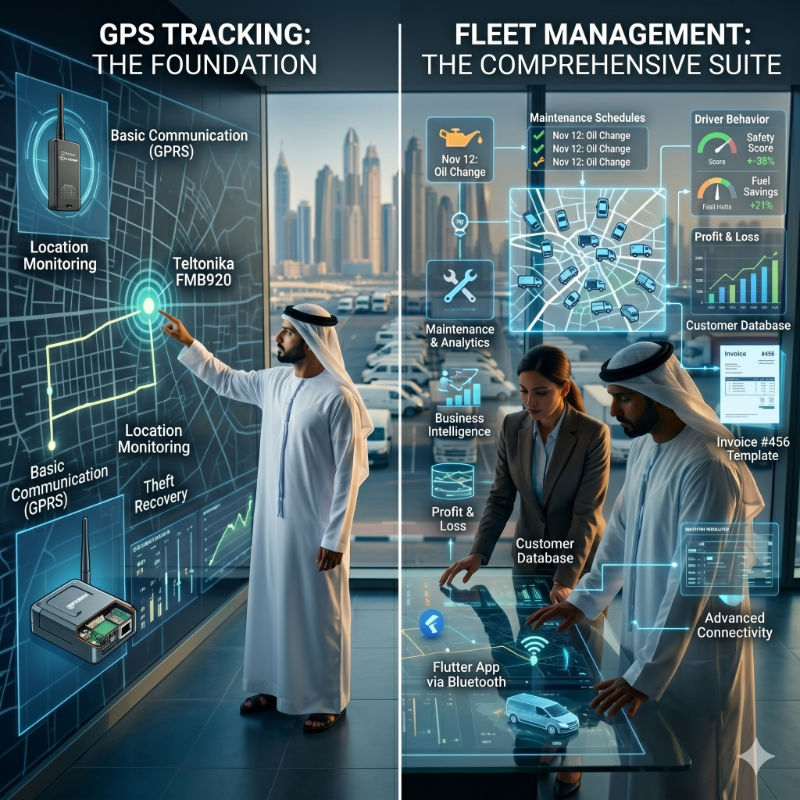
For a private car owner, the insurance discount often pays the subscription by itself. For a fleet, the fuel and accident savings are far bigger than the cost. We work through the numbers in our guide on reducing fleet fuel consumption, and explain how full fleet platforms go further than tracking in GPS tracking vs fleet management.
How to Choose a GPS Tracking System in the UAE
What to Look For Once You Understand the Technology
Now you know how the pieces fit, you can judge any vendor properly. In the UAE, insist on:
- Multi-constellation GNSS, for accuracy in Dubai's high-rise areas
- A dual-carrier (Etisalat + du) M2M SIM, for reliable coverage across the emirates
- Thermal-rated hardware that survives 50°C+ heat and parked-cabin temperatures
- Compliance where it applies: SIRA-certified hardware and SecurePath/Asateel registration for commercial use
- A platform in both Arabic and English, with mobile apps for iOS and Android
- API access and data portability, because your data belongs to you
- Local UAE installation and support, with certificate renewals managed for you
The full 12-point evaluation checklist is in our GPS tracking buyer's guide. For personal vehicles, see our car GPS tracker and anti-theft guide.
Frequently Asked Questions
How does GPS tracking work in simple terms?
Satellites broadcast signals. A tracking device in your vehicle listens to several of them and works out its exact position from how long each signal takes to arrive, a method called trilateration. It then sends that position, along with vehicle data such as speed and ignition status, over the mobile network to cloud software. You see it as a live dot on a map on your phone or computer. The cycle repeats every 10–30 seconds, so the location is effectively live.
Does a GPS tracker need internet or a SIM card?
Yes. The satellite side is free and one-way: the tracker only listens to satellites to find out where it is. To send that location to you, though, it needs a SIM card and a mobile data connection, just like a phone. That's why GPS tracking carries a monthly fee, which pays for the SIM data and the software platform. When there's no signal, in a tunnel or an underground garage, a good tracker saves the data and uploads it once coverage is back.
What is the difference between GPS and GNSS?
GPS (Global Positioning System) is the American satellite network specifically. GNSS is the umbrella term for all of them: GPS plus Russia's GLONASS, Europe's Galileo, China's BeiDou and Japan's QZSS. Professional trackers use multi-constellation GNSS and listen to several systems at once. That gives faster and more accurate position fixes, which counts most in places like Downtown Dubai where tall towers block satellite signals.
How accurate is GPS tracking?
In open conditions, a good GPS tracker is accurate to within 2.5–5 metres. In 'urban canyons', the high-rise districts like Dubai Marina and Business Bay, it drops to roughly 10–25 metres because the towers block and reflect signals. In underground parking GPS doesn't work at all, since the signals can't get through. Professional trackers make up for this with multi-constellation GNSS, Assisted GPS (A-GPS) for quicker locks, and dead-reckoning sensors that estimate position while the satellite signal is briefly gone.
Can a GPS tracker work without GPS signal, like in a tunnel?
Partly. When a tracker loses the satellite signal, in a tunnel or a covered car park, it can't work out a new position from satellites. Better devices use 'dead reckoning'. Built-in motion sensors (an accelerometer and a gyroscope) estimate how far and in which direction the vehicle has moved since the last good fix. That keeps the position roughly right for short stretches until the satellite signal returns. The device also buffers all its data and uploads it once the cellular connection is back, so the trip record stays complete.
Is GPS tracking legal in the UAE?
Yes, and for many vehicles it's mandatory. Rental cars in Dubai have to use SIRA-certified trackers under the SecurePath programme (since 2014). Commercial and corporate fleets in Abu Dhabi fall under Asateel (ITC), and school buses, taxis and many commercial vehicles have tracking requirements. Mandatory hardware must come from TRA + SIRA approved vendors. Employers may track company-owned vehicles used for work. Tracking a vehicle you don't own, without consent, isn't permitted. The law follows ownership and consent.
How much does GPS tracking cost in the UAE?
For a personal vehicle, budget roughly AED 350–900 for the hardware and AED 30–50 a month for the platform. Commercial hardwired trackers cost about AED 800–1,500 per vehicle for hardware and installation, with monthly platform fees of AED 50–120. Where SecurePath/Asateel compliance applies, add annual certificate renewals. Premium units that combine AI cameras and telematics cost more. Our buyer's guide has the full price breakdown by use case.
Can someone track my car without me knowing?
Technically, yes, a small battery-powered or plug-in tracker can be hidden on a vehicle. Doing it to a vehicle you don't own or control, without consent, is against the law. The legitimate uses are owners tracking their own cars, parents tracking family vehicles and employers tracking company-owned fleet vehicles. If you think someone has put a tracker on your car, a professional sweep, or a careful look at the usual hiding spots (wheel wells, bumpers, under the seats, the OBD port), can find it.
From Understanding to Action
You Now Know How GPS Tracking Works — Here's the Next Step
GPS tracking is simpler than it looks. Satellites fix a position, a device records it with vehicle data, the mobile network carries it to the cloud, and software turns it into a live map and alerts you can act on. Geofencing, driver scoring, theft recovery and fuel monitoring are all built on that one loop.
In the UAE, whether a tracker works well or drives you mad comes down to hardware quality (multi-constellation GNSS, a thermal rating, a dual-carrier SIM) and compliance (SIRA certification where it's required). You know how the technology works now, so you're in a good position to choose.
IOTee supplies and installs GPS tracking across the UAE, for single private cars, SME fleets, rental operations, school buses and enterprise logistics. Have a look at our GPS tracking solutions for the UAE, read the complete buyer's guide, or get in touch and we'll recommend something that suits your vehicles, your routes and your compliance needs.