The UAE GPS Compliance Landscape: Why It Matters and Who It Affects
Run a commercial vehicle in the UAE and GPS tracking compliance comes with it. You can't legally operate without it. That's where the UAE differs from most markets. The regulator doesn't only set the outcome. It also specifies the technology, the certified hardware, the approved vendors and the registration process.
Miss a step in that chain and the problems stack up:
- RTA refuses or revokes vehicle registration
- Mulkiya (vehicle ownership/inspection) renewal is blocked
- Insurance cover becomes a problem when you make a claim
- You're disqualified from government and corporate tenders
- You end up operating without a valid commercial licence
There are two programs UAE businesses need to understand: SecurePath in Dubai and Asateel in Abu Dhabi. Both require certified GPS tracking on specific vehicle classes. Both keep approved-vendor lists and need renewing every year. And both have documented fines and operational consequences if you don't comply.
This guide explains how the whole UAE GPS compliance system works in 2026. It's written for the fleet manager, rental operator, transport director or business owner who has to be compliant by tomorrow morning. For wider buying advice on hardware, features and pricing across the UAE GPS market, read it alongside our Best GPS Tracking Systems UAE 2026 buyer's guide.
SecurePath: Dubai's Mandatory GPS Tracking Program
What SecurePath Is and Who Runs It
SecurePath is the Dubai government's mandatory GPS tracking certification and data-feed program for commercial vehicles. SIRA (the Security Industry Regulatory Agency) runs it, working with the RTA (Roads and Transport Authority).
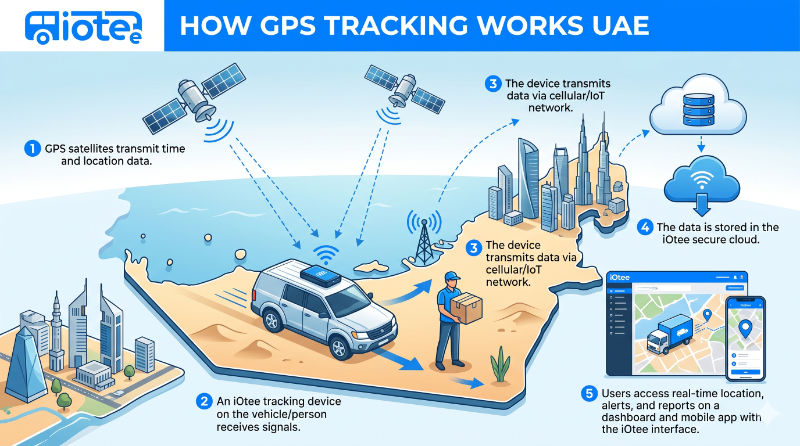
Day to day, it works like this. Every certified GPS device sends real-time location, speed and event data to the SIRA platform. That platform connects to RTA, Dubai Police and Dubai Customs systems, so the authorities can help with theft recovery, accident investigation and enforcement as things happen. You, the operator, see your own data through an approved vendor's platform (IOTee's, for example). And an Electronic Tracking Certificate is issued when the device is installed, which you'll need when you register the vehicle.
Why does SecurePath exist? It grew out of Dubai's wider smart-city and traffic-safety work. Dubai Police statistics from 2015 showed that GPS-tracked vehicles had a stolen-vehicle recovery rate above 90%, with average recovery times under 4 hours. Untracked vehicles took weeks or months. So the mandate is partly about protecting the economy, partly public safety and partly traffic management.
It became mandatory in stages:
- 2014: mandatory for all rental and lease vehicles in Dubai
- In the years after: extended to taxis, limousines, school buses and various commercial classes
- 31 October 2023: fines under the federal National Truck & Shipment Tracking System (Cabinet Resolution 95/2021, Dubai Customs Notice 9/2023) came into force for trucks moving transit, hazardous, restricted or high-duty goods through customs ports — a customs layer separate from SecurePath
- 2026 onwards: enforcement stepped up across heavy commercial, logistics and government-contract fleets
Vehicle Classes Required to Have SecurePath GPS in Dubai
If your vehicle is in any of these categories and operates in Dubai, you must comply with SecurePath.
Mandatory, with no exceptions:
- Rental and lease: cars, buses, trucks, bikes and equipment (Schedule 1 items 26–42 of Resolution 47/2017; vendors date the first rental rollout to 2014)
- Taxis and limousines: tracked through the RTA Public Transport Agency platform with a speed monitoring device (bylaw 516/2022) — a SecurePath-specific requirement is not in the text
- School buses: GPS and an 80 km/h speed control device under RTA Administrative Resolution 196/2015 (since 1 April 2016; the authority is RTA, not SIRA)
- Public transport: RTA-licensed passenger vehicles
- Government fleets: exempt from the activity permit (Resolution 47/2017 Art 3(a)); no tracking text found — tracked by policy
Mandatory for goods-transport permit holders under Executive Council Resolution 47/2017 as amended by 2/2022 (AED 4,000 per violation; vendors place these on SecurePath Premium):
- Heavy and light truck transport (Schedule 1 items 7–8), tankers and trailers
- Cargo and logistics fleets serving Dubai Customs and the ports
- Hazardous materials transport (chemicals, fuel, gas)
- Construction and concrete transport
Optional, but often held to the same standard:
- Corporate fleet vehicles where the insurer requires tracking
- High-value private vehicles whose owners want an insurance discount
- Premium and exotic cars in private hands, where owners want theft recovery
Not sure where your vehicle fits? A good rule of thumb: if it needs an RTA commercial registration, an RTA passenger transport licence or a government fleet registration in Dubai, it needs SecurePath. For rental car fleet operations in particular, there's no way around it.
The SecurePath Registration Process Step-by-Step
This is how SecurePath registration actually works for a fleet operator in Dubai.
You start by choosing a TRA + SIRA approved vendor, one that's on the official approved-vendor list. Hardware bought from a vendor who isn't approved invalidates the certification, even if the device looks identical.
Next, you book installation at a certified fitment centre. Certified technicians have to do the work, so self-installation isn't allowed. Certified mobile teams can install at your depot, though.
The hardware then goes in and gets calibrated. The wiring is tamper-evident, the antenna is placed to suit the vehicle type, and the device is registered against the vehicle's chassis number (VIN).
Fourth comes a test transmission to the SIRA platform. The vendor checks that the device is sending live data, that it's registered on SIRA's monitoring network, and that the vehicle shows up in your fleet dashboard.
Then the Electronic Tracking Certificate is issued. It's an electronic certificate from the vendor confirming the vehicle is SecurePath-compliant, and it has to go with the vehicle to RTA registration, the Mulkiya inspection and any insurance paperwork.
Finally, there's annual renewal. SecurePath certificates are valid for a year. Renewal means checking device health, platform connectivity and compliance, and your provider normally manages it with reminders so it's done before the certificate expires.
IOTee runs all six steps as one workflow for customers: TRA + SIRA approved hardware, certified installation anywhere in Dubai, automatic registration on the SIRA platform, certificate issuance and renewal management.
Asateel: Abu Dhabi's GPS Tracking Compliance Program
What Asateel Is and How It Differs From SecurePath
Asateel is Abu Dhabi's equivalent commercial GPS tracking compliance program, run by the Integrated Transport Centre (ITC). The idea is broadly the same as SecurePath, certified tracking required on commercial vehicle classes, but the two systems run separately.
The main facts about Asateel:
- It's run by ITC (the Integrated Transport Centre, Abu Dhabi's transport regulator)
- It's mandatory for goods transport for a fee (DMT Chairman Resolution 74/2021: heavy vehicles above 2.5 t unladen including trailers, light vehicles including motorcycles) and for buses of more than 9 seats (Resolution 33/2021), including buses registered outside Abu Dhabi operated inside it
- Approved devices send real-time data to the Asateel platform
- Operators whose vehicles work in both Dubai and Abu Dhabi need devices and platform integration that cover both SecurePath and Asateel
Categories that need Asateel under the published resolutions:
- Goods transport for a fee: heavy trucks, tankers and trailers above 2.5 t unladen (AED 4,000 for no GPS, GPS off or unlinked; AED 10,000 without a permit, enforced since 6 October 2022)
- Light goods and delivery vehicles including motorcycles (same resolution; Asateel issues a bike transport permit)
- Buses and coaches of more than 9 seats, including tourist, staff and rented buses (AED 2,500 per bus, deadline was 15 September 2022)
- School and student transport vehicles (DMT Chairman Decision 259/2017 and the federal UAE.S 5012:2020 standard)
- Hazardous materials transport (inside the freight resolution, plus ITC's hazmat tracking with Civil Defence permits)
No Asateel text was found for corporate own-account fleets, rental cars or taxis — vendor pages list them, the resolutions do not. Vehicles registered in another emirate need ITC out-of-emirate authorisation (1, 3, 6 or 12 months) before working in Abu Dhabi and still need the ITC-approved tracker.
Registering for Asateel follows much the same pattern as SecurePath. You choose an ITC-approved vendor, install certified hardware, register the vehicle on the Asateel platform and renew every year. The paperwork and the platform screens are different, but the routine is the same.
Pay close attention to this if your vehicles cross between emirates. Most commercial fleets in the UAE drive between Dubai and Abu Dhabi, and if yours do, your devices and platform have to satisfy SecurePath and Asateel at the same time. Some vendors sell hardware certified for only one program, so ask them directly when you're comparing vendors.
TRA + SIRA Approval: Why Vendor Choice Is a Compliance Decision
What Approval Actually Means and Why It Matters
The UAE enforces GPS tracking compliance through approved vendors. Two separate authorities approve commercial GPS hardware and providers.
TRA, the Telecommunications and Digital Government Regulatory Authority, approves the M2M cellular hardware, SIM provisioning and data-handling practices. Any IoT or telematics device used commercially in the UAE needs TRA approval as a minimum.
SIRA, the Security Industry Regulatory Agency, approves GPS tracking devices and providers specifically for SecurePath. Its approval covers device specifications, installation standards, data security and how the platform connects to Dubai government systems.
In Abu Dhabi, ITC (the Integrated Transport Centre) keeps its own approved-vendor list for Asateel.
So what does using an approved vendor actually get you?
- Hardware that passes regulatory inspection and won't be rejected at vehicle registration
- A platform certified to send data correctly to government systems
- Documents accepted for Mulkiya inspection, insurance underwriting and tender bids
- The ability to renew, since vendors who aren't approved can't renew certificates
- Support and an audit trail if your compliance is questioned during an inspection or an incident investigation
Warning signs that a vendor isn't approved or is selling grey-market kit:
- They can't show you a SIRA approval document when you ask
- The hardware is identical to a known approved model but suspiciously cheap
- They can't connect to the SIRA or Asateel platforms and only offer their own dashboard
- They can't issue an Electronic Tracking Certificate at installation
- They say "we'll sort the certification out later". Walk away.
SIRA maintains the official approved-vendor list and updates it from time to time. Check that your vendor is on the current list when you buy.
Annual Certificate Renewal: The Compliance Maintenance Cycle
What Renewal Involves and Why Missing It Is Catastrophic
SecurePath and Asateel certificates are valid for one year. Renewal is more than a formality. Someone has to confirm that:
- The device is still installed and working
- Data is still reaching the SIRA / Asateel platform correctly
- No tampering was detected during the year
- The firmware is on the currently required version
- The device hasn't been moved to another vehicle without being re-registered
Miss the renewal and several things can happen. The Mulkiya inspection includes a SecurePath / Asateel check, so an expired certificate fails the inspection, and a vehicle that fails can't legally drive on UAE roads. If a rental or commercial operator lets certificates lapse across the fleet, the whole operation stops until the renewals are done. Insurance claims involving a vehicle with an expired certificate get messy, and insurers may refuse them on the grounds that the vehicle was operating out of compliance. And at an RTA inspection or a police check, the owner faces fines and possibly having the vehicle impounded.
Timing is where fleets get caught out. Mulkiya runs on an annual cycle, and so do SecurePath and Asateel, but the two don't always line up. A vehicle registered in March needs its SecurePath renewal by March, even if its next Mulkiya isn't due until the following March. Without disciplined renewal management, fleets regularly find out about expired certificates only when a vehicle fails an inspection.
A proper renewal process looks like this:
- Reminders from your vendor 60 days ahead
- A remote diagnostic health check on the device before renewal
- A site visit if there's a hardware fault
- The renewal certificate issued before expiry
- Confirmation recorded in your fleet management dashboard
IOTee runs this as a managed service for every SecurePath and Asateel customer, so renewals are done before expiry, automatically, without surprises.
Need SecurePath or Asateel-Compliant Tracking?
IOTee supplies and installs compliant GPS tracking for rental, passenger and government fleets across the UAE.
Compliance Failure: What It Actually Costs
Real-World Consequences of Non-Compliant GPS Tracking in UAE
The fine is the smallest part of a compliance failure. The operational and reputational damage that follows costs far more.
The direct fines and penalties:
- Running a commercial vehicle without the required SecurePath/Asateel: fines that can exceed AED 5,000 per vehicle
- Failing the Mulkiya inspection because of an expired or missing certificate: risk of deregistration
- Operating without TRA-approved cellular connectivity: action from the telecoms regulator
- Repeated compliance failures: action against your trade licence and consequences for your commercial registration
Then come the operational consequences. A vehicle that isn't compliant can't legally operate, and for rental, taxi and logistics businesses that's lost revenue straight away. Government, ADNOC, school and major corporate tenders usually ask for SecurePath/Asateel compliance documents before anything else, so if you're not compliant you can't bid. Insurers may cut cover, raise premiums or refuse claims on vehicles run out of compliance. And you're weaker in any dispute, because theft recovery, accident attribution and fare disputes all rely on tracking data. Without SecurePath, there's no government-supported recovery process.
One case from the UAE rental market shows how fast this adds up. A 50-vehicle rental operator in Dubai found during a Mulkiya cycle that 12 of its vehicles had expired SecurePath certificates, because its vendor's renewal process had failed. Those 12 vehicles were grounded on the spot. Lost revenue came to AED 18,000 per day across the affected vehicles, and emergency renewals took 6 days. One missed renewal cycle cost AED 108,000+, before counting the damage with corporate customers and the hours the team spent firefighting.
And the risk grows with size. Once you're past 100 vehicles, tracking renewals by hand isn't realistic. At that point, staying compliant depends on whether your vendor handles it properly.
Compliance Checklist: Are You Actually Compliant?
Run Through This Checklist for Every Vehicle in Your Fleet
Not sure which categories apply to you? Put your vehicle type through our free UAE GPS Compliance Checker and you'll get an instant SecurePath/Asateel answer. Then use this checklist to audit GPS compliance across your UAE fleet.
For each vehicle:
- 1. Is a GPS device installed and working?
- 2. Is the device from a TRA + SIRA approved vendor (Dubai operations)?
- 3. Is the device from an ITC approved vendor (Abu Dhabi operations)?
- 4. Is there an active Electronic Tracking Certificate dated within the last 12 months?
- 5. Is the device confirmed as transmitting to the SIRA / Asateel platform, and not only to the vendor's own dashboard?
- 6. Is tamper detection active, with test alerts received recently?
- 7. Is the renewal date logged in your fleet management system?
- 8. Is a renewal reminder or workflow in place at least 60 days before expiry?
For the operation as a whole:
- 9. Does one accountable vendor handle hardware, installation, platform, certificate management and renewals?
- 10. Do vehicles that work in both Dubai and Abu Dhabi have devices and a platform that satisfy both SecurePath and Asateel?
- 11. Is there a documented audit trail showing compliance at every Mulkiya cycle?
- 12. Is there a procedure for changing vendor that keeps you compliant throughout, with no gap during the move?
If you can't answer yes to all twelve with confidence, you're exposed. In any single month the chance of it catching you is small. The cost of one missed cycle, though (operations shut down, tenders lost, insurance trouble), is high enough that "we'll deal with it if it comes up" doesn't work once you're running a fleet.
Go deeper: our vehicle GPS tracking hub covers devices, pricing and installation for cars and fleets across the UAE. For daily operations beyond compliance, see our fleet management platform and RTA-compliant speed limiters.
Frequently Asked Questions
Is SecurePath only for rental cars or all commercial vehicles in Dubai?
No. SecurePath began with rental and lease vehicles in 2014 and has grown a lot since. It now covers rental and lease fleets, bus rental, heavy and light goods transport, hazardous, fuel, gas and waste, delivery and logistics, construction equipment and cash-in-transit — every Schedule 1 activity under Executive Council Resolution 47/2017 — while taxis and school buses are tracked through the RTA's own permit systems. The direction is obvious. SecurePath covers more vehicles every year, and fleets that get compliant early avoid the scramble when a new mandate lands.
Can I use the same GPS device for SecurePath and Asateel?
Yes, as long as both SIRA (for SecurePath) and ITC (for Asateel) have approved the device and the vendor. Plenty of UAE-focused vendors hold both approvals for exactly this reason, since operators routinely have vehicles working in both emirates. When you compare vendors, confirm the hardware is dual-certified and that the platform sends data correctly to both SIRA and Asateel. IOTee holds both approvals and connects to both platforms as standard.
What if I'm using a GPS tracker that isn't SIRA approved?
If the vehicle is in a category that needs SecurePath (rental, taxi, school bus and so on), you have a compliance gap and should fix it now. You have two options. You can replace the device with a SIRA-approved one, which usually takes 60-90 minutes per vehicle. Or, if your current device uses the same chipset as an approved model, the hardware can sometimes be re-certified, though that depends on the vendor. What you can't do is carry on operating out of compliance. When an inspection or an incident exposes the gap, the consequences land straight away.
How do I check if my vendor is on the SIRA approved list?
Ask the vendor for a SIRA approval document or certificate dated within the last 12 months. If you have any doubt, check the document number with SIRA directly. The official SIRA approved-vendor list is kept centrally and updated as vendors are added or removed. If a vendor can't show you the paperwork on the spot, look elsewhere.
What happens to compliance when I sell or transfer a tracked vehicle?
When you sell or transfer a vehicle with an active SecurePath/Asateel registration, the device has to be deregistered from your fleet account. Then it's either taken out or re-registered to the new owner. The Electronic Tracking Certificate doesn't transfer by itself. If you don't deregister, you can stay on the hook for tracking obligations on a vehicle that's no longer yours. Your vendor should handle deregistration as a standard service, so check that it's in your contract.
Are private/personal vehicles required to have SecurePath?
Usually not, because SecurePath is a program for commercial vehicles. Private vehicles registered for personal use don't need it. A few related situations do bring it in, though: high-value vehicles where the insurer requires GPS tracking (and names the device), company-owned vehicles that employees use personally (these count as commercial), and some modified or imported vehicles that need specialised RTA registration. Plenty of private owners fit GPS tracking anyway, for theft recovery and an insurance discount. Our GPS tracking buyer's guide covers options for personal vehicles.
Can I switch GPS providers mid-year without losing compliance?
Yes, but plan the move so you stay compliant the whole time. The usual sequence: the new vendor installs while the old device is still active, data flow to SIRA/Asateel is checked for the new device, a new Electronic Tracking Certificate is issued, the old device is deregistered and taken out, and the Mulkiya documents are updated. Done properly, moving a 30-vehicle fleet takes 5-7 working days with no gap in compliance. A vendor that makes switching painful is protecting itself at your expense.
What's the relationship between SecurePath and the Salik tag system?
They're separate systems. Salik is Dubai's toll and road-pricing system. Every vehicle in Dubai needs a Salik tag to use toll roads, and it's an electronic toll collection system with no GPS tracking role. SecurePath is the GPS tracking compliance program for commercial vehicle classes. A commercial fleet in Dubai needs both: a Salik tag for tolls and SecurePath for tracking compliance. Different agencies run them (the RTA runs Salik, SIRA runs SecurePath), and one can't stand in for the other.
Do I need GCC roaming if my vehicles only operate within UAE?
For compliance alone, no. SecurePath and Asateel only require continuous tracking inside the UAE. You do need M2M cellular SIMs with dual-carrier UAE coverage (Etisalat + du) as a minimum, so the device works reliably in every emirate without coverage gaps. If there's any chance your vehicles cross the border (a sales rep who sometimes drives to Saudi or Oman, exotic rentals, freight forwarders), GCC roaming on the SIM keeps tracking going and stops the platform being flooded with alarms during legitimate cross-border trips.
Next Steps: Getting Compliant Without Operational Disruption
From Reading to Compliant Operation
UAE GPS compliance isn't complicated once you understand how it's put together, and it shouldn't slow your operation down. Work through it in this order.
Start by auditing where you stand. Run the checklist above against your fleet, and answer honestly. "We should be okay" isn't an answer.
Next, list the gaps: vehicles without certified hardware, certificates that are expired or missing, devices from vendors who aren't approved, renewals that were missed.
Then pick one accountable vendor. Splitting hardware, platform and compliance management between several vendors is how gaps appear. Find one TRA + SIRA approved provider who does all of it, including renewals from then on.
Fix things in waves. If you have a lot of gaps, don't try to close them all at once. Group vehicles by how urgent their compliance problem is, schedule the installations, renewals and migrations in 2-3 waves, and check each wave before starting the next.
Last, build renewals into your routine. Set reminders 60 days before expiry, check every month that devices are transmitting to the government platforms, and review compliance each quarter at fleet management level. This is ordinary operational discipline.
IOTee acts as the single accountable vendor for SecurePath (Dubai SIRA) and Asateel (Abu Dhabi ITC) compliance for UAE fleets from 5 vehicles to 500+. The hardware is certified, certified technicians install it, the platform connects to both regulators' systems, renewals are managed automatically, and one team is answerable for the whole compliance lifecycle. For particular use cases, see our rental car fleet compliance solutions, school bus tracking, government fleet solutions, or transport and logistics fleet management.
Over the next decade, the UAE businesses that come out ahead will be the ones that use their compliance setup to run better, instead of filing it away as paperwork. You have the map. Get compliant by tomorrow morning.