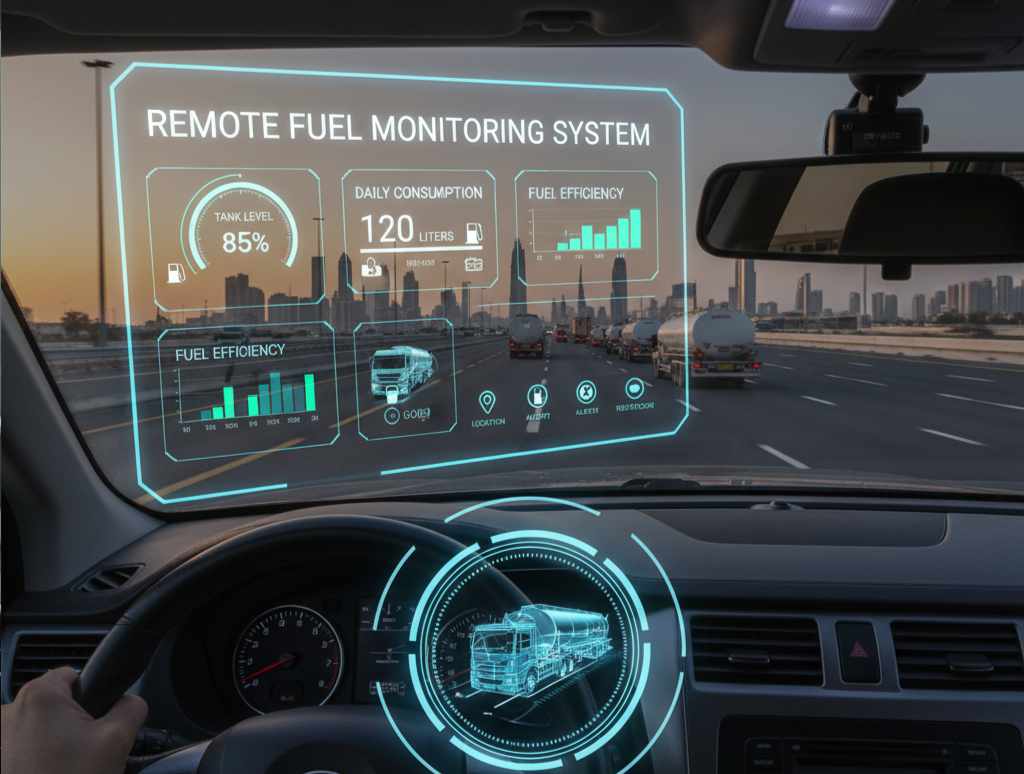
Fuel Theft Is the Largest Reversible Cost in Your UAE Fleet
In a typical UAE fleet, fuel theft eats 10-20% of the total fuel budget. You can't do anything about the pump price. Theft is different: you can get almost all of it back. Diesel cost AED 2.67 a litre in November 2025 and AED 4.30 a litre in September 2026, and fuel makes up 30-40% of fleet operating costs, so this is never a matter of a few stolen litres. A 30-vehicle fleet routinely loses AED 40,000 to AED 120,000 a year. At 100 vehicles it can pass AED 400,000.
Why does it go on for years? Because you can't see it on a spreadsheet. The fuel card statements look fine and so do the odometer readings. Nothing stands out until you fit a real-time fuel level sensor to the tank and match every drop against GPS position, time and driver. Once you do that, the leaks are obvious, and you can stop them.
This guide explains how fuel theft actually happens in UAE fleets, how to detect each method, and the system that removes 90-95% of it within 60 days. If you run vehicles, plant, generators or an on-site fuel bowser anywhere in Dubai, Abu Dhabi, Sharjah or the Northern Emirates, you're very likely losing money to at least some of what follows.
If you're weighing up a wider purchase, read this alongside our complete fuel management system buyer's guide. This article sticks to theft and how to end it.
The 7 Fuel Theft Methods Draining UAE Fleets (and the Signature of Each)
How Fuel Actually Gets Stolen — and How Each Method Is Caught
There are really seven separate problems hiding under the word 'theft', and each leaves a different trace in the data. You have to recognise the trace before you can stop the theft.
Tank siphoning is the classic. Fuel gets drawn out of the tank during overnight parking, long stops or shift handovers, usually 10-50 litres at a time. In the data, you see the level fall suddenly while the engine is off and the vehicle is stationary, nowhere near a fuel station. A refuel makes the level rise; siphoning makes it fall. A real-time sensor picks up the drop in under 3 minutes.
False receipts are the next. A driver hands in a receipt for 60 litres but only puts 45 in the tank and keeps the difference in cash. Some reuse old receipts. The giveaway is a fuel card amount that doesn't match what the tank sensor recorded: the card says 60L, the sensor saw 45L go in, and those missing 15 litres are the fraud.
Third, fuel card fraud. The company card fills a personal car, a friend's vehicle or a set of jerry cans. You'll find a card charge with no matching fill on the assigned vehicle at that station and time. The card was swiped, but the fleet tank never went up.
Fourth, depot and bowser fraud. Where you store fuel on site, it gets dispensed to vehicles that aren't authorised, into jerry cans, or sold out the back gate. The trace is dispensing with no authorised driver ID or vehicle matched at the nozzle. Without fuel control hardware on the bowser, you'll struggle to see this one at all, and it's often the biggest.
Fifth, return-line and short-fill tricks. Someone manipulates the fill so the gauge reads full when less fuel went in, or tampers with the mechanical flow meter at the depot. You'll see a steady gap between what the meter says was dispensed and what the tank sensor says arrived, on particular vehicles or with particular pump attendants.
Sixth, 'ghost vehicles' and padded mileage. Fuel is logged against vehicles that never moved, or mileage is inflated to justify drawing extra fuel. The data shows fuel used with no GPS movement or ignition activity to go with it. A parked vehicle can't burn diesel.
The seventh is the hardest to catch: collusion between a driver and a station, or a driver and a pump attendant, splitting the value of fuel that was over-billed or under-delivered. It shows up as the same discrepancy repeating with the same driver, the same station or the same time of day. You'll only spot it by matching fuel, GPS, time and driver ID over weeks, which is why pattern analytics matter here.
Look at any one of these events on its own and it looks like noise. Line them up against GPS and driver data and they become a trail of evidence.
How Much Fuel Theft Actually Costs a UAE Fleet
A Concrete 30-Vehicle Theft-Loss Model
Take a typical Dubai fleet: 30 light commercial vehicles doing 100 km a day, 26 working days a month, at 12 km/L.
- Daily fuel per vehicle: 100 km ÷ 12 km/L = 8.33 L
- Monthly fleet consumption: 30 × 8.33 × 26 = 6,497 litres
- Monthly fuel cost: 6,497 × AED 2.67 (the November 2025 diesel price) = AED 17,347
- Annual fuel cost: ~AED 208,000
Now assume a conservative 15% lost to theft, the middle of the 10-20% range UAE fleets usually find. That's about AED 31,000 a year, on only 30 vehicles.
Scale it up and it gets serious quickly. A 100-vehicle fleet loses AED 100,000+ a year to theft alone, and a 300-vehicle operation can lose AED 300,000-450,000. It happens every year, it grows, and you can prevent all of it.
Finance teams should take one point from this. Theft is a control problem. You can't negotiate the diesel price down (our 2026 fuel theft statistics show it up 77% in a year), but you can get rid of theft almost completely. UAE fleets that install sensors with alerts consistently report 90-95% fewer theft incidents within the first 60 days. The hardware doesn't physically stop anyone putting a hose in a tank. What it does is send an instant alert full of evidence, so theft can't be hidden any more, and accountability does the rest.
How Fuel Theft Detection Actually Works
The Detection Stack: Sensor, GPS, AI, and Driver ID
You need four layers working together. Each is weak on its own. Combined, they make theft visible and tell you who did it.
The foundation is a real-time fuel level sensor accurate to ±1–2%. An ultrasonic or capacitive sensor reads the tank every 10-60 seconds. Accuracy matters more than anything else here: on a 500L truck tank, every 1% of error is 5 litres. The system catches theft by spotting sudden drops against the tank's own trend, and that only works if the sensor holds steady. Cheap or badly calibrated sensors drift 2-5% in UAE heat, and at that point theft detection is useless. IOTee's fuel tracking system filters for motion and temperature, so sloshing or thermal expansion never gets mistaken for a real drop.
On top of that sits GPS and event matching. Every rise or fall in fuel is tied to a GPS position, a timestamp, the ignition state and the station name (ADNOC, ENOC, EPPCO, Emarat). Was the vehicle actually at a station when fuel went in? Was the engine off and the vehicle parked in a back lot when fuel went out? Matching the sensor against a full real-time GPS tracking feed is what turns a raw reading into proof.
The third layer is AI anomaly detection. The system learns what normal looks like for each vehicle and only flags real theft, keeping false positives under 2%. It can tell a refuel from a siphon, heat-driven volume change from a drain, and slosh on a sloping road from an actual loss.
Last comes driver ID. An iButton or RFID tag links every fuel event to a named driver. Without it you end up blaming a vehicle or a route when the problem is a person. With it, every alert tells you who was on duty.
Put the four together and each suspected theft arrives as a package of evidence: GPS location, time, how much fuel went, the estimated AED loss and the driver on duty, sent by SMS, email or push notification within minutes. Getting those alerts through reliably on cross-emirate routes depends on dual-network M2M SIM cards. Any gap in coverage is a blind spot, and thieves find blind spots.
Detection vs Prevention: Fuel Tracking vs Fuel Control
There are two levels of defence, and most serious fleets need both.
Fuel tracking is detection. It tells you that theft happened, where, when, how much, and who was driving. That alone stops most of it, because the people involved know they'll get caught. Start with the fuel tracking system.
Fuel control is prevention. It enforces the rules physically: fuel only flows once an authorised driver and vehicle have been verified, there are pre-set limits per vehicle, per driver and per shift, and depot bowsers get RFID nozzle control. If you store fuel on site you can't do without it, because depot dispensing fraud is often the biggest single loss. See the fuel control system.
The rule of thumb is simple. If all your fuel comes from public stations, tracking plus fuel card reconciliation will stop most theft. If you run your own bowser or tank, you need fuel control on the nozzle as well, because detection alone won't stop someone filling jerry cans at your own depot. Multi-depot operations can run both inside the fleet fuel management platform, with reconciliation by department and full audit trails.
The 8-Step Fuel Theft Prevention Playbook
From Suspicion to Zero Theft in 90 Days
Fleets that win against fuel theft treat it as a change in how the company works. Fitting hardware is only one step of eight, and the order matters.
1. Get a baseline. Take 90 days of fuel card statements and compare them with what the odometers say you should have used. The variance you can't explain, usually 15-25%, is your theft pool. Without this number you can't prove any savings later.
2. Fit accurate sensors and calibrate every tank separately. Each tank has its own fill curve, and generic calibration gives unreliable readings. Calibrating each tank during installation is the step amateurs skip. Professionals never skip it.
3. Link fuel to GPS, ignition and driver ID. Switch on event mapping so every rise and fall carries a location, a time and a driver. That's what turns data into evidence.
4. Set alert thresholds above your fleet's normal noise. Put the drop threshold just above normal variance so you get real theft alerts and few false alarms. Aim for under 2% false positives and detection in under 3 minutes.
5. Tell drivers openly, with an amnesty date. Say monitoring starts on a given date and anything before it is forgotten. Hiding the monitoring backfires. Announcing it is what changes behaviour, and changed behaviour produces most of the savings.
6. Put fuel control on any on-site bowser or tank. RFID nozzle authorisation and per-vehicle limits on depot dispensers close the depot-fraud gap that tracking alone leaves open.
7. Reconcile fuel cards automatically. Pull ADNOC, ENOC, EPPCO and Emarat transactions into the platform by API and match each charge to the actual fill recorded in the tank. Mismatches between card and sensor expose false receipts and personal-car fills straight away.
8. Act on every alert, every time. If an alert gets ignored, drivers learn the system is for show. Consistent follow-up (check it, document it, apply your disciplinary process) is what holds the 90-95% reduction.
Fleets that follow this sequence typically get measurable theft close to zero by the second month and keep it there. Fleets that fit the hardware but skip steps 1, 5 and 8 get about half the result for the same money.
Cut Your Fleet's Fuel Bill by 25–35%
IOTee fuel monitoring catches theft in real time, tracks consumption per vehicle, and typically pays for itself within 4–6 months.
UAE-Specific Theft Risks Generic Systems Miss
Why Fuel Theft Detection Is Harder in the UAE
A theft detection system that works fine in a mild climate often fails in the UAE, and the gaps it leaves are exactly where theft hides.
Heat causes false alarms. Diesel expands and contracts noticeably between a 20°C night and a 45°C afternoon. A sensor with no temperature compensation throws false 'drop' alerts at dusk and misses real thefts hidden inside the thermal swing. Insist on temperature-compensated sensing rated from -20°C to +85°C, in IP67 enclosures. Otherwise your alerts turn into noise and everyone learns to ignore them.
Coverage gaps between emirates are the second problem. If someone siphons a tank during a Dubai to Al Ain or Abu Dhabi to Liwa run, inside a dead zone for your one network, the alert never gets sent. Failover between Etisalat and du is part of theft prevention. Treat it as a requirement. See M2M SIM cards.
Third, the depot bowser. Plenty of UAE construction, logistics and oil and gas sites run on-site diesel bowsers with no dispensing control whatsoever. That's often the single largest source of theft, and tracking on the vehicles alone can't see it. You need fuel control hardware on the nozzle.
Dust gets in over time. UAE micro-dust is finer than typical desert dust and wears out unsealed connectors within 12-18 months. The sensor dies quietly, and theft starts again without anyone noticing. For protection that lasts, you need properly sealed hardware that has proven itself in the field.
Finally, spread-out operations. Fleets working across Dubai, Abu Dhabi, Sharjah, Ajman, Ras Al Khaimah, Fujairah and Umm Al Quwain need one dashboard that groups theft events by depot and region. Our fuel monitoring coverage for Dubai, Abu Dhabi and Sharjah covers this. A little theft at each of many sites stays invisible until you add it all up in one place.
Turning Theft Evidence Into Action: Legal & HR in the UAE
Is Fuel Monitoring Legal — and What Can You Do With the Evidence?
Monitoring company vehicles, fuel and driver activity is legal and standard practice in the UAE. If you want to be able to use the evidence, though, get the compliance side right.
The basics:
• Written disclosure in the employment contract or handbook that vehicles and fuel are monitored
• Signed consent acknowledging the monitoring scope
• Purpose limitation: data used for operational and security purposes only, with no off-hours personal surveillance
• Data protection: personal data handled under UAE Federal Decree-Law No. 45 of 2021 on personal data protection
Using the evidence:
• A tamper-proof event log (GPS, timestamp, fuel-drop amount, driver ID, AED value) supports internal disciplinary action under UAE Labour Law
• For large or repeated theft, the same evidence package supports a police report, and UAE authorities take documented fuel theft seriously
• Most fleets never get anywhere near a court, because once drivers know every litre is measured and linked to them, the theft stops. Deterrence is the point, and prosecution is rare
IOTee platforms come with retention controls, driver privacy zones (data from off-hours personal use can be masked automatically) and role-based access, so compliance is set up properly from the start.
Fuel Theft Prevention Mapped to Your Fleet Type
Which Solution Stops Theft for Your Operation
The right setup depends on where your fuel comes from and how many sites you run.
For small fleets of 1-15 vehicles that fill up at public stations, start with the fuel tracking system plus fuel card reconciliation. That catches siphoning, false receipts and personal-car fills. It's typically 80% of the value for a fraction of the enterprise cost, with ROI in 4-6 months.
With 15-50 vehicles, bring fuel into a single fleet management platform so theft, idling, route and driver data all sit together. Add fuel control if you store any fuel on site.
Large fleets of 50-200+ vehicles across several depots should run the full fleet fuel management platform, with reconciliation by department, audit-ready logs, and theft events pulled together across every depot and emirate.
Construction and plant operators face the most exposure at on-site bowsers. Put fuel control on every dispenser, and track consumption at machine level on excavators, loaders and generators, where theft disguised as idling is easy to hide.
Oil and gas and other hazardous sites need tamper-proof, intrinsically safe sensors, full control over depot dispensing and audit trails.
Logistics and long-haul routes (Dubai-Oman, Abu Dhabi-Saudi) cross borders, so they need dual-carrier coverage to get alerts out of dead zones, and GPS matching to flag drops in places a vehicle shouldn't be.
You'll rarely solve this with one product. You need the right mix, set up for where your fuel is actually leaking, and that's worth a scoping conversation before you buy anything. For a feature-by-feature comparison, see the fuel management system buyer's guide. For savings beyond theft, read the guide to reducing fuel consumption in UAE.
Next step: Compare hardwired, OBD and portable GPS tracking devices for vehicles and choose the right tracker for your fleet.
Frequently Asked Questions: Fuel Theft Prevention UAE
How do I know if my fleet has a fuel theft problem?
Take 90 days of fuel card statements and compare them with the fuel your odometers say you should have used (distance ÷ known km/L × fuel price). If you spent more than 10% over that, the unexplained gap is almost always theft and waste. Most UAE fleets find 15-25% unexplained variance the first time they run this check. To confirm it and pin it on someone, you need a real-time tank sensor matched with GPS and driver ID. Card statements on their own can never prove theft, because they always look normal.
How does a fuel sensor tell theft apart from a normal refuel?
A real refuel is a rise in fuel level at a known station, usually with the engine off and a matching fuel card transaction. Theft is a drop in fuel level, typically while the vehicle is parked with the engine off and nowhere near a station. The AI layer also filters out thermal expansion (diesel volume changes in UAE heat) and sloshing on slopes, so only real losses trigger an alert. A well-tuned system catches real theft in under 3 minutes, with a false-positive rate below 2%.
Can a fuel system stop theft from an on-site depot or bowser?
Yes, but you need fuel control on top of fuel tracking. Fuel control puts RFID or driver-ID authorisation on the nozzle, so fuel only flows to a verified vehicle and driver, within pre-set limits per vehicle and per shift. Without it, depot dispensing fraud (fuel sold off site or poured into jerry cans) is often a fleet's largest loss and the hardest one to see. Tracking on the vehicle can't see it at all. Control at the nozzle stops it.
How much can a UAE fleet save by stopping fuel theft?
Fuel theft usually accounts for 10-20% of a UAE fleet's fuel budget. For a 30-vehicle fleet spending around AED 208,000 a year on fuel, a conservative 15% theft loss is roughly AED 31,000 a year you can get back. A 100-vehicle fleet routinely recovers more than AED 100,000 a year. Fleets that install sensors with alerts consistently report 90-95% fewer theft incidents within 60 days, and most cover the cost of the system in 6-13 months from theft savings alone.
Is it legal to monitor drivers for fuel theft in the UAE?
Yes. Monitoring company vehicles, fuel use and driver activity is legal and standard practice in the UAE. Good practice means written disclosure in the employment contract, signed employee consent, limiting use to operational and security purposes, and complying with UAE Federal Decree-Law No. 45 of 2021 on personal data protection. A tamper-proof event log can support internal disciplinary action and, in serious cases, a police report. In most fleets, though, the deterrent stops the theft long before anyone files a case.
Will fuel sensors stay accurate in UAE summer heat?
Good sensors, installed and calibrated properly, hold ±1–2% accuracy in UAE conditions. That depends on three things: temperature compensation (correcting for diesel expanding and contracting between night and day), motion filtering (ignoring slosh and vibration), and calibrating each tank during installation. Sensors without these drift 2-5% in 50°C heat. That hides real thefts and sets off false alerts that staff soon learn to ignore. When you're comparing vendors, always check for UAE-specific calibration and hardware rated from -20°C to +85°C.
Stop the Leak: Your Next Step
From Reading to Recovering
Fuel theft is one of the few fleet costs that's large, comes back every year, and can be almost entirely reversed. Fleets that recover it do three things, in this order.
First, they measure the leak. Run the 90-day comparison of fuel cards against odometers and put a dirham figure on the variance you can't explain. That figure is your business case.
Second, they match the system to where the fuel is leaking. If you fill up at public stations, you need fuel tracking plus card reconciliation. If you have your own bowsers, add fuel control. If you run several depots, you need the full fleet fuel management platform.
Third, they pilot properly. Put sensors on 5-10 vehicles for 60-90 days, measure the theft you catch and the variance you close, then scale up on evidence. Hope isn't a plan.
IOTee is built for fleets in Dubai, Abu Dhabi, Sharjah, Ajman, Ras Al Khaimah, Fujairah and Umm Al Quwain, from 5-vehicle SMEs to enterprise and government operations with 500+ vehicles. Every project starts by working out where your fuel is actually disappearing, before we talk about any product. The fuel someone siphons from your trucks tonight is fuel you could be keeping by next quarter. The next move is yours.