Why Construction Fleet Management Is the Highest-ROI IT Investment in UAE Construction
UAE construction operates at scale and pace unmatched in the region. Active mega-projects across Dubai, Abu Dhabi, the Northern Emirates, and the Western Region run on enormous fleets of heavy equipment, transport vehicles, generators, and site infrastructure — with razor-thin schedules, exposed-margin contracts, and zero tolerance for downtime. Yet most UAE contractors run this complex asset base on spreadsheets, paper logbooks, and trust.
The gap between contractors who instrument their fleet and those who don't is no longer marginal — it's existential. Industry data from UAE construction projects consistently shows that contractors without integrated fleet and equipment management lose 18-25% of project operating budget to a combination of fuel theft, equipment underutilization, unscheduled breakdowns, idle hours billed but not worked, unauthorized after-hours use, and administrative inefficiency. On a AED 500M project, that translates to AED 90-125 million silently bleeding out across the project lifecycle.
A modern construction fleet management platform — combining GPS tracking, fuel control, equipment telematics, site geofencing, driver behavior monitoring, and project-level analytics — typically delivers:
- 85-95% elimination of fuel theft from site bowsers and equipment tanks
- 30-40% reduction in equipment downtime through predictive maintenance
- 20-30% improvement in equipment utilization (more productive hours per asset)
- 40-60% reduction in unauthorized after-hours and weekend equipment use
- 15-25% reduction in fleet fuel consumption through driver behavior and idle control
- ROI typically 4-8 months on the platform investment
This 2026 guide is the complete reference for UAE contractors, project managers, equipment managers, and procurement leaders. We cover what construction fleet management actually is, the unique challenges of UAE construction (heat, dust, multi-site complexity, mixed asset types, theft exposure, compliance), the technology stack required, the platform architecture, the financial case, the vendor checklist, and the rollout playbook. By the end you will have everything needed to either build the internal business case or shortlist the right partner — including how IOTee's construction transport solution integrates with the broader fleet management platform.
What Construction Fleet Management Actually Covers (UAE Context)
The Six Asset Categories on a UAE Construction Site
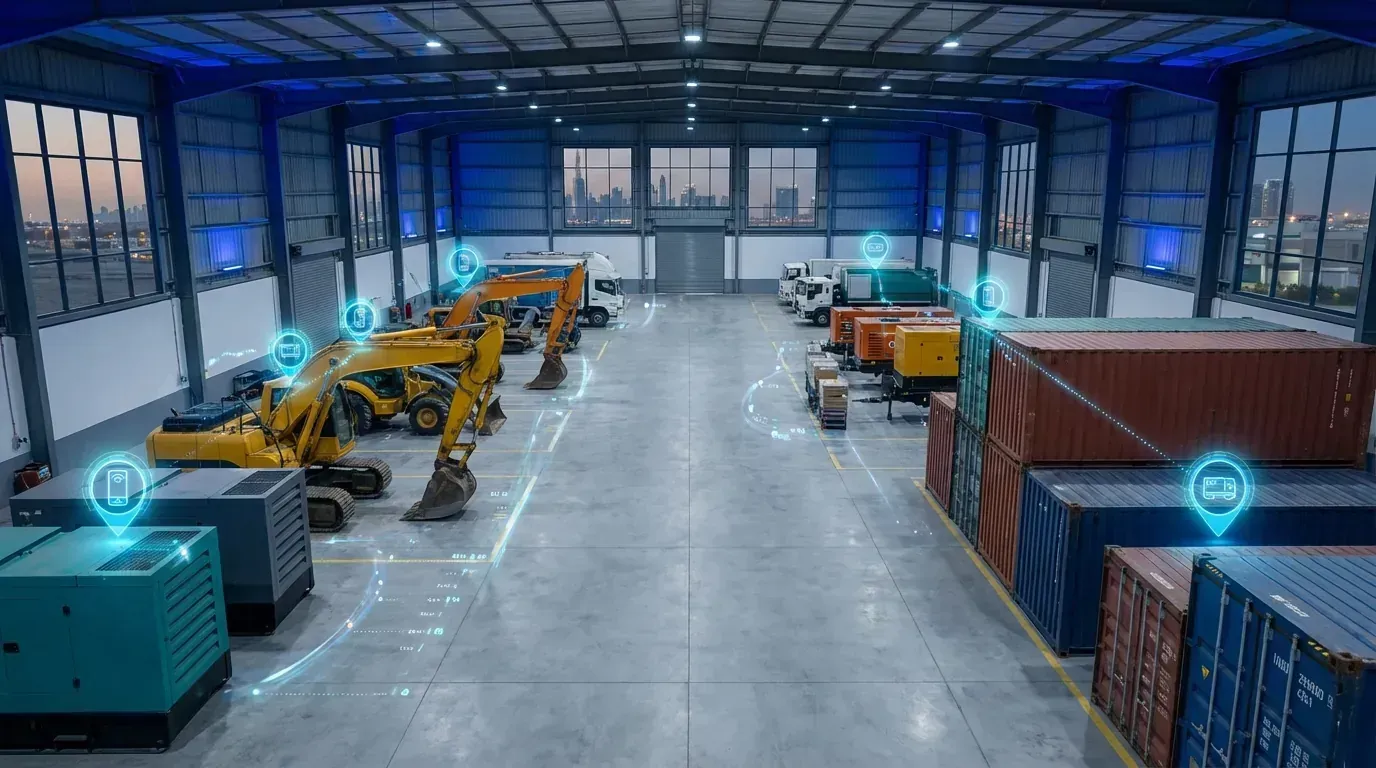
Construction fleet management is not 'GPS tracking on trucks'. UAE construction sites involve six distinct asset categories, each with its own monitoring, fuel, and operational requirements. A serious platform handles all six in one unified system.
1. On-Road Transport Fleet (Trucks, Trailers, Tippers, Mixers)
• Concrete mixers running aggressive Dubai/Abu Dhabi schedules
• Tipper trucks for aggregate, sand, debris, demolition material
• Flatbed trailers for steel, modular components, equipment relocation
• Light commercial vehicles for site supervisors, engineers, and procurement runners
• Crew transport buses
Tracking requirements: GPS, fuel, driver behavior, route optimization, customer site delivery proof, RTA permit compliance for heavy vehicles, Salik gate reconciliation.
2. Heavy Mobile Equipment (Excavators, Loaders, Graders, Bulldozers)
• Excavators (8-50 tonne classes) — primary earthmoving asset
• Wheel loaders and skid steers
• Motor graders for site preparation and haul road maintenance
• Bulldozers for grading, pushing, and ripping
• Backhoe loaders for utility work
• Compactors and rollers for sub-base and asphalt work
Tracking requirements: GPS, engine hours (the financial unit of work), fuel consumption per hour, idle hours (huge waste category), operator ID, geofenced site assignment, after-hours / weekend use detection, maintenance scheduling.
3. Static / Semi-Mobile Equipment (Cranes, Generators, Compressors, Pumps)
• Tower and crawler cranes (high-value, schedule-critical)
• Mobile cranes
• Diesel generators (huge fuel theft target — often unmonitored)
• Air compressors
• Concrete pumps
• Welding generators
• Light towers
Tracking requirements: GPS for theft protection, runtime hours, fuel consumption (especially generators), maintenance, location verification (cranes go missing more often than people realize).
4. Material Handling and Site Logistics
• Telehandlers, forklifts, scissor lifts, boom lifts
• Concrete buggies, motorized wheelbarrows
• Site shuttles
Tracking requirements: Location, runtime, operator, geofenced site assignment, theft protection.
5. Site Infrastructure (Containers, Cabins, Tools, Plant)
• Site offices and accommodation containers
• Tool cribs and equipment containers (frequent theft target)
• Pumps, scaffolding, formwork
• Spare parts inventory
Tracking requirements: Asset tracking for theft protection, location verification, accountability across project handovers.
6. On-Site Fuel Storage (Bowsers, Tanks, Dispensers)
• Site fuel bowsers (1,000-50,000L capacity)
• Fixed fuel storage tanks
• Mobile dispensing units
Tracking requirements: This is the single largest theft category in UAE construction. Tank level monitoring, dispensing event logging, vehicle/equipment authorization, RFID nozzle control, automatic reconciliation against deliveries — see IOTee's fuel control system for the enforcement architecture.
A construction fleet management platform that handles only category 1 (on-road vehicles) leaves five out of six asset classes invisible — and that is where the majority of cost, theft, and inefficiency lives. The right platform is unified across all six.
The UAE Construction Environment: Why Generic Telematics Fails Here
Eight Environmental Realities That Break Generic Systems
UAE construction conditions impose requirements that generic global telematics systems consistently fail to meet. Understanding why is the first step to picking hardware and platforms that survive five years of real operation.
1. Extreme Heat (50°C+ Ambient, 70°C+ Equipment Surface)
UAE summer ambient temperatures regularly exceed 50°C. Excavator engine bays, generator enclosures, and underbody mounting locations on heavy equipment routinely hit 80-90°C. Standard automotive-grade telematics rated to 60°C ceiling fail in their first summer. Demand industrial-grade hardware rated -20°C to +85°C minimum, with documented MTBF at high ambient.
2. Aggressive Dust and Sand Ingress
UAE micro-dust is finer than typical desert dust and is everywhere on construction sites. Standard IP65 enclosures fail within 12-18 months from dust ingress alone. IP67 minimum is required, with sealed connectors (not just sealed bodies) and field-validated dust resistance. The data is unforgiving — Sharjah, Mussafah, and ICAD construction fleets report 25-40% premature device failure rates on under-specified hardware.
3. Severe Vibration and Shock
Dozer ripping, compactor work, and excavator tracking generate continuous high-amplitude vibration that fails consumer-grade circuit boards, connectors, and antennas. Mil-spec or industrial-grade ruggedization is required, with antenna mounting that handles continuous shock without fatigue failure.
4. Large Site Areas with Patchy Coverage
Mega-projects in the Western Region, Hatta, RAK mountains, and remote infrastructure projects often have spotty cellular coverage from any single carrier. Multi-IMSI SIMs with automatic Etisalat/du failover are baseline; some sites also need satellite fallback for critical assets. IOTee's M2M SIM cards are engineered for this exact use case.
5. Mixed Diesel Quality and Theft Vulnerability
Site bowsers are a known theft target. Diesel quality varies (industrial-grade vs road-grade diesel). Fuel sensors must handle dielectric and viscosity variation across grades. Demand sensors with documented multi-fuel calibration and temperature compensation.
6. High Operator Turnover and Mixed Nationalities
UAE construction operator workforce is large, multi-national, and high-turnover. Driver-ID systems must work with low-friction enrollment (RFID cards distributed at site induction), bilingual or multilingual interfaces (Arabic, English, Hindi, Urdu, Tagalog as common languages on UAE sites), and automated handover when operators rotate between equipment.
7. Multi-Tier Subcontractor Environment
A single mega-project may have a main contractor, 10 sub-contractors, and 50 sub-sub-contractors all operating equipment on the same site. Tracking must support multi-tenant data segregation — main contractor sees everything, sub sees only their assets — without manual data hygiene work.
8. Strict Project Schedule Pressure
UAE construction runs to brutal schedule pressure (Dubai 2031, Abu Dhabi Vision, infrastructure deliveries, Expo legacy work). Equipment downtime that costs a competitor a delay penalty costs a UAE main contractor LD penalties measured in millions of AED. The platform must support proactive maintenance, predictive analytics, and root-cause analysis at speed.
These eight realities are not nice-to-haves. They are the difference between a system that demos beautifully in a sales meeting and one that operates reliably for five-plus years on a real Dubai or Abu Dhabi construction project.
The Five Highest-Cost Problems Construction Fleet Management Solves
Problem 1: Fuel Theft from Site Bowsers and Equipment Tanks
Fuel theft is the single largest financial leak on UAE construction sites — typically 15-25% of total project fuel spend. Common patterns:
- Bowser shrinkage — site bowsers receive a delivery of 10,000L; over the next two weeks 11,500L is dispensed against actual delivery records that show only 10,000L received
- Operator over-fueling — equipment tank topped up at 11pm, then an unaccounted-for amount disappears overnight
- Generator siphoning — diesel generators are massive theft targets at night when no one is on site, which is why site gensets need their own tank sensors and run-hour telemetry (see our generator monitoring guide for UAE sites)
- Receipt fraud — fuel cards charged for amounts never delivered
- Cross-fueling — non-fleet vehicles (personal cars, sub-contractor vehicles) filled on the project bowser
The fleet management response:
- Bowser tank level monitoring with continuous level sensing and reconciliation against measured dispense events
- RFID nozzle control — fuel only dispenses when an authorized vehicle/equipment RFID is presented; every event logged with vehicle, operator, time, location, amount
- Equipment tank monitoring with theft alert on overnight drops
- Generator-specific monitoring with runtime correlation (fuel disappearing without engine hours = theft)
- Card transaction reconciliation with measured fill events
Deployments using IOTee's fuel control system on UAE construction projects routinely report 85-95% reduction in fuel theft incidents within 90 days of activation. For the comprehensive technology breakdown, see our fuel management system UAE complete guide.
Problem 2: Equipment Underutilization and Hidden Idle Hours
A AED 1.2M excavator that sits idle 40% of its working hours is a project-level financial disaster. Most UAE construction managers cannot answer two basic questions accurately: 'how many hours is this excavator actually productive per day' and 'what is the cost-per-cubic-meter of work being moved'.
The patterns telematics surfaces:
- Engine running but no work (idle burning fuel and engine hours)
- Engine running, work happening, but operator on the wrong machine for the task
- Equipment not at the location it was assigned to
- Equipment at a location but mismatched to project phase
- High-value asset working sub-optimal hours while under-tasked machines sit idle
The fleet management response:
- Engine hours vs work hours distinction (idle vs productive)
- Operator productivity measured per asset class
- Site geofencing with automatic equipment-to-project assignment
- Utilization scoring by asset, by week, by project
- Reallocation alerts when an asset is under-utilized for X consecutive days
- Cost-per-output reporting (cost per cubic meter excavated, cost per ton hauled, cost per cubic meter of concrete poured)
UAE projects running utilization analytics on heavy equipment routinely uncover 20-30% productivity uplift opportunities — without buying more equipment, just by deploying the existing fleet more intelligently.
Problem 3: Unscheduled Breakdowns and Downtime Costs
An unscheduled breakdown of a critical-path piece of equipment on a UAE mega-project does not cost the rental rate — it costs the delay penalty that flows through the entire project chain. A AED 500/hour excavator going down for three days during foundation work can trigger AED 250,000 in cascading project delays.
The fleet management response:
- Engine-hour-based service scheduling (the right metric for heavy equipment, not calendar time)
- DTC / fault code ingestion with severity-ranked workflow
- Predictive failure models on cooling, hydraulics, drivetrain, electrical
- Component-specific monitoring (tire pressure, battery health, fluid levels, filter status)
- Maintenance history with full audit trail per asset
- Workshop and parts integration for fast repair routing
IOTee's fleet maintenance module integrates engine telematics, scheduled service, and predictive analytics. UAE construction operators running predictive maintenance see 30-40% reduction in unscheduled breakdowns and 15-25% extension in major component life.
Problem 4: Unauthorized After-Hours and Weekend Use
On most UAE construction sites, equipment is supposed to be parked and idle during off-hours, weekends, and Eid and National Day holidays. In reality, equipment frequently moves and operates outside authorized hours — sometimes for legitimate emergency work, sometimes for unauthorized side jobs that wear the asset, burn fuel, and expose the contractor to serious liability if an incident occurs.
The fleet management response:
- Time-based geofencing — equipment ignition or movement outside authorized hours triggers immediate alert
- Operator authorization windows by individual
- Site-level off-hours rules (different sites may have different schedules)
- Automated incident escalation to project security and management
- After-hours logbook reporting — exception-based, not blanket reporting
This single capability frequently surfaces multi-million-AED-per-year side-work patterns that contractor leadership had no idea were happening on their assets.
Problem 5: Site-to-Site Asset Reallocation and Theft
Multi-site UAE contractors lose meaningful asset value annually to two patterns: equipment that is reallocated between sites without proper handover documentation (and then 'disappears' in the records), and outright theft of high-value equipment, generators, tools, and materials.
The fleet management response:
- GPS-confirmed asset location at all times
- Site-handover workflow — formal asset transfer between project teams
- Theft alerts on movement outside any authorized site geofence
- Asset register reconciliation — physical fleet matched against accounting register monthly
- Insurance reporting — proof-of-location for any insurance claim
UAE contractors running this consistently find AED 500K to AED 5M of 'missing' assets within the first 90 days of deployment — and then prevent the next round of losses.
The Construction Fleet Management Technology Stack
What a Complete UAE Construction Fleet Platform Includes
A construction-grade platform extends the standard fleet management stack with several construction-specific capabilities. Here is the complete technology architecture.
Layer 1: In-Asset Hardware
- GPS / GNSS trackers — industrial-grade, IP67, -20°C to +85°C, with battery backup for assets without continuous power
- Engine hour counters — capture actual running time, the financial unit for heavy equipment
- CAN bus / J1939 adapters — read engine, hydraulic, and operational data from heavy equipment ECUs (J1939 is the heavy-equipment CAN protocol)
- Fuel level sensors — capacitive or ultrasonic, ±0.5% accuracy, multi-fuel calibrated, temperature compensated
- Operator ID readers — RFID or biometric, low-friction for high-turnover workforce
- Accelerometers / shock sensors — detect harsh operation, impacts, rollovers
- Cameras (dash and in-cab cameras, caravan / equipment cameras) for incident evidence and operator behavior on heavy equipment — plant, tippers and forklifts normally need a multi-channel MDVR rather than a windscreen unit, covered in our truck, forklift and heavy equipment camera guide
- Battery / power monitoring — particularly for assets that sit overnight
Layer 2: Site Infrastructure Hardware
- Bowser tank level sensors with reconciliation against delivery records
- RFID nozzle control units at fuel dispensers
- Site gate readers for entry/exit logging
- Generator and compressor monitoring kits
- Asset tags for tools, containers, and small plant (asset tracking)
Layer 3: Connectivity
- Multi-IMSI cellular SIMs with Etisalat/du failover
- Site mesh networking for areas with poor cellular (LoRa, sub-GHz, or wifi mesh)
- Satellite fallback for critical assets in remote sites
- Edge buffering for disconnected periods
Layer 4: Cloud Platform
- Asset registry across all six categories
- Real-time map view by site, by project, by asset class
- Multi-tenant project segregation (main contractor / sub-contractors)
- Operator and crew management
- Fuel reconciliation across deliveries and dispensing
- Maintenance scheduling and history
- Geofence library by site
Layer 5: Intelligence and Analytics
- Utilization analytics by asset, project, week
- Predictive maintenance models for heavy equipment
- Fuel theft anomaly detection
- Operator behavior scoring (especially for transport fleet)
- Cost-per-output analytics (per m³, per ton-km, per delivery)
- Project-level fleet cost tracking
Layer 6: Reporting, Integration, and Compliance
- Project-level cost allocation and chargeback
- Insurance and audit reports
- ERP integration (SAP, Oracle, Aconex, Procore for project management; QuickBooks, Zoho, Tally for accounting)
- Customer / client reporting (where contracts require asset visibility to the client)
- Sustainability and emissions reporting
- Geofencing-based site compliance for equipment authorization
This is what the term 'construction fleet management platform' means in 2026 UAE practice. Anything less is a partial solution that will be replaced or supplemented within 18 months.
Industry Sub-Vertical Configurations
Different Construction Sectors, Different Configurations
UAE construction is not monolithic. Different sub-verticals have distinct platform configurations.
Civil Infrastructure (Highways, Bridges, Utilities, Metro)
• Long-route haul tracking with multi-emirate operations
• Heavy emphasis on aggregate logistics tracking (tipper rotations)
• Strict government client reporting (RTA, Etihad Rail, ADM, Sharjah Municipality)
• Cost-per-cubic-meter and cost-per-ton-kilometer analytics
• Long project durations (2-5 years) require platform configurability over time
Vertical Construction (Towers, Mixed-Use, Real Estate)
• Crane and tower-crane utilization
• Concrete pour scheduling and pump tracking
• Material delivery sequencing
• Multi-floor logistics (hoists, telehandlers)
• Tight urban geofencing (limited site footprint, strict compliance)
Industrial and Oil & Gas Construction
• Hazardous-zone-rated hardware (intrinsically safe variants)
• Stringent operator certification tracking
• Integration with permit-to-work systems
• Higher-tier compliance and audit requirements
• Often requires Western Region remote-site capability
Heavy Industrial (Cement, Quarrying, Aggregates)
• 24/7 operation patterns
• Heavy-duty asset utilization (high engine hours)
• On-site fuel infrastructure (large storage, multiple dispensers)
• Tight cost-per-ton economics — fleet visibility directly drives margin
Specialized Construction (Marine, Airport, Road Maintenance)
• Specific asset classes (dredgers, asphalt pavers, line marking)
• Often time-of-day restricted operations (airport night work)
• Specialized compliance (Civil Aviation, Marine Authority)
Modular and Pre-Fabricated Construction
• Multi-leg logistics (factory → site → installation)
• Lifting and crane integration
• Precision schedule adherence
IOTee's platform is configured per-vertical at deployment so each project gets the right balance of capability and complexity, mapping cleanly into the broader transport and logistics fleet UAE operations and into the fleet management platform used across non-construction units of the same contracting group.
Track Every Machine on Every Site
Heavy-equipment GPS, site geofencing and utilisation reports for UAE construction fleets.
The Financial Case: ROI Math for a UAE Construction Contractor
A Concrete Mid-Size UAE Contractor Model (80 Mixed Assets, 18-Month Project)
Let's model a representative UAE main contractor on a single 18-month project: 80 mixed assets (40 transport vehicles, 25 heavy equipment, 10 generators/compressors, 5 cranes), AED 380M project value, 1.2M project liters fuel consumed.
Baseline (without integrated fleet management):
| Cost Category | Annual AED |
|---|---|
| Fuel (1.2M L × AED 2.67) | 3,204,000 |
| Maintenance (across 80 assets) | 2,400,000 |
| Equipment rental top-ups during downtime | 1,800,000 |
| Labor cost on idle / non-productive hours | 2,200,000 |
| Insurance | 950,000 |
| Asset losses, theft, write-offs | 600,000 |
| Administrative overhead | 480,000 |
| Total annual fleet operating cost | AED 11,634,000 |
Estimated recoverable opportunity (industry baseline for UAE construction):
- Fuel theft and waste: 20% of fuel = AED 640,800
- Equipment downtime savings: 30% of rental top-ups = AED 540,000
- Productive hour uplift (idle reduction): AED 660,000
- Maintenance optimization (predictive vs reactive): 22% of maintenance = AED 528,000
- Asset theft prevention: 60% of theft losses = AED 360,000
- Insurance reduction (driver scoring + cameras): 12% = AED 114,000
- Admin automation: 50% = AED 240,000
Total annual recoverable: ~AED 3,082,800
System investment (typical UAE construction-grade platform, 80-asset fleet):
- Hardware + installation (mix of vehicle, heavy equipment, generator, asset tracker classes): AED 220,000-340,000 one-time
- Site infrastructure (bowser sensors, RFID dispensing, site gate readers): AED 80,000-180,000 one-time
- Software + connectivity (80 assets × AED 95-160/month): AED 91,200-153,600 annual
- Cameras + driver behavior on transport subset: AED 60,000-110,000 one-time
- Setup, integration, and training: AED 40,000-90,000 one-time
Year 1 net position:
• Total savings (conservative): ~AED 3,000,000+
• Total Year 1 investment: ~AED 480,000-900,000
• Year 1 net benefit: AED 2,100,000+
• Break-even: month 3-5
Year 2 onwards: Hardware paid off — savings of AED 3M+/year flow against AED 100K-160K of recurring software, connectivity, and replacement hardware. Net annual benefit ongoing: AED 2.8M+ per year per project at this scale.
For multi-project contractors running 5-10 active projects simultaneously, the absolute numbers scale linearly. This is why every serious UAE main contractor at scale has either deployed integrated fleet management or has it as an active priority on the executive agenda for 2026.
How to Choose a Construction Fleet Management Provider in UAE
The 14-Point Vendor Checklist for UAE Construction Operators
Use this checklist when evaluating any provider. Failures on items 1-7 should disqualify a vendor immediately.
Hardware and Environmental Suitability
1. ✓ Hardware rated -20°C to +85°C, IP67 minimum, with documented UAE field reliability
2. ✓ Heavy-equipment CAN/J1939 support across major OEMs (Caterpillar, Komatsu, Volvo CE, Hitachi, JCB, Liebherr)
3. ✓ Industrial fuel sensors with multi-fuel calibration and temperature compensation
4. ✓ Bowser-grade fuel control hardware (RFID nozzle, tank level, dispensing logging)
Connectivity and Coverage
5. ✓ Multi-IMSI cellular with Etisalat/du failover, plus optional satellite for remote sites
6. ✓ Site mesh networking capability for low-cellular areas
Platform Capabilities
7. ✓ All six asset categories handled in one platform with one source of truth
8. ✓ Multi-tenant data segregation for sub-contractor environments
9. ✓ Bilingual Arabic/English UI and operator-facing displays
10. ✓ Project-level cost allocation, ERP integration (SAP/Oracle/Aconex/Procore), and accounting exports
Service and Support
11. ✓ Local UAE installation team experienced with heavy equipment installations on active sites
12. ✓ 24/7 support in Arabic and English
13. ✓ Three or more named UAE construction reference customers at your scale
14. ✓ Demonstrated case studies showing fuel theft reduction, downtime reduction, or utilization improvement on UAE projects
Commercial terms to negotiate:
• Per-asset pricing transparent and tier-disclosed
• Pilot deployment (8-15 mixed assets, 60-90 days) at reasonable cost before full commitment
• Hardware ownership at end-of-contract (you own hardware, no lease-back)
• Data portability written into the contract — full asset, fuel, and operational history exportable in standard formats at any time, free
• No multi-year hardware lock-ins
• Clear pricing for project lifecycle (installation, mid-project additions, project closeout)
Implementation: The Construction Site Rollout Playbook
Deploying Fleet Management on an Active UAE Construction Project
Construction rollouts have unique constraints — assets are in active operation, operators are on payroll for billable hours, and downtime for installation is unaffordable. Here is the proven playbook.
Weeks 1-2: Project Audit and Configuration
• Asset register: every vehicle, every piece of heavy equipment, every generator, every static asset documented
• Site map: project boundary, working zones, fuel infrastructure, gate locations
• Project organization: sub-contractor list, multi-tenant requirements, reporting hierarchy
• Define explicit success metrics with target ranges: fuel-loss %, equipment utilization %, breakdown rate, on-time-completion %
• Configure platform tenant, project, sites, geofences, alert recipients
Weeks 3-4: Pilot Installation (8-15 mixed assets)
• Install on a representative cross-section: 4 transport vehicles, 4 heavy equipment, 2 generators, 1 crane, plus bowser instrumentation
• Calibrate fuel sensors per-asset (no shortcuts)
• Validate operator ID workflow with site induction integration
• Tune alert thresholds against site noise patterns
• Train project ops, fuel manager, equipment manager, and site security on dashboards
Weeks 5-8: Full Project Rollout
• Phased installation by asset class — typically transport first, then heavy equipment, then site infrastructure
• Maximum 6-10 assets per day per installation team to avoid project disruption
• Each asset validated end-to-end before returning to billable operation
• Operator briefings in Arabic, English, Hindi, Urdu, Tagalog as relevant
• Day-1 amnesty policy on operator behavior; new monitoring starts on date X
Weeks 9-11: Optimization and Coaching
• First fuel reconciliation cycle complete
• Bottom 10% of operators identified and coached
• Equipment utilization analysis identifies under-utilized and over-utilized assets
• Predictive maintenance schedules set per asset
• First insurance / client reporting cycle generated
Week 12: Project Review and Forward Plan
• Month-1 results presented to project leadership
• Decisions on remaining sites, additional asset coverage, or extended capabilities
• Insurance renewal data pack prepared for next renewal cycle
• ERP integration validated against project cost allocation
UAE contractors that follow this playbook hit 20%+ project fleet cost reduction within 90 days and 30%+ within six months. Contractors that skip change management and treat the rollout as pure hardware install typically achieve half those results.
Related: See how GPS tracking for vehicles works in the UAE — device types, pricing from AED 500/year, and coverage across all seven emirates.
Frequently Asked Questions: Construction Fleet Management UAE
How is construction fleet management different from regular fleet management?
Regular fleet management focuses on on-road vehicles. Construction fleet management adds five additional asset categories: heavy mobile equipment (tracked via engine-hours and J1939 CAN, not road-vehicle telematics), static and semi-mobile equipment (cranes, generators, compressors), site materials handling, on-site fuel storage and bowser dispensing control, and small plant / asset tracking. It also adds construction-specific workflows: site geofencing with sub-contractor multi-tenancy, project-level cost allocation, after-hours unauthorized use detection, and tight integration with project management platforms (Aconex, Procore) and ERP. A platform built only for road vehicles will miss the majority of construction asset value. See our broader Fleet Management UAE Complete 2026 Guide for the comparison.
How do you track heavy equipment that doesn't have OBD-II?
Heavy equipment uses J1939 CAN bus (the heavy-vehicle equivalent of OBD-II) on most modern Caterpillar, Komatsu, Volvo CE, Hitachi, JCB, and Liebherr equipment built within the last 12-15 years. A J1939-capable telematics device reads engine RPM, hours, fuel rate, fault codes, oil pressure, coolant temperature, and many other parameters. For older equipment without J1939, hour meters and fuel sensors can be installed independently, with GPS providing location and a dedicated engine-on detector providing runtime — capturing 80% of the operational telemetry without ECU integration. The platform should support both modern J1939 integration and legacy independent-sensor configurations transparently.
Can fleet management really reduce fuel theft on UAE construction sites?
Yes — this is the most consistent and largest single ROI category. UAE construction sites running integrated fuel control (RFID nozzle authorization, bowser tank level monitoring, dispensing reconciliation, equipment tank monitoring with overnight theft alerts) routinely report 85-95% reduction in fuel theft incidents within 90 days. The mechanism is not hardware preventing theft — it is the combination of unavoidable accountability (every dispense logged with vehicle, operator, time, location, amount) and instant evidence-rich alerts that change site behavior. For a deeper technology breakdown see our fuel management system UAE complete guide.
Will operators resist fleet management deployment?
Some will, initially — particularly operators who have benefited from the lack of accountability. Best practice is transparent communication: announce the deployment, explain what is being measured and why, set a Day-1 amnesty boundary date (all behavior pre-date is forgiven), provide formal coaching and recognition for top performers, and make the process about productivity and safety rather than surveillance. UAE contractors that handle the rollout this way report broad operator acceptance within 30 days and meaningful behavior change within 60. Deployments that try to hide monitoring almost always backfire.
How does construction fleet management integrate with our ERP and project management systems?
Modern platforms expose REST or GraphQL APIs and pre-built integrations for the systems UAE contractors typically run: SAP, Oracle, Aconex, Procore, Sage 300CRE, and major UAE accounting platforms (QuickBooks, Zoho Books, Tally, Xero). Typical integrations include project-level cost allocation (fuel, equipment hours, maintenance, labor), asset register reconciliation, fuel transaction sync to accounting with VAT-compliant exports, and cost-per-output reporting feeding into project commercial reports. Always validate the specific integrations you need during vendor evaluation — generic 'has APIs' is not the same as proven integration with your specific system version.
Is the platform usable by non-technical site supervisors?
It must be. The site supervisor, fuel manager, equipment manager, and project security team are the daily users — not IT staff. A construction-ready platform has: a site map view that works on a tablet at the site office, alerts that arrive via simple SMS and push notification, exception-based reporting (you only see what needs attention), bilingual Arabic/English interfaces, and operator dashboards that work in low-bandwidth conditions. If the dashboard requires desktop and steady internet, it will not be used reliably on a UAE construction site.
What about when assets move between projects?
Multi-project asset reallocation is a first-class workflow on serious construction platforms. When equipment moves from Project A to Project B, the platform handles the handover (formal transfer, asset record updated, cost allocation switched, geofence reassignment, operator authorization scope updated, fuel allocation transferred) with full audit trail. Without this workflow, equipment 'follows' a project in records that don't match physical reality — the most common pattern that masks theft and causes asset register mismatches at audit.
Does IOTee handle complete UAE construction fleet management?
Yes. IOTee operates a unified platform covering all six construction asset categories — combining construction transport, real-time GPS tracking, heavy equipment telematics, fuel control at site bowsers, asset tracking for tools and small plant, vehicle camera systems for transport, driver behavior monitoring, geofencing for site control, tire management for road fleet, and fleet maintenance for predictive servicing — all running on industrial-grade M2M SIM cards and a single cloud platform. Coverage spans projects across all seven UAE emirates with local installation, support, and account management teams.
Next Steps for UAE Construction Operators
From Reading to Deployment
If you have read this far, you understand the size of the recoverable opportunity in construction fleet management. The remaining question is how to convert that opportunity into a structured deployment that fits your project, your asset mix, and your sub-contractor reality.
Three immediate actions:
Action 1: Run a 30-day fuel and asset reconciliation audit. Pull 90 days of bowser deliveries, dispensing records, equipment runtime logs, and asset register. Calculate the variance. Most UAE contractors find 18-25% unexplained fuel and significant asset register mismatches — that is your savings pool.
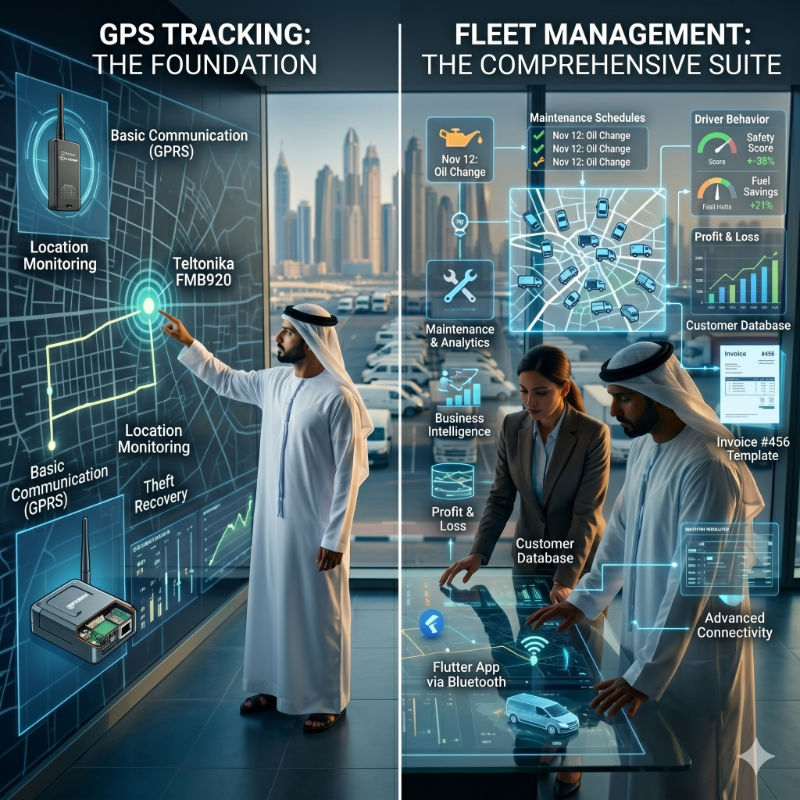
Action 2: Read the companion guides. This pillar focuses on construction. For the cross-functional fleet picture, read Fleet Management UAE Complete 2026 Guide. For the fuel deep-dive, the fuel management system UAE complete guide. For the GPS-vs-fleet-management decision context, see Fleet Management vs GPS Tracking. For the school-bus parallel framework on regulatory-driven verticals, see the School Bus Fleet Management RTA Compliance UAE guide.
Action 3: Run a structured pilot on a single project. Pick 8-15 mixed assets, instrument the bowser, run 60-90 days against the same project against an explicit baseline, measure the delta in fuel theft, equipment utilization, and breakdown frequency, then scale across the contractor portfolio with confidence.
IOTee partners with UAE contractors ranging from single-project SMEs to multi-billion-AED main contractors operating across all seven emirates. Whether the priority is fuel theft control, equipment utilization, predictive maintenance, sub-contractor governance, or full integrated project fleet management, every engagement starts with a scoping conversation matched to your project profile — not a pre-packaged sales pitch.
The UAE contractors who will dominate the next decade are the ones who treat their fleet and equipment as a measured, instrumented, optimized asset class — not a cost center to be tolerated. The technology has matured, the ROI math is unambiguous, and the regulatory environment increasingly rewards transparent, audit-ready operations. The next move is yours.