Real-Time vs Passive GPS Tracking: What Is the Actual Difference?
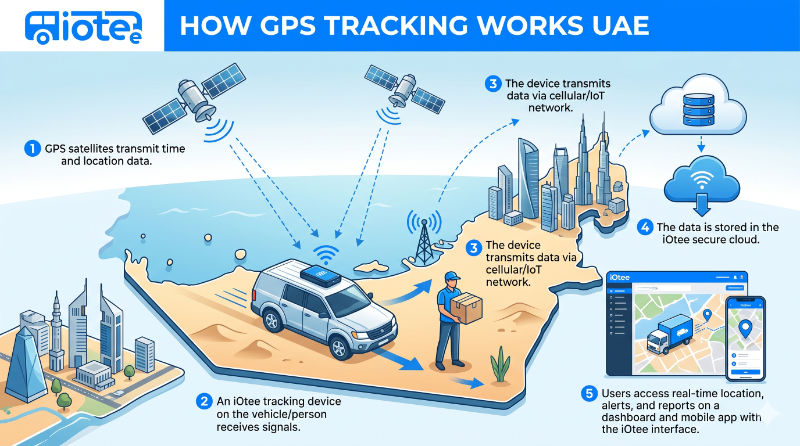
Real-time GPS tracking sends each position over the mobile network as soon as it's recorded, so the vehicle shows up on a live map within seconds. Passive GPS tracking saves positions to onboard memory and shows you nothing until someone physically gets the device back and downloads it. Both use the same satellite signal and produce the same coordinates. The only difference is when you see them, and that one difference decides almost everything else.
For UAE commercial fleets, the question is mostly answered before price even comes up. Abu Dhabi's Asateel platform and Dubai's SIRA-regulated SecurePath programme are both built around devices that report live to a government platform. A passive logger can't satisfy either mandate, whatever it costs. So in the UAE, passive tracking is a niche tool and nobody should treat it as the budget option. Buyers who don't know this usually find out when a permit application gets refused.
We've written this for buyers who've been quoted both. It explains how each design really works, where the regulatory line sits, the few cases where passive logging is still right in 2026, what each costs, and a way to decide that you can get through in an afternoon. If you want the wider market picture first, our GPS tracking systems buyer's guide covers device categories and choosing a vendor.
How Each System Actually Works
Passive GPS Logging: Record Now, Read Later
A passive tracker, often sold as a GPS logger or data logger, has a GNSS receiver, a clock, a battery and a memory chip inside. It works out its position at fixed intervals and writes each one to internal storage. There's no modem and no SIM.
Getting the data out is manual. Someone takes the device off, or plugs into it over USB, Bluetooth or a docking cradle, pulls the log file and loads it into software. Until then, as far as your operation is concerned, the data might as well not exist.
What you get and give up with a logger:
- No ongoing connectivity cost, since there's nothing to connect
- Long battery life on standalone units, because the modem is usually what drains power most
- It records anywhere with a view of the sky, including remote desert sites and routes near tunnels, and picks up again after underground car parks once the signal returns
- The data stays on the device until you move it, which occasionally matters for privacy-sensitive work
- You can't act on anything, because every insight arrives after the event
The retrieval loop is the real limit. If the vehicle is stolen, broken down or 200 km away on a delivery, you can't read the logger. Its data is history by design.
Real-Time GPS Tracking: The Cellular Link That Changes Everything
A real-time tracker takes the same GNSS receiver and adds a mobile modem and a SIM. Each position is pushed to a server over the mobile network, usually every 10 to 60 seconds while the vehicle's moving, and the platform draws it on a live map.
That connection is what makes location data useful day to day. The server sees positions as they happen, so it can check rules against them. A rule that only fires after the event is really a report, and you can't call it an alert.
Here's what the live link makes possible:
- A live map position that keeps refreshing while the vehicle moves
- Event alerts for geofence entry and exit, after-hours movement, speeding, harsh braking, idling and fuel level drops
- Two-way control on wired units, including remote immobilisation and door or PTO status
- Reporting to government platforms, which is the only way SecurePath and Asateel compliance can happen
- Links into dispatch, ERP and customer ETA systems through a live API
- An ongoing cost for the M2M SIM and platform subscription
Most modern units are actually a bit of both. Nearly every decent real-time GPS tracker sold in the UAE stores positions in internal memory when it loses coverage and sends them once the network comes back. We'll come back to that further down, because it's the detail most comparison articles miss.
What Both Share: The Satellite Fix Itself
Neither design changes how accurate the position is. Both receivers solve the same equations against the same satellites, and accuracy is limited by physics and receiver quality. Having a modem makes no difference.
The US government commits to a broadcast signal with a daily global average user range error of 2.0 metres or better, with 95% probability, and says a GPS-enabled smartphone is typically accurate to within a 4.9 metre radius under open sky. Real-world accuracy then gets worse with poor satellite geometry, atmospheric conditions and receiver design, and, most relevant for UAE fleets, when buildings block or reflect the signal (multipath).
That last one is what bites in this market. The high-rise stretch along Sheikh Zayed Road, multi-storey loading structures, mall basements and the steel canyons of a container yard all bounce and block signals. Any vendor promising sub-metre accuracy from a standard vehicle tracker is overselling. Ask instead how the device behaves when the sky is blocked. Its best-case figure tells you very little.
Side by Side: Where the Two Architectures Diverge
Passive GPS Logging, Assessed Honestly
Passive logging isn't bad technology. The range of jobs it suits has just shrunk a long way, and there are still a few situations, covered later in this guide, where it's the right answer.
Strengths
- No recurring connectivity or subscription cost — the device is a one-off purchase with no SIM, no data plan and no monthly platform fee
- Excellent battery life on standalone units, because the cellular modem is normally the dominant power consumer
- Functions with no network coverage at all, which suits remote desert sites, quarries and border areas with patchy service
- Data never leaves the device until someone deliberately downloads it, which suits a small number of privacy-sensitive or investigative uses
- Simple hardware with few failure modes — no SIM to expire, no APN to misconfigure, no roaming agreement to lapse
- Adequate for pure after-the-fact analysis, such as a one-off route survey or a mileage reconstruction for an audit
Weaknesses
- Cannot satisfy Asateel, SecurePath or SIRA requirements, because those platforms require live transmission to a government system — this alone rules passive out for most UAE commercial vehicles
- Useless for stolen vehicle recovery — a device you must physically hold to read is a device you cannot read once the vehicle is gone
- No alerts of any kind, since geofence breaches, speeding, idling and fuel-drop notifications only exist if a server sees the data as it happens
- Manual retrieval does not scale — a 40-vehicle fleet means 40 physical download operations on every reporting cycle
- Data gaps are invisible until download, so a failed device can go unnoticed for weeks
- No driver deterrent effect, because drivers quickly learn that nobody is watching until month end, if at all
- No dispatch, ETA or customer-visibility value, which is where much of the commercial return on tracking now sits
Real-Time GPS Tracking, Assessed Honestly
Real-time tracking is the default for UAE commercial fleets. It still has trade-offs, though, and a fair comparison should spell them out instead of pretending the choice is obvious.
Strengths
- The only architecture that meets UAE regulatory mandates — Asateel, SecurePath and SIRA-regulated deployments all require live reporting to an approved platform
- Makes theft recovery realistic, because the vehicle's position is available to you and to police at the moment it matters
- Enables every alert-based control — geofencing, after-hours movement, speeding, idling thresholds and fuel-level drops
- Supports live dispatch and customer ETAs, which is where last-mile and service fleets recover much of the subscription cost
- Driver behaviour improves measurably once drivers know the data is live, before any coaching programme begins
- Integrates with fuel sensors, temperature probes, cameras and CAN bus, turning one device into a full telematics feed
- Remote diagnostics — you can confirm a unit is alive and reporting without touching the vehicle
Weaknesses
- Recurring cost for the M2M SIM and platform subscription, typically the main objection from small fleets
- Depends on cellular coverage, so quality of service varies at remote sites, in underground parking and on cross-border routes
- Higher power draw than a passive logger, which matters for battery-powered asset trackers on non-powered equipment
- Needs a functioning data path end to end — an expired SIM, a lapsed roaming agreement or a misconfigured APN silently stops the feed
- Data sits on a vendor's platform, making vendor selection, data ownership terms and exit provisions genuinely important
- More failure modes to manage across hardware, connectivity and software layers
The UAE Compliance Reality: Passive Trackers Cannot Comply
Asateel, SecurePath and What an Approved Device Means
Abu Dhabi's Integrated Transport Centre runs the Asateel platform. The ITC's executive regulation for bus passenger transport describes it as a system that lets operators track vehicle movement and specify their locations in real time, while monitoring whether drivers follow traffic rules. Operators need an ITC permit before they start, and permits are issued per vehicle, for vehicles fitted with compliant tracking devices.
Look at how it works as well as what it requires. A government platform that shows live vehicle positions can only be fed by a device that transmits live. No setting, firmware version or software trick lets a memory-only logger report to Asateel, because the data path the platform relies on simply isn't in that hardware.
Dubai's SecurePath programme under SIRA works on the same logic, and so do RTA-supervised categories such as school buses and passenger transport. You can check where your fleet stands with each authority using our UAE GPS compliance checker, and the SecurePath and Asateel compliance guide sets out the full requirements.
For buyers, that settles it. If the vehicle is in a mandated category anywhere in the UAE, the passive option simply isn't available to you. Any vendor who offers it as a compliant alternative is either wrong or not worth dealing with.
The 2G Shutdown That Retired a Generation of Cheap Trackers
There's a second, less obvious reason bargain trackers fail here, and it tends to catch people importing hardware from cheaper markets.
The UAE's Telecommunications and Digital Government Regulatory Authority shut down 2G GSM networks on Etisalat and du at the end of 2022, halting sales of 2G-only devices from June 2022. The stated aim was to free up spectrum for newer generations that can handle large numbers of IoT devices. So a 2G-only GPS tracker is dead in the UAE, however little it cost and however well it worked back home.
Before you buy any real-time unit for use here, check four things:
- The modem supports 4G LTE, ideally with LTE-M or NB-IoT for low-power asset tracking
- The SIM is on a UAE network with a documented APN, and isn't some grey-market data SIM
- Roaming is arranged in writing if your vehicles go into Oman or Saudi Arabia
- The device is on the approved list for whichever authority covers your vehicle class
It's also a good reason not to treat connectivity as just another commodity line. A tracker is only as real-time as its data path, and the cheapest SIM you can find is a common cause of patchy reports that look like hardware faults.
Where Real-Time Tracking Earns Its Subscription
Time-Critical Events, Where Minutes Decide the Outcome
Live data matters most for events where every minute of delay costs you.
In August 2026, a woman in Dubai called police at 3:30am and passed out mid-sentence. Police traced the call to the Nad Al Sheba area and, within minutes, the first patrol located her parked and locked vehicle. They got to her in time to treat severe hypoglycaemia. The location data helped because it was there while the emergency was still going on.
Fleets face the same pattern all the time:
- A stolen vehicle, where the recovery window is a matter of hours and you need to hand the position to police straight away
- A driver's medical emergency or accident somewhere remote, where sending help means knowing where the vehicle is right now
- A refrigerated load warming up, where an alert at the moment of failure saves the cargo and an end-of-month report doesn't
- A valuable asset leaving a site out of hours, which you can only stop while it's happening
A passive logger does nothing for any of these. It's also why car GPS trackers for theft recovery are all real-time products, even in the consumer market.
Decisions That Expire, and Alerts That Only Exist Live
Emergencies aside, most of the money tracking makes you comes from decisions that go stale quickly.
Reassigning a job, updating a customer's ETA, rerouting round a road closure, confirming a delivery really happened, sending the nearest free vehicle to an urgent call: all of these have to be decided during the working day. Data you download next week can't help with any of them.
The same goes for every threshold-based control a fleet depends on. Geofence breach notifications, after-hours movement warnings, speeding alerts, idle time thresholds and sudden fuel drops picked up by a fuel tracking system all come from a server watching a live stream. The device alone can't do them. Take the stream away and each one becomes a monthly report describing losses you can't stop any more.
There's a behavioural side as well. Driver behaviour monitoring works partly because drivers know the data is live. If everyone knows the system gets read once a quarter, it won't change how anybody drives on a Tuesday afternoon.
See your fleet live before you commit to anything
IOTee installs approved real-time GPS trackers in all seven emirates, with Asateel and SecurePath compliance, 10-second updates, Arabic and English interfaces, and installation and support included.
Where Passive Logging Still Makes Sense in 2026
The Genuinely Remaining Use Cases
To be fair to passive logging, it hasn't disappeared. Its patch has just got smaller. We think it's still defensible in four situations.
- Unpowered assets in places with no coverage at all: a trailer, skip or container parked long term at a remote site with no mobile signal, where battery life matters more than seeing it live
- One-off route or utilisation surveys where the whole point is looking back, and nobody will act on the data before it's downloaded
- Investigative or evidence work with a specific legal basis, where you need a tamper-evident local record instead of an operational feed
- Research and engineering data capture, such as checking a route model, where high-frequency logging matters more than live visibility
All four share one thing: nobody needs to act while the vehicle is moving. That's the test to use. If anyone in your operation would change a decision today based on where a vehicle is right now, passive logging is the wrong design, and the real question becomes which real-time platform to buy.
Store-and-Forward: The Hybrid Most Fleets Already Own
Calling it real-time versus passive, as if you have to pick one, is mostly a sales habit. Any competent modern tracker does both.
When a real-time unit loses mobile coverage, it keeps recording. It writes positions to internal flash memory just like a passive logger, then sends the stored history as soon as the network is back. This store-and-forward behaviour is why a good tracker draws an unbroken trip line through an underground car park or a dead zone, while a poor one draws a straight line between two points far apart.
Things to ask a vendor about buffering:
- How many positions does the unit store offline, and for how long?
- Does it back-fill in the right order, or tack them on out of sequence?
- Are stored positions timestamped by the device clock or by when they reach the server?
- What happens to stored data if the device loses power before it reconnects?
The answers tell serious hardware apart from budget units far better than any accuracy figure on a spec sheet. A tracker with generous buffering gives you most of the resilience people think they're getting from a passive logger, while staying fully compliant and fully live. Our guide to how GPS tracking works goes further into the data path.
What Each Option Costs in the UAE in 2026
Hardware, Connectivity and Subscription
The price gap is smaller than the difference in design suggests, and it shrinks further once you look at total cost of ownership instead of the sticker price.
A passive logger is a one-off hardware purchase with no ongoing fee. The hidden cost is labour. Every download takes staff time, somebody has to schedule it, and if a device fails between downloads you get a silent gap in the data that nobody notices until retrieval day.
A real-time tracker means hardware plus a SIM and platform subscription. IOTee publishes per-vehicle pricing of AED 500 for the first year including hardware and installation, then AED 400 a year on renewal, going up to AED 750 and AED 600 when you add fuel monitoring.
Measure the price against what tracking prevents, and forget comparing it with the logger. With UAE diesel at AED 3.80 per litre in August 2026, one siphoning incident stopped, one vehicle recovered, or a modest cut in idling and unauthorised trips pays a year's subscription on several vehicles. You can model that for your own fleet with the fleet savings calculator, and our fleet management software cost guide shows what UAE vendors charge at each tier.
How to Choose: A Framework for UAE Buyers
Five Questions That Settle It
Go through these in order. Most buyers have their answer by the first or second question.
- Is the vehicle in a mandated category? Commercial vehicles in Abu Dhabi under Asateel, SIRA-regulated categories in Dubai, school buses, taxis, passenger transport and most rental fleets must be real-time. That's the decision made.
- Would anyone act on a live location? If dispatch, security, customer service or a safety officer would change a decision today, you need real-time.
- Do you need alerts? Geofence, theft, idling, speeding and fuel-drop notifications all need a live feed.
- Is there mobile coverage where the asset sits? If there really isn't, and the asset has no power, a logger or a low-power buffering device is reasonable.
- Who's going to physically collect the data, and how often? If nobody can give you a clear answer, a passive deployment will quietly stop producing data within two months.
One sanity check: if the honest reason for going passive is the monthly fee, you're looking at a budget decision dressed up as a technical one. Weigh the subscription against one prevented theft or one month of unmonitored fuel loss before you decide.
Buying Mistakes That Recur in This Market
The same mistakes come up again and again when UAE companies buy tracking, and every one is cheap to avoid:
- Buying imported 2G-only hardware that hasn't been able to connect to any UAE network since the TDRA shutdown
- Assuming a passive logger meets a compliance requirement, then finding out at the permit application
- Treating the SIM as a commodity, which gives patchy coverage that looks like device failure
- Ignoring buffering, then blaming GPS accuracy for gaps that are really connectivity gaps
- Not asking who owns the data, or how you'd export it if you switched vendor
- Not checking for an Arabic interface when your drivers and supervisors mostly work in Arabic
For a structured vendor comparison, our review of the best GPS vehicle tracking companies in the UAE and the wider fleet tracking systems overview cover what to check before signing. For unpowered equipment specifically, see asset tracking.
Not sure which category your vehicles fall into?
Tell us your fleet type and emirate, and IOTee will confirm the compliance requirement, suggest the right device class and quote installation anywhere in the UAE.