Why Your Car Needs a GPS Tracker in the UAE
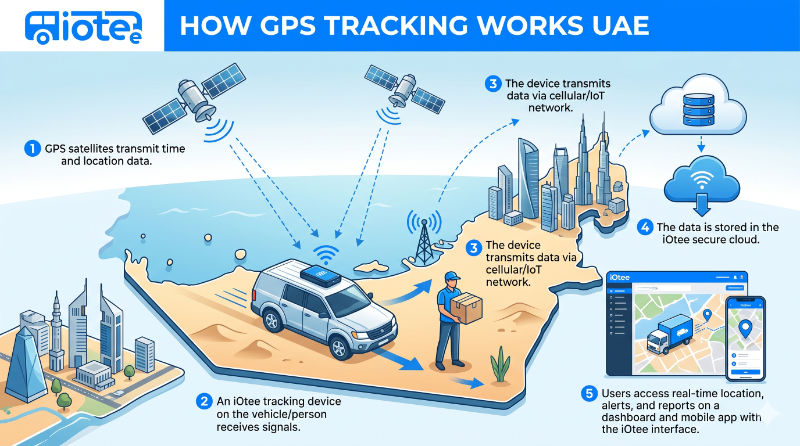
A car GPS tracker is a small device fitted to your car that keeps reporting its live location, movement and alerts to an app on your phone. For UAE drivers it covers three jobs. It protects the car from theft. It helps you get the car back quickly if someone takes it. And it shows you how and where the car is being driven, whether that's by a teenager, a relative, a hired driver or the valet.
Theft rates in the UAE are low compared with most countries. A tracker still makes sense, for two reasons. Cars here are expensive, and when one does go missing (stolen, driven toward a border, or just taken somewhere it shouldn't be) the first 30 minutes decide whether you get it back. With a tracker you aren't guessing. You're looking at a live map and calling the police with an exact location.
Most owners actually fit one for everyday reasons. They want to know a new driver isn't speeding, find the car in a huge mall car park, get a ping if it leaves a set area, or keep a full trip history. A decent tracker costs less per month than one tank of fuel, and the simpler types go in within minutes.
Below you'll find the four types of car GPS tracker, how recovery really works, 2026 UAE prices, the SecurePath rules for private cars, and how to choose the right unit for your car. If you'd rather have someone fit and manage it for you, IOTee's personal vehicle tracking service covers the whole UAE.
What a Car GPS Tracker Actually Does (Beyond a Dot on a Map)
The Core Capabilities Worth Paying For
A good car tracker should do a lot more than show a dot on a map. For a personal car in the UAE, these are the features worth paying for:
- Real-time location: live position every few seconds in a phone app, instead of where the car was ten minutes ago.
- Theft and movement alerts: a push notification the moment the car moves when it shouldn't, or the ignition comes on without you.
- Geofencing: draw a zone (home, school, the emirate boundary) and get told when the car enters or leaves it.
- Speed and driving alerts: find out when a teen or driver goes past a speed you've set, which matters on UAE highways.
- Trip history: every journey, route and stop, kept for weeks.
- Recovery mode: live tracking you can share straight with the police.
- Engine immobilisation (some hardwired units only): cut the starter remotely so a thief can't drive off.
What separates a toy from a proper tracker is live accuracy and alerts you can rely on. If the device only updates every few minutes, or the alerts arrive late, it lets you down at exactly the moment you need it. IOTee's real-time GPS tracking platform runs on live, second-by-second updates instead of occasional pings.
The 4 Types of Car GPS Tracker — Which One for Your Car?
Plug-In, Hardwired, Magnetic, or App-Based
There are four common designs. Which one suits you depends on what you care about most: an easy install, hidden anti-theft protection, or something you can move around.
OBD plug-in trackers go into the car's OBD-II diagnostic port under the dashboard. They take seconds to fit, need no wiring and draw power from the car, so you never charge them. The downside is that a thief can find one and pull it out just as fast, so they're better for keeping an eye on a driver than for stopping theft. They suit teen or new-driver monitoring, quick DIY setups and people renting a car.
Hardwired hidden trackers are wired into the car's electrics by an installer and tucked out of sight. They're always powered, hard to tamper with, and can include a remote engine cut-off. For theft recovery nothing beats them, because a thief can't find and remove one in a hurry. If your car is valuable or theft is your main worry, this is the one. It's also the heart of IOTee's personal vehicle tracking install.
Magnetic or portable battery trackers are self-contained. You stick one under a seat, in the boot, or magnetically on the chassis, with no wiring at all. You can move it between cars, a caravan, or even valuables. The catch is charging: battery life runs from days to months depending on how often it reports. They're good as a hidden backup, for short-term use, or for owners who don't want anything wired in. See portable GPS tracking.
Then there's the app-only option, which relies on a phone left in the car. It costs nothing in hardware and isn't reliable. Someone can take the phone, the battery dies, and there's no immobiliser. Treat it as a temporary stopgap when there's no budget.
Our advice is simple. If theft and recovery are the point, get a hidden hardwired tracker. If you mostly want to watch a driver or need something portable, an OBD or magnetic unit will do. Plenty of owners run a hardwired unit plus a hidden magnetic backup, so if a thief finds one, the other keeps reporting.
Car Theft in the UAE: How a Tracker Gets Your Car Back
The Recovery Sequence, Step by Step
When a tracked car is stolen or taken without permission, recovery tends to follow the same steps, and each one needs live data.
It starts with the alert. As soon as the car moves unexpectedly or the ignition comes on, the tracker pushes a notification to your phone, and catching it in those first minutes matters more than anything that follows.
Next you open the app and watch the car move: the exact street, its speed, the direction it's heading. No guesswork.
If your hardwired unit has a remote relay, you can cut the starter. Once the car stops, it won't restart, and the thief is stuck.
Then you hand over to the police. UAE police move quickly when you give them a live, precise location, and sharing the real-time position turns a vague report into an exact address. That's much faster than waiting on CCTV footage or witnesses.
Borders are the last piece. Geofencing tells you the instant the car gets near an emirate or national boundary, and a car heading for a border needs action straight away.
This is why a hidden hardwired tracker matters. If the thief finds a plug-in OBD unit and rips it out, your only signal is gone. A concealed, always-on tracker keeps reporting through the whole recovery. For coverage across the country and into Oman, a dual-network connection keeps the signal going in patchy areas. It's the same backbone behind IOTee's GPS tracking across the UAE.
Beyond Theft: Everyday Reasons UAE Drivers Fit a Tracker
It Is Not Just About Stolen Cars
Most UAE owners end up using their tracker for ordinary things far more often than for theft:
- New and teen drivers: a speed alert when a young driver goes past the limit you set, and a clear view of where they actually went. It does encourage safer driving.
- Families and shared cars: when several relatives or a hired driver use one car, everyone can see where it is without phoning around.
- Elderly relatives: a quiet confirmation that a parent got where they were going.
- Finding the car: locate it straight away in a massive mall or airport car park.
- Workshops and valets: check the car wasn't taken for a joyride while it was at the garage or with valet parking.
- Long trips away: leave the car at the airport for weeks and get an alert if it moves at all.
- Insurance: some UAE insurers give premium discounts for cars with an approved tracker, so ask yours.
Those everyday uses are why a tracker pays for itself in convenience long before it ever helps recover a stolen car. If your household runs more than one car, you can usually manage them all on one account. The personal vehicle tracking page shows how that works.
SecurePath & Asateel: Does a Private Car Need a Tracker by Law?
Mandatory vs Voluntary Tracking for Personal Vehicles
The UAE's GPS tracking mandates, SecurePath in Dubai and Asateel in Abu Dhabi, apply mainly to commercial vehicles, rental cars, heavy vehicles, school buses and certain regulated fleets. Ordinary private cars generally fall outside them. So if you own and drive a personal car, a tracker is almost always voluntary. You fit it for security and convenience because you want to, and the law doesn't require it.
There are two caveats.
- If your 'personal' car is really a rental, a lease, or registered commercially, the mandatory rules may apply, and the tracker has to be an approved, registered device.
- Rules change. Who must comply, which devices are approved, and how registration and yearly renewal work are all covered in our SecurePath, SIRA & Asateel compliance guide.
Even when nobody requires it, we'd still fit an approved-grade tracker on a private car. You get the same recovery capability the regulators designed those programmes around, and if your car's status ever changes, the device already meets the standard. If you're comparing options across personal and commercial use, the wider GPS tracking systems buyer's guide goes through every category.
Protect Your Car from AED 500/Year
Hidden GPS tracker with theft alerts, live tracking and family sharing, fitted by a professional installer.
How to Choose a Car GPS Tracker in the UAE (Checklist)
10 Things to Check Before You Buy
Run any car tracker you're considering in the UAE against this list:
- Real-time updates: every few seconds while the car is moving. Every few minutes isn't good enough.
- Alerts that arrive: movement, ignition, speed and geofence alerts that reach your phone instantly.
- Heat rating: a UAE summer pushes a parked car's interior past 70°C, so the tracker has to be rated to survive it and still be working in August.
- Dual-network coverage: Etisalat and du failover so the signal gets through tunnels, underground parking and cross-emirate drives.
- Battery life (portable units): match the reporting frequency to how often you'll actually recharge.
- A decent app: a clean iOS or Android app with map, history and alert settings that you'll really open.
- Immobiliser option: for serious anti-theft, a hardwired unit that supports a remote cut-off.
- Clear subscription pricing: know the monthly or yearly SIM and platform fee before you buy. Cheap hardware on an expensive plan is a trap.
- No lock-in and local support: a UAE team for install and help, and the right to keep your data and account.
- A hidden install: for anti-theft, the device has to be out of sight. One sitting in the OBD port won't do.
If a tracker fails any of the first three (real-time updates, reliable alerts, heat rating) it isn't fit for UAE conditions, however cheap it is. If you want a vetted local option, IOTee installs and supports trackers in Dubai, Abu Dhabi, Sharjah and every other emirate. Our ranking of the best GPS tracking companies in the UAE explains how to judge providers.
Car GPS Tracker Price in the UAE (2026)
What a Tracker Actually Costs
You pay for a car GPS tracker in the UAE in two parts: the device and installation once, then an ongoing subscription for the SIM and the tracking platform.
One-off hardware and installation:
• OBD plug-in tracker: AED 150-400, and you fit it yourself.
• Magnetic or portable battery tracker: AED 200-600, with nothing to install.
• Hardwired hidden tracker: AED 300-800 for the device, plus AED 100-250 for installation depending on how it's hidden and whether the immobiliser is wired in.
The subscription is usually AED 20-60 a month, or about AED 200-500 a year if you pay up front. Plans with an immobiliser, longer history or premium support sit toward the top of that range.
Add it up and a good hardwired car tracker with real-time tracking and recovery usually comes to AED 600-1,400 in the first year, then just the subscription after that. Compared with the value of the car it's guarding, and the daily convenience, that's cheap security. Be wary of rock-bottom 'lifetime free' trackers. The hardware is often poor, and the 'free' service has a habit of quietly stopping. For a fuller cost breakdown across tracker tiers, see the GPS tracking buyer's guide.
Installation: DIY or Professional?
Which Trackers You Can Fit Yourself
How hard the install is depends completely on the type.
An OBD plug-in is pure DIY: find the OBD-II port under the dashboard, plug it in, activate the app. About two minutes. A magnetic or portable unit is DIY too. Charge it, hide it under a seat or in the boot, switch it on. No tools needed.
Hardwired hidden units are a job for a professional. The tracker gets wired into the car's electrics and concealed, and if you want remote engine immobilisation, it has to be connected to the starter circuit properly. That clean, hidden install is what makes it work against theft, so don't cut corners here.
For anti-theft, professional hidden installation is really the whole point. A tracker a thief can spot and yank out in five seconds protects nothing. IOTee does concealed installs across the UAE as part of personal vehicle tracking, and also offers a no-wiring magnetic tracker if you'd prefer that. Local install and support is available in Dubai and Sharjah, among other emirates.
Frequently Asked Questions: Car GPS Tracker UAE
How much does a car GPS tracker cost in the UAE?
Budget AED 150-400 one-off for an OBD plug-in, AED 200-600 for a magnetic or portable unit, or AED 300-800 plus AED 100-250 installation for a hidden hardwired tracker. The tracking subscription (SIM plus platform) is about AED 20-60 a month, or AED 200-500 a year paid in advance. A good hardwired car tracker with real-time tracking usually costs AED 600-1,400 in year one, and after that you only pay the subscription.
Can a GPS tracker help recover a stolen car in the UAE?
Yes. A real-time tracker alerts you the moment the car moves unexpectedly, shows you its live location street by street, and lets you pass that exact position to UAE police so they can recover it quickly. Hardwired units can also cut the engine remotely so the thief can't restart the car, and geofencing warns you as soon as the car gets near an emirate or national border. A hidden, always-on tracker does far more for recovery than a plug-in unit that a thief can find and pull out in seconds.
What is the best type of GPS tracker for a personal car?
If you want real anti-theft protection and recovery, go for a hardwired hidden tracker. It's concealed, always powered, hard to tamper with, and it can immobilise the engine. If you just want to keep an eye on a teen or new driver, an OBD plug-in is easier and cheaper. For something portable or a hidden backup, a magnetic battery tracker works without any wiring. Lots of UAE owners pair a hardwired main unit with a hidden magnetic backup, so the car can still be tracked if one device is found.
Is it legal to put a GPS tracker on a car in the UAE?
Yes. You can legally fit a GPS tracker to a car you own. Tracking your own car, or a company car when drivers have been properly told about it, is standard practice. Mandatory programmes such as SecurePath (Dubai) and Asateel (Abu Dhabi) cover mainly commercial, rental and regulated vehicles, and ordinary private cars generally fall outside them. If you want to track a car you don't own, get the owner's consent and handle the personal data responsibly under UAE Federal Decree-Law No. 45 of 2021.
Do GPS trackers work in UAE summer heat and underground parking?
Good trackers are rated to keep running through UAE summer cabin temperatures above 70°C. Cheap ones aren't, and many die by mid-summer, so check the heat rating before you buy. In underground or covered parking where the satellite signal is weak, a good tracker falls back on cell-tower location and reports the last known position, then updates as soon as the car is back under open sky. Dual-network coverage (Etisalat plus du) keeps it connected through tunnels and dead zones.
Can I track my car from my phone in real time?
Yes. A modern car GPS tracker works with an iOS or Android app that shows your car's live location every few seconds, along with trip history, speed, and instant alerts for movement, ignition or leaving a geofenced zone. You can check it from anywhere, share a live link, and choose which notifications you get. The one thing to confirm before buying is real-time updating. Avoid devices that only refresh every few minutes.
Protect Your Car Today
Your Next Step
For the money, a car GPS tracker is about the best upgrade you can make to a car in the UAE. It protects against theft, speeds up recovery if the worst happens, and makes daily life easier for family, drivers and parking. Your decision comes down to two questions. Do you want hidden anti-theft protection (a hardwired tracker) or easy monitoring and portability (an OBD or magnetic unit)? And is the device real-time, heat-rated and properly supported here?
IOTee fits and manages car GPS trackers across Dubai, Abu Dhabi, Sharjah, Ajman, Ras Al Khaimah, Fujairah, Umm Al Quwain and Oman, from one family car to several cars on a single account. Start with personal vehicle tracking for a hidden, professionally fitted setup, or pick a portable magnetic tracker if you'd rather avoid wiring. If you want camera protection as well, read why many UAE drivers pair a tracker with a dash camera. Your car is probably one of the biggest things you own. For about the price of a tank of fuel a month, you'll always know where it is.