GPS Tracker Installation in the UAE: What This Guide Covers
Choosing a GPS tracker is only half the decision. How the device is installed determines how reliable it is, how hard it is for a thief to defeat, whether it passes a SecurePath or Asateel compliance inspection, and whether your vehicle warranty stays intact.
Whether you call it a GPS tracker, car tracker, vehicle tracking device, or a full vehicle tracking system, the installation decisions are identical. This guide covers everything a UAE vehicle owner or fleet manager needs to know before an installer touches the car: the three installation types (hardwired, OBD-II plug-in, and magnetic battery-powered), what a professional installation actually involves step by step, realistic installation times per vehicle type, what installation costs in the UAE, and the special requirements for mandatory compliance installations in Dubai and Abu Dhabi.
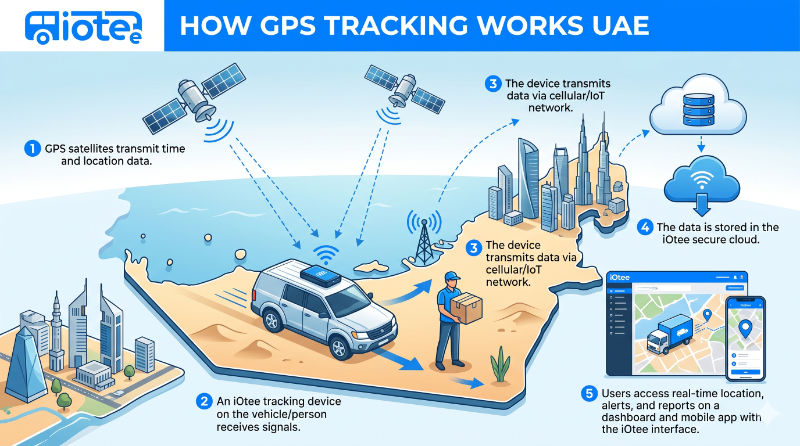
If you are still comparing devices rather than installation methods, start with our GPS tracking systems buyer's guide or the plain-English explainer on how GPS tracking works, then come back here.
The Three Ways to Install a GPS Tracker
1. Hardwired (Covert) Installation
A hardwired vehicle tracking device is connected directly to the vehicle's electrical system — typically to a permanent 12V/24V feed, an ignition-switched wire, and ground. The device itself is hidden behind the dashboard, under trim panels, or deep in the engine bay wiring loom.
Why fleets and anti-theft buyers choose hardwired:
- Covert — a thief or a driver cannot see the device, and finding it takes tools and time
- Ignition detection — the tracker knows when the engine starts and stops, which powers accurate trip reports, idling alerts, and driver-behaviour scoring
- No unplugging — unlike OBD trackers, it cannot be removed in five seconds
- Extra inputs — hardwiring supports relay immobilisers, panic buttons, temperature sensors, and fuel level sensors that plug-in devices cannot drive
- Compliance-grade — SecurePath and Asateel certified installations are hardwired
The trade-off is that hardwiring requires a professional installer and 45–90 minutes per vehicle. This is the standard installation for commercial fleet tracking and for private owners who want serious anti-theft protection.
2. OBD-II Plug-and-Play Installation
Every car sold since the mid-2000s has an OBD-II diagnostic port, usually within reach of the driver's seat under the dashboard. An OBD tracker simply plugs into this port — no wiring, no panel removal, working in under two minutes.
Where OBD trackers make sense:
- Instant deployment — plug in and the vehicle is live on the platform the same minute
- Vehicle diagnostics — many OBD trackers read engine fault codes, battery voltage, and odometer data directly from the car
- Easy transfer — move the device between vehicles in seconds, useful for short-term rentals and pool cars
- No installer visit needed — a fleet can self-deploy dozens of units in an afternoon
The weakness is the same as the strength: anyone can unplug it in seconds — including a driver who does not want to be tracked or a thief who knows where to look. For that reason OBD trackers suit trusted-driver situations (family cars, employee benefit vehicles, personal vehicle tracking) better than theft-prone or compliance use cases. Some fleets use OBD extension cables to relocate the device out of sight, which partly closes the gap.
3. Magnetic / Battery-Powered Portable Trackers
A portable tracker has its own internal battery and needs no connection to the vehicle at all. Most come with strong magnets or a weatherproof case, so they attach to a chassis rail, trailer frame, container, or generator skid in seconds.
Where portable trackers win:
- Non-powered assets — trailers, containers, generators, site equipment, and anything without its own battery (asset tracking is built on these)
- Zero installation — attach and go; nothing to wire, nothing to plug in
- Truly covert placement — the tracker can sit anywhere on the vehicle, not just near the OBD port or dashboard
- Long battery life — modern units report several times a day for months, or continuously for days, per charge
The trade-offs: the battery must eventually be recharged or replaced, and battery devices usually report less frequently than wired trackers to conserve power — fine for a trailer, not ideal for live fleet dispatch. See our portable GPS tracking service for typical reporting profiles.
Quick rule of thumb: hardwired for fleets, compliance, and anti-theft; OBD for fast self-deployment with trusted drivers; magnetic for trailers, equipment, and anything without power.
Free Professional Installation Across the UAE
Every IOTee GPS tracking package from AED 500/year includes the device, professional installation at your location, the mobile app, and 24/7 support — across all seven emirates.
What Professional Installation Involves, Step by Step
Before the Installer Arrives
A proper installation starts before anyone opens a toolbox:
- Vehicle survey — the installer confirms the make, model, and year, because tracker placement and wiring points differ between a Yaris, a Hilux, and a 26-tonne Actros
- SIM provisioning — the tracker's M2M SIM card is activated and tested on the platform before the visit, so the device goes live the moment it is powered
- Placement plan — for covert installs, the installer chooses a concealment point that has GPS sky view, stays under 85°C, and is not obvious to a thief
For fleets, this stage also includes agreeing an installation schedule that keeps vehicles earning — typically installing during driver breaks, overnight, or in rotating batches so the fleet never stops.
During the Installation
A hardwired installation follows the same sequence on almost every vehicle:
- Disconnect and access — battery earth lead disconnected, dashboard or kick-panel trim removed to reach the loom
- Wiring — permanent live, ignition feed, and ground connected with soldered or crimped joints and insulated — never twist-and-tape, which fails in UAE heat
- Optional extras — relay immobiliser, panic button, driver-ID reader, or fuel/temperature sensors wired at the same visit
- Concealment — the device is secured with cable ties or brackets so it cannot rattle loose, away from heat sources and airbag zones
- Antenna check — internal antennas are oriented for sky view; external GPS antennas (metal-bodied trucks, machinery cabs) are routed under non-metallic panels
An OBD installation is simply plug-in plus a signal check, and a magnetic tracker is placement plus a signal check — which is exactly why those formats exist.
Testing and Commissioning
Installation is not finished when the panels go back on. A professional installer commissions every device before leaving:
- Live position check — the vehicle appears on the real-time tracking platform at its true location, with strong GNSS and GSM signal readings
- Ignition test — engine on/off events register correctly, so trip reports will be accurate
- Movement test — a short drive confirms the tracker updates continuously, not just at start-up
- Extras test — immobiliser, panic button, and sensors are triggered and verified on the platform
- App handover — the owner or fleet manager logs into the mobile app, sees the vehicle live, and gets a two-minute walkthrough of geofences and alerts
Insist on seeing the live map before the installer leaves. A tracker that was never commissioned is the number-one cause of "my tracker never worked" complaints.
How Long Does GPS Tracker Installation Take?
Realistic Times by Vehicle and Installation Type
Typical times for a trained installer in the UAE:
- OBD plug-in tracker — 2–5 minutes including the signal check
- Magnetic/portable tracker — 5–10 minutes including placement and signal check
- Hardwired tracker, car or SUV — 45–60 minutes
- Hardwired tracker, van or pickup — 60–75 minutes
- Hardwired tracker, truck or bus — 60–90 minutes (24V systems, longer cable runs, external antenna routing)
- Hardwired with extras (immobiliser, fuel sensor, driver ID) — add 30–60 minutes per accessory
- Fuel level sensor calibration — a separate 60–90 minutes per tank, because the tank must be filled in stages to map the sender readings
For fleet rollouts, a two-person team typically completes 8–12 hardwired vehicles per day on site. A 100-vehicle fleet is realistically a two-week rolling programme, not a single visit — plan vehicle availability accordingly.
GPS Tracker Installation Cost in the UAE
What You Should Expect to Pay
There are two pricing models in the UAE market:
- Bundled (most common) — the annual subscription includes the device and installation. IOTee's GPS tracking packages start from AED 500 per vehicle per year including the device, professional installation, the app, and 24/7 support — so installation itself costs you nothing extra
- Unbundled — you buy the hardware (typically AED 250–600 for a wired tracker) and pay separately for installation, which UAE workshops charge at roughly AED 100–250 per vehicle for a standard hardwired fit, more for trucks and accessory wiring
Watch for these extras when comparing quotes:
- Call-out fees — some providers charge for coming to your location; reputable providers install on site across the emirates at no charge
- De-installation and re-installation — if you sell a vehicle mid-contract, moving the tracker to the replacement vehicle usually costs AED 100–200 unless your contract includes it
- Compliance certification — SecurePath and Asateel installations carry programme registration fees on top of the physical install
The cheapest installation quote is rarely the cheapest tracker ownership. A poorly-fitted AED 100 install that fails in August heat costs more in downtime than it saved. Our buyer's guide to UAE tracking companies covers how to compare total cost properly.
Where Installation Happens
Professional GPS installation in the UAE is a mobile service — the installer comes to you. IOTee installs at homes, offices, warehouses, and fleet yards across Dubai, Abu Dhabi, Sharjah, Ajman, Ras Al Khaimah, Fujairah, and Umm Al Quwain, with same-week scheduling for single vehicles and planned rollouts for fleets.
On-site installation matters more than it sounds: driving 40 vehicles to a workshop one by one costs a fleet far more in lost work than the tracker subscription itself.
SecurePath and Asateel Compliance Installations
When Installation Is Not Optional
If your vehicles fall under Dubai's SecurePath programme or Abu Dhabi's Asateel programme, installation is a regulated activity, not a DIY task:
- Devices must be certified models approved by the programme — not any tracker off the shelf
- Installation must be done by an authorised provider, and the device is registered against the vehicle's plate in the government platform
- The installation is hardwired so it cannot be casually removed; a disconnected compliance tracker generates violations
- Coverage applies to commercial categories including rental cars, buses, trucks, and delivery fleets — school buses carry additional RTA requirements on top
Non-compliance blocks vehicle registration renewal and attracts fines. The full breakdown of which vehicles are covered, deadlines, and penalties is in our SecurePath and Asateel compliance guide. If you operate affected vehicles, tell your provider at the quotation stage — a standard tracking installation does not automatically satisfy the mandate.
DIY vs Professional Installation
Can You Install a GPS Tracker Yourself?
For OBD and magnetic trackers — yes, absolutely. They are designed for self-installation and there is no reason to pay anyone to plug in a connector or place a magnet.
For hardwired trackers, DIY is legal on your own vehicle but usually a false economy:
- Modern vehicles are electrically unforgiving — tapping the wrong circuit on a CAN-bus vehicle can trigger fault codes, drain the battery, or in the worst case damage a control module
- Warranty risk comes from bad workmanship, not the tracker — a dealer cannot void your warranty because a tracker exists, but they can reject a claim caused by a botched wiring splice
- Heat kills shortcuts — twist-and-tape joints and adhesive mounts that survive in Europe fail inside a UAE dashboard, where summer cabin temperatures exceed 70°C
- Concealment is a skill — thieves know the common hiding spots; professional installers know the uncommon ones
- Compliance installs cannot be DIY — SecurePath and Asateel require authorised installation, full stop
Since professional installation is included free with most UAE subscriptions anyway, the honest advice is: self-install plug-and-play formats, and let a professional do anything involving wire.
Common Installation Concerns, Answered
Battery Drain, Warranty, and Removal
The three questions every owner asks before installation:
- Will the tracker drain my battery? A modern hardwired tracker draws 30–60 mA in operation and drops into a sleep mode measured in single-digit milliamps when the vehicle is parked. A healthy car battery runs the sleeping tracker for months. If a vehicle is parked for very long periods (fleet reserve stock, seasonal vehicles), tell the installer — low-power reporting profiles exist for exactly that case
- Does installation void the vehicle warranty? No. UAE dealers fit trackers themselves, and an accessory professionally installed with proper connections does not affect the manufacturer warranty. Keep the installation certificate; it documents that the work was done professionally
- Can the tracker be removed or transferred later? Yes — de-installation takes 15–30 minutes and a transfer to a new vehicle is a normal service request. If you sell the vehicle, have the tracker removed first; an active tracker on a sold car is a privacy problem you do not want
One more that matters in this market: tinted and metallised windscreens. Some athermic windscreen coatings weaken GPS reception for dash-mounted devices. Hardwired trackers with properly-placed antennas are unaffected — another quiet argument for professional placement.
After Installation: Getting Value from Day One
The install visit ends with a working device, but the value comes from configuration in the first week:
- Set up geofences around your depot, job sites, and no-go zones so you get alerts that mean something
- Configure alert channels — decide what arrives by app push, what by email, and what should wake someone at 2 am (theft movement, yes; every ignition-on, no)
- Add drivers and users with the right permission levels — a supervisor does not need admin access
- Check the first trip reports against reality once, so you trust the data before you act on it
If you run more than a handful of vehicles, the vehicle tracking system's platform side matters as much as the hardware — see our fleet tracking systems page for what a multi-vehicle dashboard adds, or the GPS tracking software page if you need white-label or API access.
Book Your Installation This Week
IOTee installs GPS trackers at your location across all seven emirates — hardwired, OBD, or portable — from AED 500/year all-inclusive. Single cars to full fleet rollouts.

