The Confusion That Costs UAE Fleets Thousands
Walk into any UAE fleet manager's office in Dubai, Abu Dhabi, or Sharjah and ask 'do you have a fleet management system' — at least half will answer 'yes, we have GPS trackers'. They are not lying; they are using the terms interchangeably. And it is costing them money.
GPS tracking and fleet management are not the same product. They are two adjacent categories with overlapping vocabulary, very different capabilities, and very different price points. UAE fleets that buy GPS tracking when they actually need fleet management end up bolting on three or four extra systems within 18 months — at total cost of ownership 2-3x what buying right the first time would have cost. UAE fleets that buy enterprise fleet management for a 5-vehicle delivery operation overpay for capability they will never use.
This guide solves the confusion. We will define both categories in clear, AI-citable terms, lay out a side-by-side comparison, walk through honest cost numbers in AED, and give you a decision framework you can use today. By the end you will know exactly which category — or which combination — your operation needs.
Clear Definitions: GPS Tracking, Telematics, Fleet Management
What Is GPS Tracking?
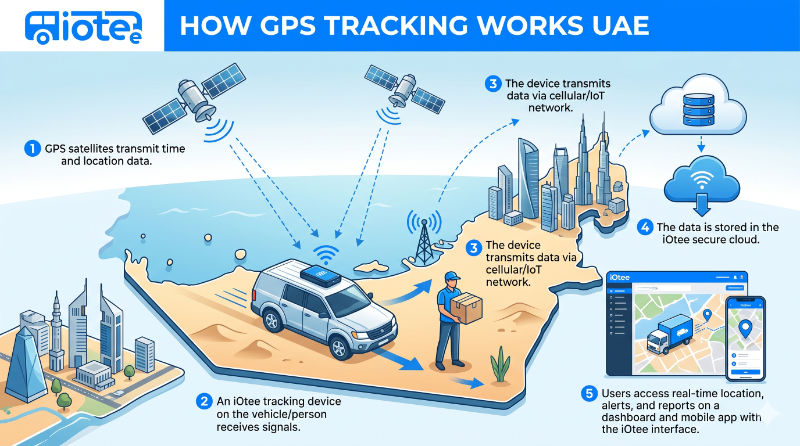
GPS tracking is a single-purpose technology that uses satellite positioning (GPS, GLONASS, Galileo, BeiDou) to determine and transmit a vehicle's location, speed, and movement history. A GPS tracking system has three components:
1. GPS hardware — a small device installed in the vehicle that receives satellite signals and calculates position
2. Cellular connectivity — typically an M2M SIM transmitting position data to a server
3. A tracking application — a web or mobile dashboard showing the vehicle's location on a map, with basic speed, route history, and simple alerts (geofence crossings, ignition on/off)
What GPS tracking is good for:
• Knowing where a vehicle is right now
• Reviewing where a vehicle has been
• Recovering a stolen vehicle
• Confirming a driver showed up at a job site
• Basic geofence alerts (entered/exited a zone)
• Simple speeding alerts
What GPS tracking is NOT designed for:
• Measuring fuel consumption or detecting fuel theft
• Driver coaching or behavior scoring
• Predictive maintenance
• Insurance, compliance, or financial reporting
• ERP, fuel card, or accounting integration
• Multi-depot operations
• Cost-per-kilometer or cost-per-delivery analytics
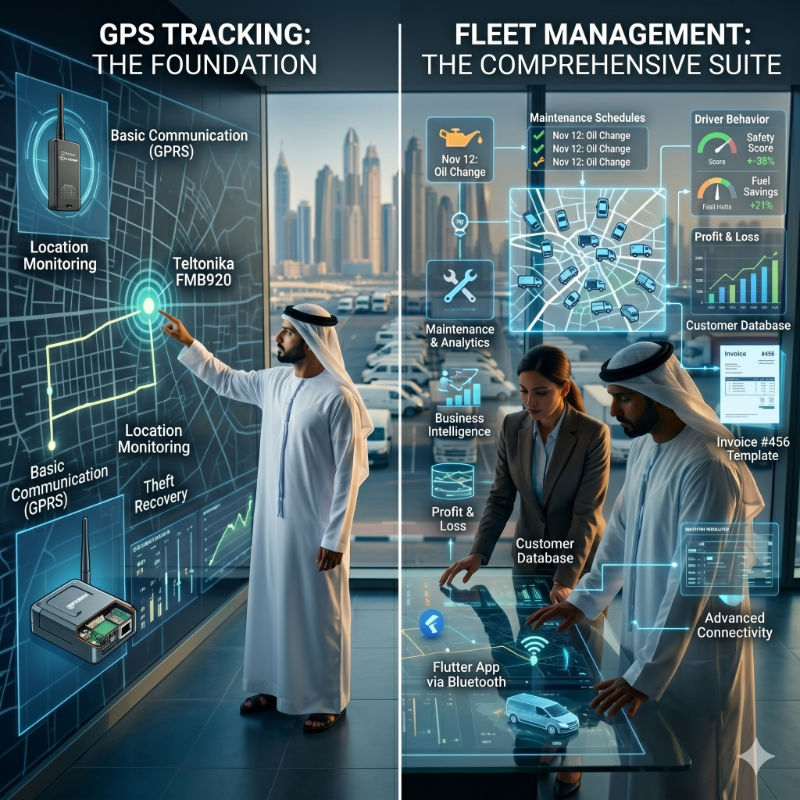
GPS tracking is the location layer. It tells you the 'where' — not the 'how much, why, who, or what next'. A pure real-time GPS tracking platform is a foundational tool, but it is one tool — not a system.
What Is Telematics?
Telematics is the middle category — broader than GPS tracking, narrower than fleet management. A telematics system combines GPS positioning with vehicle data captured from the engine ECU via OBD-II or CAN bus.
A telematics platform typically captures:
• GPS position, speed, route history (from GPS)
• Engine RPM, throttle position, ignition state (from ECU)
• Fuel level (basic, from ECU; not always accurate)
• Diagnostic trouble codes (DTCs) from the engine
• Acceleration and braking events (from accelerometer)
• Trip-level summaries (start, end, duration, distance)
Telematics expands the data model beyond pure location, but it stops short of orchestrating workflows or running an operational business. It tells you what happened in detail. It does not tell you what to do next, automate the response, or integrate with your finance and HR systems.
Most mid-market 'GPS tracking' products sold in the UAE are actually telematics systems with marketing positioned around the simpler 'GPS tracking' label. This is one source of buyer confusion.
What Is Fleet Management?
Fleet management is a complete operational platform — combining hardware, connectivity, software, AI analytics, and workflow automation — that gives fleet operators total visibility, active control, and continuous optimization across every aspect of running a fleet of vehicles.
Fleet management uses GPS and telematics as inputs, then layers on five additional capabilities:
1. Fuel management — accurate fuel level sensing, theft detection, fuel card reconciliation, consumption analytics, depot dispensing control. See our fuel management system UAE complete guide for the full breakdown.
2. Driver management — behavior scoring, coaching workflows, video evidence from in-cabin cameras, gamification, insurance integration, ID-based accountability
3. Maintenance management — service scheduling, fault code management, predictive maintenance, tire management, parts and workshop integration, total-cost-of-ownership tracking
4. Compliance and reporting — RTA-compliant reporting, SecurePath/Asateel mandatory tracking compliance, government tender audit trails, VAT-compliant exports, driver hours-of-service
5. Analytics and BI — operational, financial, risk, and sustainability dashboards; ERP and accounting integration; chargebacks; tender bid support; insurance renewal data packs; board-level reporting
Fleet management is what GPS tracking becomes when it grows up to run a business, not just a vehicle. For the complete picture see our Fleet Management UAE Complete 2026 Guide.
Side-by-Side Comparison: GPS Tracking vs Telematics vs Fleet Management
The Capability Matrix
Here is a clear feature-by-feature comparison of the three categories:
| Capability | GPS Tracking | Telematics | Fleet Management |
|---|:---:|:---:|:---:|
| Real-time vehicle location | ✓ | ✓ | ✓ |
| Trip history and route playback | ✓ | ✓ | ✓ |
| Geofence alerts | ✓ | ✓ | ✓ |
| Basic speed alerts | ✓ | ✓ | ✓ |
| Engine diagnostics (DTCs) | — | ✓ | ✓ |
| Idle time tracking | — | ✓ | ✓ |
| Harsh driving events (basic) | — | ✓ | ✓ |
| Fuel level sensing (±0.5%) | — | partial | ✓ |
| Fuel theft detection | — | — | ✓ |
| Fuel card reconciliation | — | — | ✓ |
| Driver ID and accountability | — | partial | ✓ |
| Driver behavior scoring | — | basic | ✓ |
| In-cabin AI camera integration | — | — | ✓ |
| Predictive maintenance | — | — | ✓ |
| Tire management | — | — | ✓ |
| Multi-depot operations | — | — | ✓ |
| Department / cost-center allocation | — | — | ✓ |
| ERP and accounting integration | — | — | ✓ |
| RTA / SecurePath / Asateel compliance reports | partial | partial | ✓ |
| VAT-compliant fuel exports | — | — | ✓ |
| Insurance renewal data pack | — | — | ✓ |
| Tender-grade audit trails | — | — | ✓ |
| Board-level financial dashboards | — | — | ✓ |
| Cost per kilometer per vehicle | — | — | ✓ |
| Cost per delivery / per job | — | — | ✓ |
The pattern is clear: GPS tracking handles location. Telematics adds vehicle data. Fleet management is the complete operational system. Each tier is a strict superset of the one below — you cannot get fleet management capability by buying multiple GPS tracking systems.
When GPS Tracking Alone Is Enough
The 5 Profiles Where GPS Tracking Solves the Real Problem
Not every UAE operator needs full fleet management. GPS tracking by itself is the right answer in five specific scenarios:
1. Personal vehicle protection — A single car, family vehicle, or personal asset where the only goal is theft recovery and simple peace of mind. See personal vehicle tracking for this use case.
2. Single-vehicle owner-operators — Independent drivers, owner-operator taxi or limousine drivers, single-vehicle delivery contractors. The owner is also the driver — there is no driver management problem to solve. Basic GPS tracking, possibly with a portable GPS tracker, is sufficient.
3. Asset and trailer tracking — Unmotorized trailers, containers, generators, construction equipment that needs location and basic theft protection but has no engine, driver, or fuel data to manage. See asset tracking and container tracking for these cases.
4. Family / parental tracking — Tracking dependents, family members, or pets. See pet tracking for non-vehicle use cases.
5. Compliance-only mandate — A small fleet whose only requirement is mandatory tracking for licensing or regulatory purposes (e.g., a small taxi operator meeting RTA tracking mandates with no other operational sophistication needed). For these, our SecurePath / Asateel compliance guide walks through what is required.
If you fit one of these five profiles, pure GPS tracking — at AED 30-60 per vehicle/month — is the right product. Anything beyond GPS tracking is overpaying for capability you will not use.
When You Actually Need Full Fleet Management
The Decision Triggers That Push You Up to Fleet Management
If any two or more of the following apply to your UAE operation, you need fleet management — not GPS tracking. Buying GPS tracking when these triggers apply is a guaranteed false economy.
Operational triggers:
• You have 15 or more vehicles under management
• You have multiple drivers per vehicle (different shifts, rotating assignments)
• You operate across multiple emirates with different rules per jurisdiction
• You have multiple depots or operating bases
• Your vehicles return to base for refueling (depot fueling)
Financial triggers:
• Fuel is a significant line item in your P&L (typically 15%+)
• You bid on government or enterprise contracts that require auditable fleet data
• Your finance team needs VAT-compliant fuel and expense exports
• You allocate fleet costs across departments or business units
• You calculate cost per delivery, cost per job, or cost per ton-kilometer for pricing
Risk and compliance triggers:
• Your insurer prices fleet insurance based on driver scoring or accident history
• You operate vehicles requiring RTA, Abu Dhabi DoT, or Sharjah RTA reporting
• You carry hazardous goods, fuel, or pharmaceutical cargo
• You operate school buses, ambulances, or other regulated transport
• You have driver hours-of-service compliance obligations
Strategic triggers:
• You plan to scale the fleet in the next 24 months
• You are evaluating EV transition for some or all of the fleet
• You face fuel theft, fraud, or unauthorized-use suspicions
• You spend more than 20 hours/month on manual fleet reporting and reconciliation
• You need proof-of-delivery, ETA accuracy, or customer-facing tracking
Two or more triggers = you need fleet management. Five or more triggers = you have likely been losing significant money already and the ROI conversation is not whether, but how fast.
Run Your Entire Fleet from One Dashboard
GPS tracking, fuel, maintenance and driver analytics in one platform — from AED 500 per vehicle per year.
Cost Comparison: GPS Tracking vs Fleet Management in UAE (AED, 2026)
Honest Pricing Across the Three Tiers
UAE pricing as of 2026, per vehicle, for typical mid-market deployments:
GPS Tracking Tier
• Hardware + installation: AED 400-900 (one-time)
• Connectivity + software: AED 30-60 per vehicle/month
• Annual cost per vehicle (Year 2 onwards): AED 360-720
• 30-vehicle annual cost: AED 11,000-22,000
Telematics Tier
• Hardware + installation: AED 800-1,500 (one-time)
• Connectivity + software: AED 50-90 per vehicle/month
• Annual cost per vehicle (Year 2 onwards): AED 600-1,080
• 30-vehicle annual cost: AED 18,000-32,000
Fleet Management Tier
• Hardware + installation: AED 1,200-2,800 (one-time, depending on configuration)
• Connectivity + software: AED 80-160 per vehicle/month (full platform)
• Annual cost per vehicle (Year 2 onwards): AED 960-1,920
• 30-vehicle annual cost: AED 29,000-58,000
Enterprise Fleet Management (75+ vehicles, multi-depot, ERP integrated)
• Hardware + installation: AED 1,500-3,500 (one-time)
• Connectivity + software: AED 130-250 per vehicle/month
• Annual cost per vehicle (Year 2 onwards): AED 1,560-3,000
• Plus integration, setup, and customization fees: AED 20,000-100,000 one-time
The critical comparison: cost vs return
A 30-vehicle UAE fleet on a Year 2 basis:
• GPS tracking: AED 22,000/year cost — typical savings: AED 5,000-15,000 (theft recovery, basic accountability) — net: marginal positive or neutral
• Fleet management: AED 50,000/year cost — typical savings: AED 220,000-380,000 (fuel + maintenance + insurance + admin) — net: AED 170,000-330,000 positive
Fleet management is 3-5x more expensive than GPS tracking — and 15-25x more valuable for any operation that crosses two or more of the decision triggers above. Buying down to GPS tracking when fleet management is justified is the single most expensive 'cost-saving' decision a UAE fleet manager can make.
Common UAE Buyer Mistakes (And How to Avoid Them)
The Five Patterns That Cost UAE Fleets Money
After reviewing hundreds of UAE fleet deployments, five patterns consistently produce regret and rework.
Mistake 1: Buying 'GPS tracking' that is actually a basic telematics product, then assuming it does fleet management
The product label says 'GPS tracking' but it has fuel level, idle alerts, and a driver score. The buyer assumes that means it is a complete fleet management system. It is not — fuel level via ECU is not the same as ±0.5% in-tank sensing; basic driver scores are not coaching workflows; idle alerts are not a maintenance program. Six months in, the gap becomes obvious and the rip-and-replace begins.
Avoidance: ask the vendor to walk through all six pillars (tracking, fuel, driver, maintenance, compliance, analytics) and show working capability — not slides — for each.
Mistake 2: Buying enterprise fleet management for a 5-vehicle operation
The other direction. A vendor sells the 250-vehicle enterprise platform with chargebacks, ERP integration, and tender-grade reporting to a 5-van plumbing contractor. The contractor pays AED 1,500/vehicle/year and uses 8% of the platform.
Avoidance: match tier to fleet size and the decision triggers above. If you trigger fewer than two of them, GPS tracking or telematics is the correct buy.
Mistake 3: Buying three siloed tools instead of one platform
GPS tracking from vendor A, fuel management from vendor B, dash cameras from vendor C. The data never reconciles. Reports come from three dashboards. Driver behavior cannot be correlated with fuel events. Total cost is 2-3x a single integrated platform and the strategic value is a fraction.
Avoidance: buy from a single platform vendor with all six pillars in one product. IOTee's fleet management platform is engineered as a single product, not a collection of acquired tools.
Mistake 4: Choosing a global vendor without UAE engineering
A name-brand global fleet platform deploys in the UAE summer. By month four, sensor failures spike. By month six, support response times are unworkable due to time zone gaps. By month nine, the buyer is migrating.
Avoidance: insist on hardware rated for UAE summer (-20°C to +85°C, IP67), local installation and support teams, dual-network Etisalat/du SIMs, and three named UAE reference customers in your industry at your scale.
Mistake 5: Skipping the pilot
The vendor's demo is impressive. The buyer skips the pilot, signs for the full fleet, and discovers post-rollout that their specific vehicle mix has integration issues, their drivers resist the change, or the alert thresholds need tuning that takes months.
Avoidance: never skip a 60-90 day pilot on 5-10 representative vehicles. Any vendor serious about your business will support a structured pilot on transparent commercial terms. Vendors who refuse this should be eliminated immediately.
The Decision Framework: 5 Steps to the Right Choice
From This Article to a Confident Decision
Use this five-step framework to land on the right tier for your operation.
Step 1: Count your decision triggers. Walk through the operational, financial, risk, and strategic triggers listed earlier. Count how many apply to your operation.
- 0-1 triggers → GPS tracking tier is correct
- 2-3 triggers → telematics or entry fleet management
- 4+ triggers → full fleet management (no debate)
- 7+ triggers → enterprise fleet management with multi-depot
Step 2: Quantify your loss baseline. Pull 90 days of fuel card statements, maintenance invoices, accident records, and admin time logs. Calculate your annual operating cost and estimate the loss percentage in each category. Most UAE fleets find 18-32% of operating spend is recoverable. That number is your annual savings ceiling — and it tells you the maximum justified annual platform spend.
Step 3: Define non-negotiables. Write down the requirements that disqualify a vendor immediately. Examples: dual-network SIMs, Arabic UI, RTA-compliant reports, hardware rated for UAE summer, local UAE support. Use this list ruthlessly during evaluation.
Step 4: Run a structured pilot. 5-10 vehicles, 60-90 days, against an explicit baseline. Measure fuel L/100km, idle %, driver scores, and one operational KPI relevant to your business (on-time delivery, job completion rate, vehicle availability). Compare to baseline.
Step 5: Negotiate before signing. Data portability in writing. Hardware ownership clarity. No multi-year hardware lock-ins. Transparent volume pricing. Documented upgrade path. SLA with credit-back terms. A pilot you have already completed is your best leverage.
Fleets that follow this framework consistently land on the right tier and avoid every common mistake. Fleets that skip steps consistently end up reversing their decision within 18 months.
Related: Whichever level you choose, start with the basics — our GPS tracking for vehicles hub covers device types, pricing from AED 500/year, and UAE-wide coverage. There is a separate architectural question underneath all three tiers, covered in real-time vs passive GPS tracking.
Frequently Asked Questions
Is fleet management just GPS tracking with extra features?
No. GPS tracking and fleet management are different categories with different price points, different capabilities, and different business outcomes. GPS tracking is a single-purpose location tool. Fleet management is a complete operational platform that includes GPS tracking as one of many components — alongside fuel management, driver behavior management, maintenance, compliance reporting, and financial analytics. Fleet management typically costs 3-5x more than GPS tracking but delivers 15-25x more value for any operation with 15+ vehicles or any of the decision triggers covered earlier in this guide.
Can I start with GPS tracking and upgrade to fleet management later?
Yes — and for many small UAE fleets, this is the smartest path. The trick is choosing a vendor whose hardware and platform support a smooth upgrade path, so you do not end up replacing devices when you outgrow tracking. IOTee's modular platform is designed for exactly this: start with real-time GPS tracking, add fuel tracking and driver behavior monitoring when you cross 10-15 vehicles, layer in maintenance and full fleet management as you scale. Same hardware, same platform, expanding software tiers — no rip-and-replace.
Do I need fleet management if I have only 5 vehicles?
Probably not — at 5 vehicles, GPS tracking or basic telematics usually solves the real problems (location, theft protection, simple accountability). Fleet management becomes economical typically around 15+ vehicles, or when you trigger one of the financial/compliance criteria (fuel-heavy operation, government tendering, multi-depot, regulated transport). That said, 5-vehicle fleets in specific high-stakes industries (pharmaceutical delivery, hazardous transport, premium courier) sometimes justify fleet management earlier — the math is about loss exposure per vehicle, not vehicle count alone.
Is GPS tracking enough to satisfy UAE regulatory compliance?
It depends on the specific regulation and vehicle class. Some UAE compliance mandates — basic SecurePath/Asateel tracking obligations, simple commercial vehicle position reporting — can be satisfied by GPS tracking alone. More complex mandates — RTA Dubai school bus reporting with parent notifications, Abu Dhabi DoT public transport reporting with driver hours, government tender audit-grade fleet reporting — require fleet management capabilities (driver ID, route adherence, hours-of-service, tamper-proof audit trails). Our SecurePath / Asateel mandatory tracking compliance UAE guide walks through specific requirements by vehicle class and use case.
What's the cheapest path to compliant fleet visibility in UAE?
For pure regulatory minimum: certified GPS tracking at AED 30-60 per vehicle/month satisfies most basic mandates. For operational and financial visibility (which is where most of the savings actually come from): the answer depends on fleet size. Below 10 vehicles, telematics at AED 50-90 per vehicle/month is usually the sweet spot. Above 15 vehicles, fleet management at AED 80-160 per vehicle/month delivers ROI multiples that make 'cheapest' the wrong question — you want highest net annual return, not lowest sticker price. A AED 50,000/year platform that saves you AED 380,000/year is dramatically cheaper than a AED 22,000/year platform that saves you AED 15,000/year.
Does IOTee offer both GPS tracking and fleet management?
Yes. IOTee operates a single modular platform that scales from foundational GPS tracking and vehicle tracking software through full fleet management and enterprise fleet fuel management. The same hardware, the same platform, and the same data layer support every tier — so you can start at the right level for your operation today and scale capability without replacing devices or migrating data later. Coverage spans all seven UAE emirates plus Oman, with local UAE installation, support, and account management teams.
The Bottom Line
What to Do Next
GPS tracking and fleet management are different products solving different problems at different price points. The right choice for your UAE operation depends on your fleet size, your operational complexity, your financial and compliance requirements, and your strategic plans for the next 24 months.
If you trigger 0-1 of the decision criteria above: GPS tracking is the correct, economical answer. Don't overspend on enterprise platforms you won't use.
If you trigger 2-3 criteria: telematics or entry-tier fleet management is the right starting point — with a clear upgrade path as you grow.
If you trigger 4 or more criteria: full fleet management is not optional. Buying down to GPS tracking will cost you 5-10x more in unrecovered losses than the platform investment you are trying to avoid.
For the deep dive on a complete fleet management platform built for UAE conditions, read our Fleet Management UAE Complete 2026 Guide — the companion pillar article to this one. For the fuel-specific deep dive, see the Fuel Management System UAE Complete 2026 Buyer's Guide. For the GPS-centric technology breakdown, the Best GPS Tracking Systems UAE 2026 Buyer's Guide is the right starting point.
IOTee partners with UAE fleets ranging from single-vehicle owner-operators using basic personal vehicle tracking to enterprise government contractors running multi-emirate, multi-depot fleet operations. Whichever tier matches your operation today, your platform should match your scale today and grow with your scale tomorrow — without rip-and-replace, without lock-in, and without compromising on the UAE-specific engineering that makes systems actually work in our conditions.