Is GPS Tracking Legal in the UAE? The Short Answer
Yes. Tracking a vehicle you own, or a company vehicle your employees drive for work, is legal in the UAE as long as the people driving it know. What's illegal is secretly tracking another person's location: the UAE's cybercrime law lists "tracking, monitoring ... or keeping the geographic location data of third parties" without consent as a privacy offence, with at least six months' imprisonment and/or a fine of AED 150,000 to AED 500,000.
So the device is never the problem. Consent and authority are. The same small tracker is a sensible anti-theft tool on your own Land Cruiser, a normal part of running a delivery fleet, and a criminal case waiting to happen when it's hidden under your ex-husband's bumper.
This guide covers the four situations people actually ask us about: employers tracking company vehicles, people tracking a spouse or adult relative, tracking your own car or your child, and companies in DIFC or ADGM with their own data rules. For the cases where a tracker is required by law (SecurePath in Dubai, Asateel in Abu Dhabi), we've written a separate SecurePath and Asateel compliance guide.
One plain caveat before we start. We install and run GPS tracking systems; we aren't lawyers. This is general information about how the laws read, and it isn't legal advice. If you're facing a dispute, a dismissal or a police complaint, speak to a UAE-licensed lawyer.
The Three UAE Laws That Decide Whether Tracking Is Legal
Article 44 of the Cybercrime Law Names Location Tracking Directly
The law that matters most is Federal Decree-Law No. 34 of 2021 on Countering Rumours and Cybercrimes, in force since 2 January 2022. Its Article 44 punishes anyone who uses an information network or any IT means to invade someone's private or family life "without his consent in cases other than those authorized by law".
The article then lists five types of conduct. Most are about recording, photographing and publishing. The fifth is about exactly the thing a GPS tracker does: tracking, monitoring, revealing, transmitting, disclosing, copying or keeping the geographic location data of third parties. The official English translation is linked above, and the article is short enough to read in a minute.
Two phrases in that article do most of the work. "Without his consent" means the person whose location is tracked can make it lawful by agreeing. "In cases other than those authorized by law" covers tracking that another law allows or requires, such as a mandatory SecurePath device. Almost every legitimate tracking setup in the UAE sits on one of those two legs.
The penalty is imprisonment for at least six months, a fine between AED 150,000 and AED 500,000, or both. In February 2024 the Abu Dhabi Judicial Department warned publicly that using tracking devices, GPS trackers included, to stalk or spy on people can lead to exactly that.
Article 431 of the Penal Code Covers Recording in Private
The Crimes and Penalties Law, Federal Decree-Law No. 31 of 2021, has its own privacy offence in Article 431. As Gulf News summarised it, anyone who interferes with the privacy and family life of individuals by recording or transmitting private conversations, or taking pictures of a person in private, faces imprisonment and a fine.
Article 431 doesn't mention location. It matters for vehicle tracking anyway, because plenty of cheap trackers sold online have a built-in microphone and a "voice monitoring" feature, and in-cab cameras record sound. A device that listens to the people inside a car is a bigger legal problem than one that only reports coordinates.
If you're buying hardware for your own car or a fleet, turn off any audio feature you don't have a clear, disclosed reason to use. Our vehicle camera installation service sets up driver-facing cameras with that in mind.
The PDPL Governs How Businesses Handle Location Data
Federal Decree-Law No. 45 of 2021 on the Protection of Personal Data (the PDPL) has applied since 2 January 2022. Location history tied to a named driver is personal data, so a company running a tracked fleet is processing personal data every few seconds.
The PDPL's default rule is that processing needs the data subject's consent, followed by a list of exceptions. According to DLA Piper's summary of the law, one exception covers processing needed to meet obligations and exercise rights in the field of employment, and another covers performing a contract with the person. Article 5 adds the familiar principles: collect data for a specific and clear purpose, keep it limited to that purpose, keep it accurate and secure, and don't keep it after the purpose is fulfilled.
There's an honest gap here. The PDPL left its detail, including the penalties for breaking it, to Executive Regulations and a later Cabinet decision. As of June 2026, Morgan Lewis reported that those implementing regulations still had not been issued and that no regulator had been clearly designated to enforce the law against private companies. The same month the UAE announced a Federal Authority for Artificial Intelligence and Data, which is expected to pick this up. Check the current position before you rely on any of it.
We'd treat the PDPL as the standard you'll be judged against once enforcement starts, and build to it now. The cybercrime law, which has no such gap, is the one that bites today.
Employers: How to Track Company Vehicles Legally
Company Vehicles Used for Work: Legal With Written Notice
An employer tracking its own vehicles, driven by its own staff for work, is on solid ground in the UAE. You own the asset, you have an obvious business reason (dispatch, theft, fuel, safety, driver behaviour), and in many cases the tracker is legally required anyway.
What turns that solid ground into a defensible position is paperwork. Article 44 hinges on consent, and the PDPL hinges on transparency. A driver who signed a notice at vehicle handover explaining that the vehicle is tracked, why, and who sees the data can't credibly claim later that their location was taken without consent.
Law firm CMS points out that the PDPL has no "legitimate interests" basis of the kind European employers rely on, and that consent given by an employee can be withdrawn. In practice that means you want both: tracking that is genuinely tied to the job, and a signed acknowledgement on file. Our free fleet policy generator drafts a GPS tracking privacy notice and a vehicle use policy you can hand to a lawyer for review.
Working Hours, Off-Duty Use and Vehicles Taken Home
This is where most real disputes start. A van that sits in a Mussafah yard overnight raises no questions. A pool car that a sales manager takes home to Mirdif every evening and uses at the weekend with your permission is different, because the tracker is now recording where an employee spends their private time.
The law doesn't set a working-hours rule for trackers, so this part is our opinion. Keep tracking running around the clock for theft recovery, because a vehicle that disappears at 2am is exactly when you need it. Then restrict who can look at off-duty trips, and only look when there's a specific reason, such as a theft, an accident or a fine that needs assigning. Routinely reviewing where an employee went on Friday night is the kind of use that's hard to tie to the business purpose you wrote in the notice.
Some fleets go further and let the driver mark a trip as private, so it's stored but hidden from line managers. Ask your provider whether its platform can do that before you promise it in a policy.
One case to avoid entirely: tracking an employee's own car, the one they bought with their car allowance. You don't own it and it's part of their private life all day. If you need trip records for mileage claims, use a driver app the employee switches on for work trips, with their written agreement.
What to Put in an Employee Vehicle Tracking Policy
A good tracking notice is one or two pages and reads like a plain explanation. It should cover, at minimum:
- Which vehicles are tracked and what the device records: location, speed, ignition, harsh braking, fuel level, and camera footage if fitted
- Why: the specific purposes, written so a driver can understand them
- When tracking runs, and how off-duty or personal-use trips are handled
- Who can see live and historical data, by role
- How long data is kept, and what happens to it after
- Whether tracking data can be used in disciplinary cases, and how the driver can respond
- How a driver can ask to see or correct their own data
- Who to contact with questions, in English and Arabic if your drivers need it
Have each driver sign it at handover and keep the signed copy with their HR file. If you've already fitted in-cab cameras or driver-monitoring cameras, say so in the same document and put a visible sticker in the cabin.
Data Retention and Who Gets Access
The PDPL says personal data shouldn't be kept after the purpose is fulfilled, and it expects controllers to keep data secure against unauthorised access. It doesn't give a number of days for GPS data, and nobody can honestly quote you one.
Pick a period that matches your actual uses and write it down. If you use trip history to settle traffic fines, Salik disputes and insurance claims, you need it for as long as those can realistically come back to you. If you only use it for live dispatch, you need far less. Then delete or anonymise on schedule. Old, forgotten location history on every driver is a liability, and nobody looks at it anyway.
Access matters as much as retention. Dispatchers need live positions. Line managers usually need reports. Very few people need a driver's full movement history. Set user roles in the platform accordingly, and remember that every extra login is another way for the data to leak. Under Article 45 of the same cybercrime law, an employee who uses electronic means to disclose confidential information they obtained through their work commits a separate offence, which is one more reason to keep the circle small.
Private Individuals: Tracking a Spouse, Ex or Adult Child
Tracking Another Adult's Car Without Consent Is a Crime Risk
If you hide a tracker on your wife's or husband's car without their agreement, you are doing what Article 44 describes: tracking a third party's location without consent. Being married doesn't change that. A senior Dubai prosecutor told Gulf News that "marriage should not be deemed as an alibi for a husband or wife to bug the other party without permission or consent".
Owning the car doesn't save you either. In the case covered in that same report, which predates the current laws, a man secretly fitted a tracking and bugging device to his ex-wife's car. His defence was that the car was registered in his name and he wanted to recover it if it was stolen. The Dubai Appeal Court still convicted him, with three months' jail and an AED 10,000 fine. What the law protects is the person's location and private life, whoever's name is on the Mulkiya.
The same applies to an adult son or daughter, a sibling, an ex-partner, or a domestic worker using a family car for their own errands. If they're an adult and they haven't agreed, don't track them.
AirTags, Phone Apps and Shared Accounts Count Too
Article 44 covers any information network, electronic system or IT means, so the method doesn't matter. A Bluetooth tag in a glovebox, a location-sharing app installed on someone's phone without their knowledge, or a logged-in family account used to follow a partner who never agreed to it all involve tracking a person's location.
The National's 2024 report described a Dubai case in which a woman was accused of hiding an Apple AirTag inside her daughter's teddy bear to follow her former husband. She denied it, saying it was for her pets, and the trial was still running when the article was published. Whatever the outcome, it shows that small consumer tags are now turning up in UAE court files.
Location sharing that both people knowingly switched on, and either can switch off, is a different thing entirely. Plenty of couples and families share locations by choice. That's consent.
If You Think Someone Is Tracking Your Car
Check the usual places: the OBD port under the dashboard, behind the bumpers, inside the wheel arches, under the seats, and in the boot lining. A hardwired tracker will be connected near the fuse box or behind the dashboard, which needs a technician to check properly. Our anti-theft car tracker guide shows where trackers normally go, which is also where to look.
If you find something, photograph it in place before you touch it and note the date and where it was. Then report it to the police, who can treat it as possible evidence. Pulling it off and throwing it away feels satisfying and destroys the trail.
Fleet Tracking With the Privacy Notice Sorted From Day One
IOTee sets up company-vehicle tracking with role-based access, data retention you choose, and a driver notice template ready for your lawyer to review.
Tracking Your Own Car and Your Children
Your Own Car: Legal, but Tell Anyone Else Who Drives It
Fitting a tracker to a car you own and drive yourself raises no privacy question, because the only location being recorded is yours. It's the main reason people buy a personal vehicle tracker: theft alerts, recovery, and a record of where the car was parked when it got scraped.
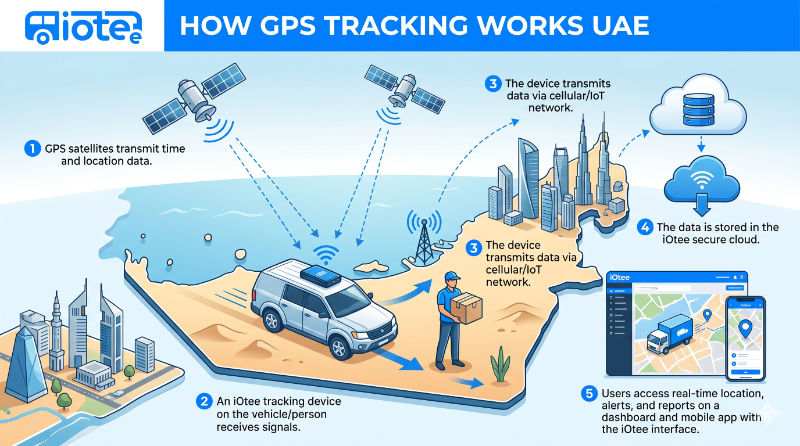
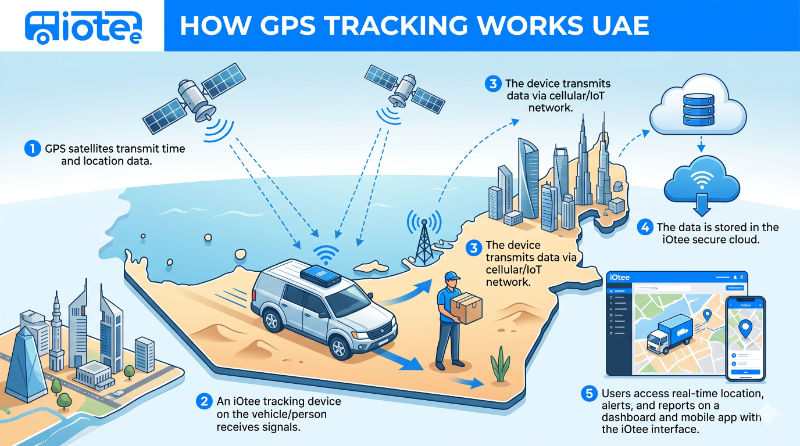
The question changes when someone else drives it. If your driver takes the car to the school run every morning, or your brother borrows it for a week, the tracker is now recording their location. Tell them. A one-line message is enough for family; for a paid driver, put it in their contract. That removes the "without consent" problem before it exists. If you're curious how the device itself works, our plain-English GPS tracking explainer covers it.
Minor Children: Parental Supervision, With Care Around Custody
We haven't found a UAE law that deals specifically with parents tracking their own minor children, and we'd be wary of anyone who claims there's a clear rule. Parents supervising a child's safety is ordinary family life, and a tracker in a teenager's car or a smartwatch on a ten-year-old isn't unusual.
The risk comes when parents are separated. A tracker on the child that is really being used to follow the other parent is a privacy problem for the adult being followed, and the AirTag case above shows courts will hear it. If you share custody, agree on any tracking in writing.
Once your child is an adult, they're a third party like anyone else, and the consent rules above apply in full.
Free Zones: DIFC and ADGM Have Their Own Data Protection Rules
Which Data Law Applies to Your Company
The PDPL doesn't apply to companies in free zones that have their own data protection legislation. In practice that means the two financial free zones, as CMS notes (Dubai Healthcare City also has its own health data rules).
- A company registered in DIFC follows DIFC Law No. 5 of 2020 on Data Protection, supervised by the DIFC Commissioner of Data Protection.
- A company registered in ADGM follows the ADGM Data Protection Regulations 2021, supervised by ADGM's Office of Data Protection.
- A mainland company, or one in a free zone without its own data protection law (JAFZA, for example), generally falls under the federal PDPL.
Unlike the federal PDPL, both financial free zones already have regulators with active enforcement, a point the Morgan Lewis analysis also makes. If your fleet is run by a DIFC or ADGM entity, have your compliance team document vehicle tracking under those rules before rollout. The criminal law is the same everywhere: Article 44 of the cybercrime law applies in DIFC and ADGM just as it does on the mainland.
When the Law Requires a Tracker
SecurePath, Asateel and Other Mandatory Tracking
For many commercial vehicles the legal question runs the other way, because a tracker is compulsory. Dubai's SecurePath programme, run by SIRA, and Abu Dhabi's Asateel, run by the Integrated Transport Centre, require approved tracking devices on several categories of commercial vehicle. We cover who's in scope, approved devices and certificates in the SecurePath and Asateel guide, and our free GPS compliance checker tells you in a minute whether your vehicles are covered.
A mandate makes the device lawful. It doesn't mean every use of the data is automatically fine. The driver still needs to know the vehicle is tracked, and the same rules on access and retention still apply to what your managers do with the trip history. Fleets that also use geofencing alerts should list them in the driver notice too, since an alert on leaving a depot after hours is a form of monitoring the driver should be told about.
A Quick Checklist Before You Switch Tracking On
Six Questions to Answer First
Run through these before a tracker goes into any vehicle someone else drives:
- Who owns the vehicle, and who actually drives it?
- Has every driver been told in writing, and signed?
- What exactly is the tracking for, and is each feature you've enabled tied to that purpose?
- Are audio recording and any feature you can't justify switched off?
- Who can see live and historical data, and is that list as short as it can be?
- How long is the data kept, and who deletes it?
If you can't answer the second question with a yes, stop there. Everything else depends on it.
For fleets, we set this up as part of every fleet management deployment: user roles, retention settings and a notice template. If you'd like to talk through your situation, contact the IOTee team. For anything that's already turned into a dispute, a lawyer is the right call.