What a Commercial Vehicle Camera System Actually Is
A camera system for a truck, bus, van or forklift is built around an MDVR, a mobile digital video recorder. It hides under a seat or behind a trim panel and records 3, 4, 8 or more separate cameras onto one synchronised timeline. That's the whole difference from a windscreen dash cam, which is one sealed unit with one lens and its own card. On a 13-metre trailer, or a reach truck stacking at nine metres, a single forward lens tells you almost nothing about the incident you'll have to explain.
The UAE's crash figures make the case better than any brochure. Ministry of Interior data shows heavy trucks involved in 325 crashes in 2025, heavy buses in 131 and light buses in 115, out of 6,014 crashes nationally. Sudden swerving was the biggest single cause, at 1,074 incidents. A year earlier the same ministry counted 321 crashes involving large vehicles, causing 40 deaths and 251 injuries. Behind each of those is a file where the fleet either has footage or has an argument.
What changed in 2026 is the cost of getting started. Next to the connected 4G builds, IOTee now installs offline MDVR systems. Same 3, 4 or 8 channels, same cameras, same recorder-grade hardware, but they write to an SD card or SSD with no SIM and no monthly platform fee. For plenty of yard equipment and short-radius fleets that's honestly the right answer, and it took us a while to start saying so out loud.
MDVR vs Dash Cam: Where Consumer Kit Runs Out
Why a Windscreen Camera Stops Being Enough Above 3.5 Tonnes
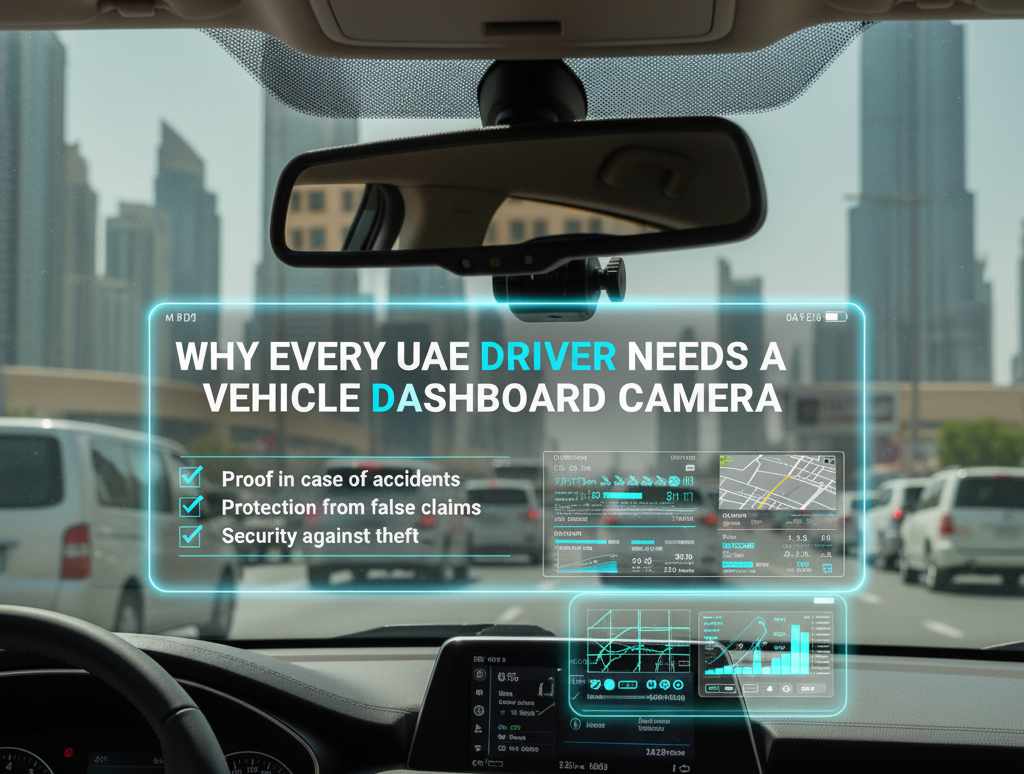
A dash cam is built on one assumption: whatever you need to prove happened in front of the vehicle. That's true for a saloon car on Sheikh Zayed Road. It stops being true the moment the vehicle has a blind side, a load, a passenger deck or a lot of reversing to do.
On commercial vehicles, three limits show up quickly.
Cable length is the first. A rear camera on a 40-foot trailer sits 15 to 18 metres of cable away from the windscreen. Consumer units come with a 6-metre lead and no aviation connectors, so the cable either doesn't reach or doesn't survive the trailer coupling.
Power is the second. Trucks and buses run on 24 V. Forklifts run on 24 V, 48 V or 80 V DC, and plant equipment throws voltage spikes every time it starts. A 12 V dash cam in the cigarette lighter is a warranty claim waiting to happen.
The third is evidence. When a claim is disputed, every angle needs to be stamped against the same clock. Four separate dash cams give you four clocks, four cards, and exactly the kind of gap lawyers love.
An MDVR solves all three by design. It accepts 24 V or 12 V input with wide-range protection, uses locking aviation plugs on runs up to 20 metres, and writes every channel into one file structure with a shared GPS-synced timestamp. If you're trying to decide on angles more than recorders, our guide to front, rear, interior and side camera coverage goes into what each lens is for.
Channel Count Is a Wiring Decision, Not a Price Tier
Fleets often ask us which channel count is "best". It's the wrong question. The number of physical blind spots on the vehicle decides the channel count, and each extra camera means another cable run. You're paying for installation work, never a licence upgrade.
- 3-channel: road, cabin, rear. The minimum for any vehicle carrying passengers or cargo.
- 4-channel: road, cabin, rear and one side. The most common commercial build in the UAE, and usually the best value per camera.
- 8-channel: buses, tankers, refuse trucks, low-loaders. Both sides, rear, door, deck and a driver-facing AI lens.
- 16-channel: articulated buses, airside vehicles and specialist plant. Rare, and specified to meet a contract.
One tip before you buy. Ordering a 4-channel recorder and fitting three cameras is normal and sensible. The spare channel costs next to nothing at install time. Adding it later costs a workshop day.
Offline MDVR or 4G? The Question Fleets Ask Us First Now
What an Offline SD-Card System Gives You — and What It Doesn't
An offline MDVR records everything locally to an SD card or SSD. Nothing leaves the vehicle until someone pulls the card or plugs in at the depot. There's no SIM, no data plan and no monthly platform charge. You pay for the hardware and installation, and then it's yours.
Now the rough maths on retention, since it's what everyone wants to know. Four 1080p channels at typical H.265 bitrates use about 3.5 GB an hour, so a 512 GB card holds about two weeks of ten-hour shifts on loop. Drop the side and rear channels to 720p and you're close to a month. That's plenty for the normal claim cycle, where incidents are reported the same day.
Offline works well for:
- Forklifts, reach trucks and yard equipment that never leave a warehouse in JAFZA, KEZAD or Dubai Industrial City
- Short-radius delivery vans that come back to one depot every night
- Owner-operators and small fleets who want the evidence without another monthly bill
- Sites where getting a SIM approved is a procurement headache, even though it's technically easy
It falls down in a few places. If the vehicle is stolen or catches fire, the evidence goes with it. Nobody gets an alert. And you'll only discover a camera has been dead for three weeks when you go looking for footage you needed.
When the 4G Version Earns Its Monthly Fee
A connected MDVR does three things an offline box simply can't, and each is worth money to a certain kind of operation.
It sends the clip while the event is still fresh. After harsh braking or a collision, a 20-second clip uploads within a minute, so your side of the claim is built before the other driver's story is. It reports on its own health: the platform knows channel 3 has been offline since Tuesday, which is exactly the failure that quietly wrecks offline deployments. And it makes AI useful in real time. ADAS lane departure and forward collision warnings, plus DSM detection of fatigue, phone use and smoking, feed a driver score instead of piling up in a folder of video nobody watches.
That third point is where the safety payback really comes from. Footage on its own doesn't change how people drive. Weekly feedback with a score and some coaching does. That's why we treat cameras as one input into driver behaviour monitoring, never as a product on their own. Connected units run on M2M SIM cards with Etisalat and du failover, which matters more than you'd think on the Dubai–Abu Dhabi corridor and in the mountain stretches of RAK and Fujairah.
The Split Most UAE Fleets Land On
In practice, mixed fleets rarely choose just one. The pattern we see most often: 4G on the vehicles that carry the risk, offline on the vehicles that carry the volume.
Picture a logistics operator in Jebel Ali. It might run connected 4-channel AI systems on 18 long-haul trucks, because those trucks cross emirates, spend time on ADNOC or client sites, and produce the expensive claims. The same company could fit offline 2-channel units to 40 forklifts in the warehouse, since a forklift never leaves the building and nobody needs a live feed of aisle 12. Both groups get the same installation standard. Only one gets a SIM.
If the trucks already have real-time GPS tracking, put the connected cameras on the same platform. Then location, speed and video line up on one timeline, and you're not flicking between three tabs.
Camera Configurations by Vehicle Type
Rigid Trucks, Tippers and Tractor-Trailers
Start with 4 channels: forward road, driver-facing, rear and the nearside blind spot. The nearside camera is the one fleets leave off and later regret, because in the UAE that kerbside blind spot is where motorcycle couriers and pedestrians are.
Tippers and mixers add a fifth angle on the body or drum, mostly to settle arguments about where a load was really dropped. Tractor-trailers need a wireless or trailer-mounted rear camera with a break-away connector, because trailers get swapped and the tractor stays the same. For construction fleets on Dubai and Abu Dhabi sites, this goes hand in hand with construction transport tracking and the wider approach in our construction fleet management guide.
On specs, three things matter here. IP69K-rated external housings. Aviation connectors on every joint. And at least 1080p on the forward channel, so a plate at distance is readable, which is more than just visible.
Buses, School Buses and Staff Transport
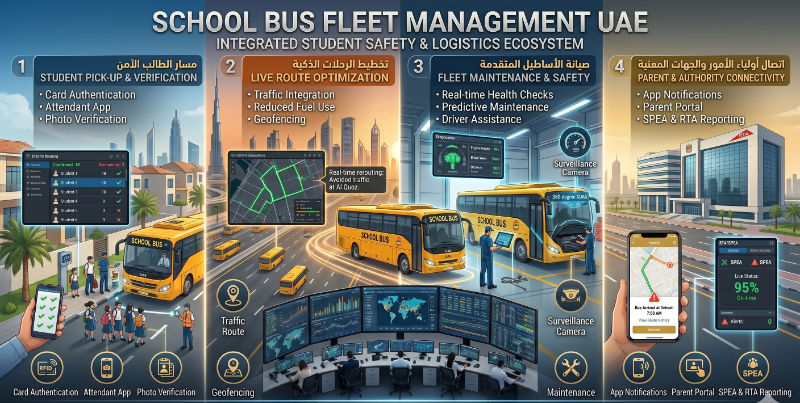
Buses are the one category where regulation sets the camera count and you don't get to use your judgement. UAE school buses must have CCTV to operate. The working standard across the emirates is at least three to four cameras: forward road, an interior view covering the whole passenger area, driver-facing, and a rear or blind-spot view. Abu Dhabi's Integrated Transport Centre and Dubai's RTA both expect footage to be kept and handed over on request.
Staff transport buses in the free zones aren't regulated in the same way, but the client contract usually is. And nobody wants to defend a 40-seat bus with a single windscreen camera. Eight channels is the realistic build: road, front cabin, rear cabin, driver, entry door, both sides and reverse.
If you run school routes, read the full compliance picture in our UAE school bus RTA compliance guide. Cameras are one of about ten mandatory components on the school bus tracking platform, and inspectors tend to check that they're actually recording. Being mounted isn't enough.
Vans, Pickups and Last-Mile Delivery
Most vans are covered by two or three channels: road, cabin, and the cargo bay or rear. The cargo camera works harder than people expect. It ends the "it was damaged when I got it" conversation, and it's the reason last-mile operators renew.
High-roof panel vans have a truly dangerous rear blind spot in a loading bay. A reversing camera with a dash monitor pays for itself the first time the van misses a bollard it would have hit. Delivery fleets on tight drop schedules across Dubai and Sharjah usually want the connected version. The value comes from matching proof-of-delivery times against logistics tracking data. Reviewing video afterwards is secondary.
Forklifts, Reach Trucks and Warehouse Equipment
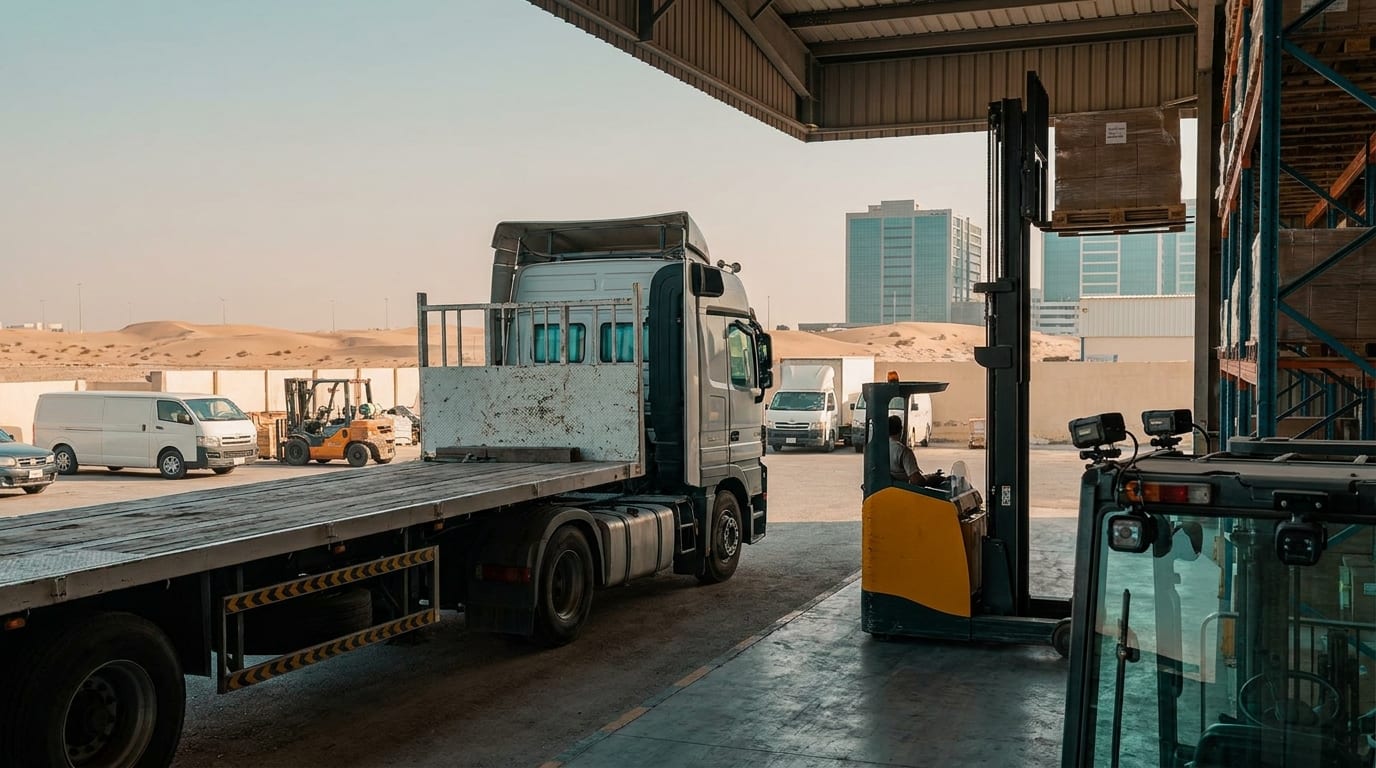
This is the fastest-growing part of our camera work, and most fleet managers haven't priced it yet. A forklift camera system is normally 2 to 4 channels: a mast or fork-tip view, rear, and optionally both sides, all feeding a cab monitor the operator can actually see.
The risk is well documented, even though the UAE doesn't publish its own breakdown. US OSHA data puts forklift overturns at around a quarter of all forklift-related deaths, and pedestrians struck by the vehicle make up the other big category. Both come down to people not being able to see. In Abu Dhabi, lifting equipment falls under OSHAD-SF Code of Practice 34.0 on the safe use of lifting equipment, which governs operator certification, inspection and record-keeping. Cameras aren't named in it. Even so, contractors increasingly use them to prove the control measures they claimed in their risk assessment.
Warehouse machines bring three specific problems. Voltage comes first: forklifts run 24 V to 80 V DC and need a proper DC-DC converter. A cigarette adapter won't do. Vibration is next. Mast-mounted cameras take constant shocks, so anti-vibration mounts and shielded cable are mandatory. Then connectivity: most warehouses are steel boxes with poor mobile signal, which is exactly why offline recording suits this kind of equipment. If you also want to know where the machines are and how many hours they've run, asset tracking is the cheaper add-on.
Excavators, Loaders, Cranes and Heavy Plant
With heavy plant, 360-degree surround view stops being a luxury. Four wide-angle cameras stitched into a bird's-eye view on the cab monitor remove the rear and offside blind zones behind most site strikes. On a site full of pedestrians and banksmen, that one live view does more for safety than any amount of recorded footage.
Excavators and wheel loaders usually get surround view plus a recorded rear channel. Mobile cranes often add a hook-block camera, so the operator can see the load and doesn't have to rely on the radio. Everything on a site machine has to cope with dust and cab temperatures above 50 °C, and that rules out most consumer hardware straight away.
If you work on ADNOC sites, be aware that in-cab AI monitoring has gone from optional to expected in the IVMS space. Our oil and gas fleet and ADNOC IVMS guide explains where camera requirements fit into those contractor standards.
Tankers, Bowsers and Refrigerated Trailers
Tankers carry the highest stakes per incident, so they get the fullest build: 6 to 8 channels covering road, driver, both sides, rear, the discharge point and, on fuel bowsers, the pump and hose area. The discharge-point camera is what stops arguments about delivered volume. It works best alongside fuel tracking data, so the video and the litres tell the same story.
Reefer trailers add a camera in the cargo compartment, mainly to prove the door stayed shut and the load stayed stacked. Whether the load stayed cold is a separate question, answered by temperature monitoring. When a delivery gets rejected, though, you usually need both records in the same email.
Not sure how many channels your vehicles need?
IOTee surveys your fleet, plans the camera layout for each vehicle type, and installs offline or 4G MDVR systems on trucks, buses, vans, forklifts and heavy plant across all seven emirates.
What the UAE Actually Does to Camera Hardware
Heat, Dust, Vibration and Voltage
When camera systems fail in the UAE, the cause is usually the environment. The electronics themselves are rarely to blame. A truck cab parked in Al Quoz in August gets well above 60 °C inside, and cheap recorders throttle, drop channels or just stop writing.
What to insist on:
- A recorder rated to at least 70 °C operating, with a metal chassis and no internal fan. Fans pull in dust and die first
- IP69K external cameras, because the ones on tippers and mixers get pressure-washed every week
- SD cards or SSDs rated for continuous surveillance write cycles. A standard consumer card in a looping MDVR fails within months, and it fails silently, which is worse
- Wide-range DC input with spike protection: 9 V to 36 V for road vehicles, and a dedicated converter for 48 V and 80 V machines
- Anti-vibration mounts on plant and forklifts, with shielded cable kept away from alternator and radio looms
One more, learned the hard way. Specify an internal supercapacitor in the recorder instead of a lithium backup cell. Lithium cells swell in UAE cab heat. Supercaps don't.
The Legal Line: Recording, Storing and Sharing Footage
Recording Is Legal — Publishing Is Where People Get Fined
Using cameras on your own vehicles in the UAE is legal, and police accept clear footage as evidence in accident and traffic-fine disputes. Dubai Police let drivers object to an accident report and submit supporting evidence, and dashcam footage can support a traffic fine dispute as long as the video clearly shows what happened.
Putting that footage online is another matter. Under Federal Decree-Law No. 34 of 2021 on Countering Rumours and Cybercrimes, capturing or publishing images of other people without consent is a privacy offence, in a public place or anywhere else. Posting it on social media pushes the penalty up sharply, to fines that can reach hundreds of thousands of dirhams, plus possible imprisonment and deportation.
For fleets the rule fits on one line. Footage goes to the police, the insurer or your own investigation file, and nowhere else. That includes the company WhatsApp group, which is where most UAE fleets get into trouble.
Cabin Cameras and Federal Decree-Law No. 45 of 2021
Driver-facing cameras record an identifiable person at work. That makes the footage personal data under the UAE's Personal Data Protection Law, Federal Decree-Law No. 45 of 2021. It doesn't make cabin cameras a problem. It just means there's paperwork, and you should do it once and do it properly.
Four things put a fleet on solid ground:
- A written monitoring policy in Arabic and English, signed by every driver at onboarding
- A stated purpose limited to safety, incident investigation and compliance, with no general surveillance
- A set retention period, usually 30 to 90 days unless the footage is attached to an incident
- Access control, so footage is only pulled by named people with a logged reason
Drivers push back much less when the policy spells out what the footage is for. What really changes minds is seeing it used to clear them. The first time a DSM clip proves a driver wasn't at fault, the argument in the depot is over.
2026 Pricing and the Payback Maths
What a System Costs Installed in the UAE
These are typical installed prices we quote in 2026, per vehicle, for hardware plus fitting. Cable runs, AI features and body type all shift them, so read them as bands. They aren't a price list.
- Offline 2-channel forklift or van kit with cab monitor: AED 900–1,900, no recurring cost
- Offline 4-channel MDVR, truck or van: AED 1,800–3,200, no recurring cost
- 4G 4-channel MDVR with ADAS and DSM: AED 3,500–6,500, plus AED 45–95 per vehicle per month for SIM and platform
- 8-channel bus or tanker build: AED 6,000–11,000, plus connectivity if specified
- 360-degree surround view for plant and heavy equipment: AED 4,500–8,500
People tend to miss one comparison. An offline 4-channel system costs about the same as eighteen months of a connected subscription. If the vehicle really doesn't need live upload, that's real money that stays in the business.
A Worked Payback Example for a 20-Truck Fleet
Assumptions first, because a payback number without them is just marketing. Say you have twenty rigid trucks with offline 4-channel systems at AED 2,600 each installed. That's AED 52,000 one-time, and nothing monthly.
- Disputed claims: assume six contested incidents a year, with footage clearly settling two in the fleet's favour, at an average exposure of AED 9,000 each. That's AED 18,000 a year
- Insurance: assume a 10% premium cut on an AED 4,800 annual policy per vehicle, which UAE insurers commonly offer for documented camera and telematics coverage. That's AED 9,600 a year
- Reversing and manoeuvring damage: assume four AED 1,500 body repairs avoided, or AED 6,000 a year
That adds up to roughly AED 33,600 a year against AED 52,000, so payback comes at around nineteen months, and there's no ongoing cost after that. The connected version costs more up front and adds a monthly fee. What it does, and the offline build can't, is move the biggest lever in the model, accident frequency, through coaching. Run both cases with your own numbers. The fleet savings calculator is a quicker sanity check than a spreadsheet.
Specifying and Installing Without Regret
Ten Questions Worth Asking Before You Sign
On paper, camera quotes look much the same. In the workshop they turn out very different. These questions separate them:
- What's the recorder's rated operating temperature, and is it fanless?
- Are the external cameras IP69K, or only IP67?
- Are all the camera joints aviation connectors, or spliced and taped?
- Which SD card or SSD comes with it, and is it surveillance-rated?
- What happens to recording when the vehicle battery dips during cranking?
- Can I add a channel later without replacing the recorder?
- Is footage timestamped against GPS time or the recorder's internal clock?
- How do I get footage off: card swap, USB, Wi-Fi at the depot, or 4G?
- Who owns the video, and where is it kept if it's a cloud platform?
- What's the warranty on labour, as well as on the hardware?
That last question catches people out. Hardware warranties are common. The real cost sits in the workshop day it takes to re-run a failed cable.
The Install Details That Decide Whether It Survives
A well-specified system installed badly will perform worse than a mid-range system installed properly. Almost every camera failure we get called out to is a cable or mounting problem.
So what does a good install look like? The recorder goes somewhere with airflow where it can't be kicked, and never on a parcel shelf in direct sun. Cables run inside the existing looms with a grommet at every panel pass, and never through a drilled hole with bare edges. Power comes from a fused permanent live with a proper ignition sense, never spliced into the radio feed. Trailer rear cameras use break-away connectors so the coupling can't shear the cable. Every channel is checked on the monitor before the vehicle leaves, and the timestamp is checked against GPS.
Then comes the part everyone skips: writing down which camera is on which channel. Six months on, when someone needs the nearside view from a Tuesday in March, that note decides whether it takes two minutes or two hours. If you already run fleet management or geofencing, log the camera install in the same vehicle record.
Where to Start
Pick the Vehicle That Hurts Most, Then Scale
Fleets that try to put cameras on everything at once usually get stuck at budget approval. The ones that succeed pick one vehicle class, normally the one producing the claims or the one a client contract is about to demand. They fit five or six units and run them for a quarter before deciding anything else.
A sensible first step: fit offline 4-channel systems to the vehicles that never need live upload, and connected AI systems to the ones carrying the real exposure. Look at which footage gets pulled in the first ninety days, and let that pattern tell you where channel five should go.
If a client tender or an authority requirement is behind all this, check where you stand first. The UAE GPS and fleet compliance checker maps the requirements by emirate and vehicle type. The complete UAE fleet management guide explains how cameras fit alongside tracking, speed limiters and driver scoring in one deployment.
Trucks, forklifts or a mixed fleet — we'll survey it
IOTee installs offline and 4G MDVR camera systems from 2 to 16 channels across the UAE, using in-house fitting teams in Dubai, Abu Dhabi, Sharjah and the Northern Emirates.