Why School Bus Compliance in UAE Is Non-Negotiable
School transport is one of the most heavily regulated categories of vehicle operation in the UAE — far stricter than commercial logistics, taxis, or even hazardous goods transport. The reason is straightforward: every vehicle on the road carries children whose safety the operator is legally and morally accountable for, and the UAE's regulators have made the rules accordingly tight.
For schools, transport contractors, and fleet operators, RTA-compliant school bus fleet management is not a competitive feature — it is the license to operate. Non-compliance carries consequences across four serious dimensions:
- Regulatory — license suspension or revocation, hefty per-vehicle fines, and inability to renew School Transport Services (STS) authorization
- Reputational — UAE parents are highly informed and unforgiving; a single incident becomes regional news within hours
- Financial — insurance non-coverage in case of an incident on a non-compliant vehicle, potential personal liability for school administrators
- Operational — a non-compliant bus can be impounded immediately at any RTA inspection, stranding children mid-route
The regulatory framework has tightened materially over the last decade. Following several high-profile child-in-bus incidents across the GCC, the UAE moved from advisory guidelines to mandatory technology and process requirements covering every aspect of school transport. By 2026, the requirements span GPS tracking, speed limiters, CCTV cameras, child-detection systems, driver monitoring, supervised attendance, real-time parent communication, and tamper-proof audit trails — all expected to operate as one integrated platform, not separate tools.
This guide is the complete 2026 reference for any school administrator, transport manager, or fleet contractor responsible for school bus operations in Dubai, Abu Dhabi, Sharjah, or any other UAE emirate. We cover the regulatory landscape by emirate, the mandatory technology stack, the compliance checklist that determines pass-or-fail at RTA inspection, the most common compliance gaps that get operators in trouble, the platform architecture that satisfies every requirement in one system, the implementation playbook, and the ROI math. Every section is grounded in current 2026 UAE regulatory practice.
The UAE School Bus Regulatory Landscape (2026)
RTA Dubai — School Transport Services (STS)
Dubai's Road and Transport Authority operates the most comprehensive school transport regulatory framework in the UAE through its School Transport Services (STS) subsidiary and the regulatory function within RTA itself. Any school bus operating in Dubai — whether owned by the school, leased, or run by a third-party transport contractor — must hold a valid STS-issued or RTA-approved permit.
Core RTA Dubai STS requirements include:
- Mandatory GPS tracking with real-time data feed accessible to RTA monitoring systems
- Mandatory speed limiter capping the bus at 80 km/h (with stricter limits in school zones and urban areas)
- Mandatory CCTV cameras — typically minimum 3-4 cameras (front-facing road, interior cabin, driver-facing, rear-facing)
- Mandatory bus supervisor (conductor / nanny) in addition to the driver, present on every trip
- Mandatory child-detection systems — sensors and procedures to ensure no child is left on the bus after the route ends
- Standardized yellow exterior color and required signage
- Distinct retractable stop arm and flashing lights for drop-off and pick-up
- Approved seating capacity with age-appropriate seatbelts (typically 3-point for older children)
- First aid kit, fire extinguisher, emergency exits to specification
- Maximum vehicle age (typically not exceeding the RTA-defined retirement age for school buses)
- Annual safety and compliance inspection at RTA-approved testing centers
- Driver eligibility — UAE driving license of appropriate class, clean record, age and experience minimums, mandatory periodic medical fitness, RTA-approved school bus driver certification
- Parent communication system — real-time bus location, expected arrival, child onboarding/offboarding events accessible to parents
- Insurance at coverage levels specified for school transport
Non-compliance is enforced via fines, license suspension, vehicle impoundment, and — in serious cases — operator blacklisting from school transport contracting.
For an operational view of how a tracking platform satisfies these mandates end-to-end, see IOTee's school bus tracking UAE solution.
Abu Dhabi — Integrated Transport Centre and DoT
Abu Dhabi school transport is regulated by the Integrated Transport Centre (ITC) under the Department of Municipalities and Transport (DoT). Requirements parallel Dubai's framework with several Abu Dhabi-specific considerations:
- GPS tracking with data feed to ITC's centralized monitoring platform
- Speed limiter at 80 km/h with reduced limits in school and residential zones
- CCTV cameras with retention requirements for incident investigation
- Bus supervisor mandatory on every trip
- Child onboarding/offboarding tracking with parent notification
- Driver certification specific to Abu Dhabi school transport
- Vehicle technical and safety inspection at ITC-approved facilities
- Compliance with UAE Federal Decree-Law on personal data protection for video and tracking data
- Defined route approval — school bus routes must be registered and adhered to; deviations trigger alerts
Abu Dhabi historically has been particularly strict on route adherence and dwell time at stops — operators are expected to maintain the registered schedule with documented justification for any deviation. Fleet management platforms serving Abu Dhabi school operators must support route registration, real-time adherence monitoring, and exception reporting as core capabilities.
For Abu Dhabi-specific school bus operations, see the Abu Dhabi fleet management regional offering.
Sharjah, Northern Emirates, and Federal-Level Considerations
Sharjah RTA, Ajman Public Transport Authority, Ras Al Khaimah Transport Authority, Fujairah Transport, and Umm Al Quwain authorities operate frameworks that closely follow the federal Ministry of Interior and federal Transport Authority guidelines, with local enforcement adaptations.
Common requirements across the Northern Emirates:
• GPS tracking with data accessibility to local authorities
• Speed limiter compliance
• CCTV and child-detection systems
• Mandatory bus supervisor
• Annual technical inspection
• Approved driver certification
• Standardized signage and color coding
Federal-level considerations:
• UAE Ministry of Education sets minimum age for school transport workers, training mandates, and supervisory ratios
• Federal Transport Authority governs interstate school transport (a school in Sharjah running a route picking up students from Dubai or Ajman, for example)
• Federal Decree-Law No. 45 of 2021 on Personal Data Protection governs the handling of child personal data, video footage, and location data — a strict compliance area for school transport operators
• UAE Civil Defence sets fire safety, emergency exit, and extinguisher specifications
A single school bus operating in Dubai picking up students who reside in Sharjah must comply simultaneously with RTA Dubai STS rules, Sharjah RTA rules for the Sharjah leg of the route, UAE Federal data protection law, and Ministry of Education requirements. A modern school bus fleet management platform handles multi-jurisdiction compliance as a configuration setting, not a custom build.
The Mandatory Technology Stack for Compliant UAE School Buses
What Every Compliant School Bus in UAE Must Have Onboard (2026)
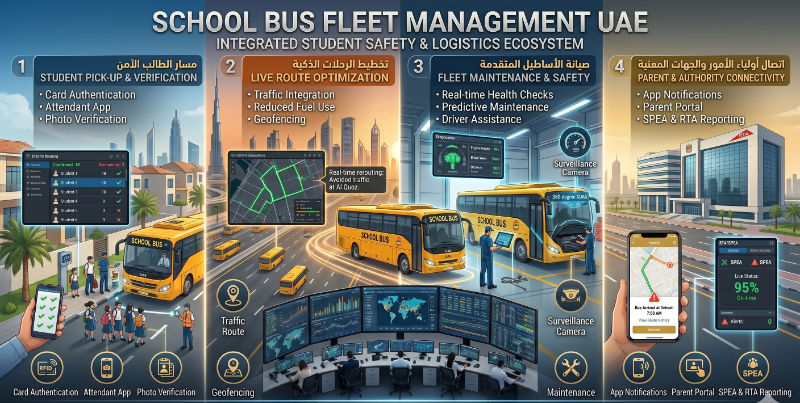
Compliance is delivered through a specific, integrated technology stack. Each component is itself mandatory; together they form the operational backbone of every approved school bus in the UAE.
1. GPS / GNSS Tracker with Live Telemetry
• Real-time position, speed, heading, ignition state
• Sub-30-second update frequency
• Cellular failover (Etisalat + du) for cross-emirate coverage
• Tamper-proof installation (sealed enclosure, tamper alerts)
• Live data feed to RTA / ITC monitoring systems where required
IOTee's real-time GPS tracking platform running on M2M SIM cards is the foundational layer.
2. Speed Limiter (Mechanical + Telematic)
• Hardware-enforced cap at 80 km/h (or stricter, per emirate)
• Telematic verification — alerts if mechanical limiter is bypassed or fails
• Speed-zone-aware policy (lower limits inside school zones)
• Tamper detection and alerting
IOTee's speed limiter solution integrates the mechanical limiter with the tracking platform so all speed events are logged and audit-ready.
3. CCTV Camera System (Multi-Channel)
• Forward-facing road camera (incident evidence, route verification)
• Interior cabin camera (child supervision, behavior monitoring)
• Driver-facing camera (drowsiness, distraction, phone-use detection)
• Rear or side camera (loading, blind-spot, reversing safety)
• Continuous recording with cloud upload triggered by events
• Defined retention period (typically 30-90 days, longer for incident footage)
• Privacy-compliant storage per UAE Federal Decree-Law No. 45 of 2021
A full vehicle camera installation typically configures 3-4 cameras per school bus, wired back to a single multi-channel recorder rather than separate units. For the angle-by-angle breakdown, see our multi-camera dash cam UAE guide; for the recorder side, our MDVR vehicle camera systems guide.
4. Child Detection / Anti-Forgotten-Child System
• Sensor-based scan of the bus cabin after route end
• Driver acknowledgment workflow at end-of-route (must walk to back of bus to disable alarm)
• Backup automated alerts to operations center if acknowledgment is missed
• Audit log of every end-of-route check
This is the most life-critical component of the stack and the one regulators inspect most rigorously.
5. Child Onboarding / Offboarding Tracking
• RFID, NFC, or biometric tap-in/tap-out at bus entry and exit
• Each student tied to a registered profile (parent contact, home address, school, class)
• Automatic real-time notification to parents on every onboarding and offboarding event
• Mismatch detection (child boards but does not offboard at expected stop, or vice versa)
6. Driver Behavior and Driver Identification
• Driver behavior monitoring with harsh-event detection (acceleration, braking, cornering, speeding)
• Driver ID via RFID or biometric (tied to certified school bus driver records)
• AI-based driver-facing camera analysis (drowsiness, distraction, phone use, seatbelt)
• Driver coaching workflow with video evidence
7. Parent Communication App
• Real-time bus location on map
• Expected arrival time at stop with live updates
• Push notification on child onboarding and offboarding
• Route history and trip details
• Emergency contact and incident notification
8. Driver-Facing Tablet / In-Cab Display
• Route guidance and stop list
• Manifest of expected children with onboarding/offboarding status
• Two-way communication with operations center
• Emergency button
9. Telemetry Backbone, Cloud Platform, and Compliance Reporting
• Centralized cloud platform aggregating data from all hardware components
• Automated RTA / ITC compliance reports on demand
• Tamper-proof audit logs
• Role-based access (operator, school administrator, parent, inspector)
• APIs for integration with school management systems
10. Geofencing and Route Adherence
• Defined geofences for the school, each pickup stop, and the route corridor
• Real-time alerts on route deviation, unscheduled stops, missed stops, or exit from the registered route
IOTee's geofencing module handles route adherence as an automated rules engine — no manual monitoring required.
These ten components are not optional accessories — they are the integrated compliance baseline. A platform that delivers eight of the ten leaves your operation exposed on the missing two. Demand all ten, integrated, in a single platform with a single source of truth.
The Compliance Checklist: Pass or Fail at RTA Inspection
The 25-Point UAE School Bus Compliance Audit
Use this checklist as a self-audit before any RTA, ITC, or Sharjah RTA inspection. Each item is binary — pass or fail. A single failure on items 1-10 is sufficient to trigger immediate non-compliance findings.
Hardware Compliance (1-10) — Critical Path
1. ✓ GPS tracker installed, sealed, transmitting live data, no tamper events in last 30 days
2. ✓ Speed limiter set to 80 km/h, mechanical and telematic verification both active
3. ✓ Front-facing road camera operational, recording, footage retained per policy
4. ✓ Interior cabin camera operational with full passenger area coverage
5. ✓ Driver-facing camera operational with AI driver monitoring active
6. ✓ Rear or side blind-spot camera operational
7. ✓ Child detection / anti-forgotten-child system installed and tested in last 7 days
8. ✓ Child RFID / biometric onboarding system functional with current student registry
9. ✓ All cameras synchronized with telemetry timestamp (events are reconcilable)
10. ✓ Cellular connectivity active, dual-network failover configured
Driver and Supervisor Compliance (11-15)
11. ✓ Driver holds current RTA-approved school bus driver certification
12. ✓ Driver passed periodic medical fitness within required interval
13. ✓ Driver clean record (no disqualifying violations in lookback period)
14. ✓ Bus supervisor (conductor) present on every trip with documented attendance
15. ✓ Both driver and supervisor identifiable by RFID/biometric on every trip
Vehicle Compliance (16-20)
16. ✓ Annual technical and safety inspection passed within last 12 months at approved center
17. ✓ Vehicle within maximum age limit
18. ✓ Yellow exterior color and required signage compliant
19. ✓ First aid kit, fire extinguisher, emergency hammers, exits all to specification
20. ✓ Insurance coverage current at school transport levels
Operational and Data Compliance (21-25)
21. ✓ Real-time data feed accessible to RTA / ITC monitoring (where required)
22. ✓ Parent communication app operational, all enrolled parents activated
23. ✓ Route registered with authority, adherence monitored, deviations logged with justification
24. ✓ End-of-route child detection check logged for every trip in last 30 days
25. ✓ Personal data handling compliant with UAE Federal Decree-Law No. 45 of 2021
The audit cadence that prevents trouble:
• Pre-trip checklist — daily, by driver
• Weekly compliance check — by transport manager (camera operation, RFID readers, alerts)
• Monthly internal audit — by school admin (driver records, footage retention, alert logs)
• Quarterly external audit — by transport vendor or independent compliance auditor
• Annual RTA / ITC formal inspection — passed first time, not after rectification cycles
Operators that maintain this cadence rarely fail formal inspections. Operators that treat compliance as a once-a-year scramble routinely fail and face suspension.
The Five Most Common UAE School Bus Compliance Gaps
Where Operators Actually Get in Trouble
Across hundreds of UAE school bus deployments, five compliance gaps account for most regulatory findings and incidents.
Gap 1: Cameras 'Installed' but Not Operational
A camera is mounted but the recording is broken, the angle is wrong, or footage retention has lapsed. RTA inspections increasingly require live footage demonstration during inspection — passing the visual installation check is not enough.
Avoidance: automated daily camera health checks via the platform; alert if any camera goes offline; weekly footage spot-checks by the transport manager.
Gap 2: Speed Limiter Bypass or Drift
Mechanical speed limiters can be bypassed by determined drivers (or quietly fail through wear). Telematic verification — comparing actual recorded speed against limiter set point — catches both.
Avoidance: integrate the speed limiter with the tracking platform; alert on any speed event over the cap; investigate every alert.
Gap 3: End-of-Route Child Check Not Performed
The most life-critical compliance gap. The driver finishes the route, parks the bus, and skips the cabin scan. A child asleep at the back is at catastrophic risk in UAE summer heat (interior temperatures exceeding 70°C within minutes).
Avoidance: hardware-enforced workflow — the bus alarm cannot be disabled until the driver physically walks to the back of the bus and presses the disable button; backup automated alert to operations center if the disable button is not pressed within 2-3 minutes of route completion; daily audit log review.
Gap 4: Route Deviation Without Justification
Drivers sometimes take shortcuts, run personal errands, or improvise stops. Even minor deviations from the registered route can trigger compliance findings, and major deviations are operationally dangerous (parents waiting at unattended stops, children dropped at wrong locations).
Avoidance: real-time geofence-based route adherence with automatic alerts on deviation; transport manager dashboard reviews all deviations daily; documented justification required for every variance.
Gap 5: Personal Data Handling Non-Compliance
Video footage of children, location data, parent contact details, and biometric records are all personal data under UAE Federal Decree-Law No. 45 of 2021. Storing footage on uncontrolled local DVRs, sharing data with unauthorized parties, or retaining data beyond the required period are all compliance failures with rising enforcement.
Avoidance: cloud-platform with role-based access, defined retention periods, audit trail of all data access, signed parent consent forms, and data processing agreements with the platform vendor.
These five gaps are responsible for the overwhelming majority of regulatory findings, parent complaints, and serious incidents in UAE school transport. A platform engineered specifically for school transport — not a generic fleet management product retrofitted for school buses — handles all five as default behavior, not as features to be configured.
Keep Every Student Safe on Every Trip
RTA-aligned school bus tracking with live parent apps, attendance and driver monitoring — trusted by UAE schools.
How Schools and Contractors Should Choose a School Bus Fleet Management Platform
The 10-Point Vendor Evaluation Checklist for UAE School Transport
Generic fleet management products often miss the specific child-safety and parent-communication requirements that define school transport. Use this 10-point checklist to evaluate any vendor — any single failure should disqualify them.
Compliance and Approvals
1. ✓ Platform is approved by RTA Dubai (or supports RTA STS data feed) and ITC Abu Dhabi where applicable
2. ✓ Vendor has named UAE school operator references with three or more years of operation
3. ✓ Compliance reporting templates for RTA, ITC, and Sharjah RTA are out-of-the-box, not custom
Child Safety
4. ✓ Hardware-enforced end-of-route child detection workflow (not just an alert)
5. ✓ RFID / biometric child onboarding/offboarding with real-time parent notification
6. ✓ AI-based interior camera monitoring (driver and child safety)
Parent Experience
7. ✓ Parent app available in Arabic and English with live bus location, ETA, and onboarding/offboarding push notifications
8. ✓ Multi-channel notifications (push + SMS + email fallback for parents without smartphones)
Platform Foundation
9. ✓ All ten technology components in one platform with a single source of truth
10. ✓ UAE Federal Decree-Law No. 45 of 2021 compliant data handling, role-based access, retention controls
Commercial considerations to negotiate:
• Per-bus monthly pricing transparent and inclusive of all ten components
• Hardware ownership clear at end-of-contract
• Data portability — every child record, every video, every report exportable in standard format on request
• Pilot deployment on 2-3 buses for a 60-day evaluation before scale commitment
• 24/7 support in Arabic and English with documented incident response time
Cost and ROI: What School Bus Fleet Management Costs in UAE
Honest Pricing for UAE School Bus Compliance (2026)
School bus fleet management is more expensive per vehicle than commercial fleet management because the technology stack is more comprehensive. 2026 typical UAE pricing per bus:
- Hardware + installation (one-time): AED 5,500-9,500 per bus (GPS, speed limiter integration, 3-4 cameras, RFID/biometric reader, in-cab tablet, child detection)
- Software + connectivity (per bus per month): AED 180-320
- Annual recurring (Year 2 onwards) per bus: AED 2,160-3,840
- Parent app (typically included): no additional per-parent charge in most school packages
Sample 30-bus school operation:
• One-time investment: AED 165,000-285,000
• Year 1 software/connectivity: AED 65,000-115,000
• Year 2 onwards annual: AED 65,000-115,000
The financial case beyond compliance:
Most schools approach this as a 'cost of operating' line item rather than an ROI investment, but a properly deployed platform delivers measurable financial benefits:
- Insurance premium reduction: 10-20% typical with documented driver scoring and camera evidence
- Accident frequency reduction: 35-50% with driver behavior coaching, reducing repair costs and bus downtime
- Fuel and operating cost reduction: 12-20% via fuel tracking, idle reduction, and route optimization
- Reduced parent attrition: schools with strong transport visibility retain enrolment better than those without
- Reduced administrative overhead: 30-50 hours/month saved on manual reporting, attendance reconciliation, and parent communication
- Bid competitiveness: contractors bidding to schools with strong platform capability win disproportionately more contracts
For most UAE school operations, the platform pays for itself through insurance and operating savings alone within 12-24 months — and the compliance, child safety, and parent confidence benefits arrive on day one.
Implementation: The 60-Day School Bus Platform Rollout
From Decision to Compliant Operation in Eight Weeks
School transport rollouts have an unforgiving deadline — the start of the academic year. Here is the proven 60-day playbook for UAE schools and contractors.
Weeks 1-2: Compliance Audit and Design
• Audit current state against the 25-point compliance checklist
• Document gaps; quantify exposure (regulatory, financial, reputational)
• Define platform configuration: number of buses, cameras per bus, RFID readers, route registry
• Confirm RTA / ITC / Sharjah RTA permit status; identify any renewal or upgrade work required
• Brief school leadership and parent committee
Weeks 3-4: Pilot Installation (2-3 buses)
• Install full hardware stack on 2-3 representative buses (different sizes, different routes)
• Activate parent app for the children on those buses
• Run real routes with full instrumentation
• Train drivers, supervisors, and the operations team on the platform
• Validate end-of-route child detection workflow with controlled tests
• Tune alert thresholds based on real-route data
Weeks 5-7: Full Fleet Rollout
• Staggered installation, 4-6 buses per day per installation team
• Each bus validated end-to-end before returning to operation
• Parent app rollout to remaining families with onboarding sessions
• RFID/biometric registration of every enrolled child
• Route registration with relevant emirate authority (RTA / ITC / Sharjah RTA)
• Compliance binder updated with hardware certificates, driver records, and inspection reports
Week 8: Operational Handoff and Audit Readiness
• First weekly compliance review
• First parent feedback round
• Operations dashboard configured for school transport manager
• External compliance audit by independent reviewer
• Documentation handover for RTA / ITC inspection readiness
Schools that follow this playbook open the academic year fully compliant, with parent confidence high and operational visibility complete from day one.
Next step: Compare hardwired, OBD and portable GPS tracking devices for vehicles and choose the right tracker for your fleet.
Frequently Asked Questions
Is GPS tracking mandatory on every school bus in the UAE?
Yes. RTA Dubai (under STS), ITC Abu Dhabi, Sharjah RTA, and the equivalent Northern Emirate authorities all require real-time GPS tracking on every school bus operating in their jurisdiction. The tracking system must transmit live telemetry, support route adherence monitoring, and produce auditable reports on demand. Operating a school bus without compliant GPS tracking carries immediate regulatory consequences including fines, license suspension, and impoundment.
What is the maximum legal speed for a school bus in UAE?
School buses in the UAE are typically capped at 80 km/h by mandatory mechanical speed limiter, with stricter local limits in school zones, residential areas, and urban roads (often 40-60 km/h). The exact cap and enforcement details vary slightly by emirate and by road class. The platform should enforce both the absolute cap and the zone-specific limits, with telematic verification of the mechanical limiter at all times. For the speed-control technology, see IOTee's speed limiter solution.
Are cameras required inside school buses in UAE?
Yes. CCTV is mandatory inside UAE school buses across all major emirates. Typical requirements call for a minimum of 3-4 cameras: a forward-facing road camera, an interior cabin camera covering the full passenger area, a driver-facing camera, and a rear or blind-spot camera. Footage must be retained for a defined period (typically 30-90 days, longer if linked to an incident), stored compliantly under UAE Federal Decree-Law No. 45 of 2021 personal data protection rules, and accessible to authorities on request. For the technology breakdown, see our multi-camera dash cam UAE guide.
What is a 'child detection system' and is it mandatory?
A child detection (or anti-forgotten-child) system ensures that no child is left on a school bus after the route ends. The standard implementation forces the driver to physically walk to the back of the bus to deactivate an alarm — proving they have visually scanned every row. Failure to deactivate within the required time window triggers an automated alert to the operations center, the school administrator, and (depending on configuration) emergency services. This is a mandatory safety system across UAE jurisdictions and is one of the most rigorously inspected components. Operating without a functional child detection system is grounds for immediate suspension of school transport authorization.
Do parents have a legal right to track their child's school bus?
Parents do not have a statutory 'right to track' in the abstract, but UAE school transport regulations effectively require operators to provide parents with real-time bus location, expected arrival, and onboarding/offboarding notifications via an approved app. In practice, this means every UAE school bus operation must offer a functional parent app — schools and contractors that fail to deliver this consistently lose enrolment and face regulatory pressure. The parent app must be available in Arabic and English at minimum and operate reliably across UAE cellular networks.
How long does footage from school bus cameras need to be retained?
Retention periods are set by the relevant authority and typically fall in the 30-90 day range for routine footage, with longer retention required for footage linked to incidents, complaints, or active investigations (typically until the matter is fully resolved). Storage must be compliant with UAE Federal Decree-Law No. 45 of 2021 — typically meaning encrypted cloud storage with access logs, role-based permissions, and documented retention/deletion policies. Generic 'DVR in a box' setups generally do not meet the data protection bar and increasingly fail compliance review.
Can a school operate its own buses, or must transport be outsourced?
UAE schools may operate their own buses, contract with a licensed school transport operator, or use a hybrid model — all are permitted, provided the buses, drivers, supervisors, and platform meet the regulatory requirements. STS in Dubai, for example, both operates buses directly and accredits third-party transport contractors. Schools choosing in-house operation take on the full compliance burden directly; schools choosing a contractor share that burden but remain accountable for ensuring the contractor maintains compliance.
What happens if a school bus fails an RTA or ITC inspection?
Outcomes range from rectification orders (specific issues to fix within a defined window, typically 7-30 days), through operational restrictions (bus removed from service until rectified), to license suspension (the operator's school transport authorization paused), and in severe or repeated cases license revocation and operator blacklisting. Repeat offenders and operators with safety-critical findings face escalating consequences. The financial cost — fines, lost contracts, reputational damage — typically exceeds the cost of full compliance many times over.
Does IOTee provide a complete UAE school bus fleet management platform?
Yes. IOTee operates an integrated school bus tracking and fleet management platform that covers all ten mandatory technology components — GPS tracking, speed limiter integration, multi-camera CCTV, child detection, RFID/biometric onboarding, driver behavior monitoring, parent app, in-cab tablet, geofencing-based route adherence, and full RTA / ITC / Sharjah RTA compliance reporting. Coverage spans all seven UAE emirates, with local installation, support, and account management teams. For schools and operators looking to map this to their broader fleet operation, see our Fleet Management UAE Complete 2026 Guide.
The Bottom Line for UAE Schools and Operators
What to Do This Week
School bus fleet management in the UAE is not a vehicle-tracking problem with safety features bolted on — it is a child-safety, regulatory, and parent-trust system that happens to involve buses. Treat it that way and the technology, the compliance, and the ROI all line up.
Three immediate actions for any school administrator or transport contractor:
Action 1: Run the 25-point compliance audit on every bus this week. Use the checklist in this guide. Score honestly. Any 'no' answer is a regulatory exposure that needs a remediation timeline today.
Action 2: Verify the end-of-route child detection workflow on every bus today. This is the single most life-critical component of the stack. If the workflow is missing, broken, or routinely skipped, prioritize it above every other gap.
Action 3: Map your platform against the 10 mandatory technology components. If you are running fewer than 10 in a single integrated platform — or running them across multiple disconnected vendors — you have a structural compliance gap that no amount of process discipline can fully cover.
For schools and operators ready to upgrade or evaluate options, IOTee runs structured compliance audits and pilot deployments across Dubai, Abu Dhabi, Sharjah, Ajman, Ras Al Khaimah, Fujairah, and Umm Al Quwain. Engagements typically begin with a 2-3 bus pilot during a half-term, scaling to the full operation over the academic break — so the new term opens with full compliance, full parent visibility, and full operational confidence.
The parents of every child on every bus expect their school transport operator to have done this properly. The 2026 UAE regulatory framework has made the standard explicit. The operators who treat that standard as the floor — not the ceiling — are the ones who will run the next decade of school transport in this market.