Delivery Bike GPS Tracking in the UAE: What It Is and Why Dubai Will Require It
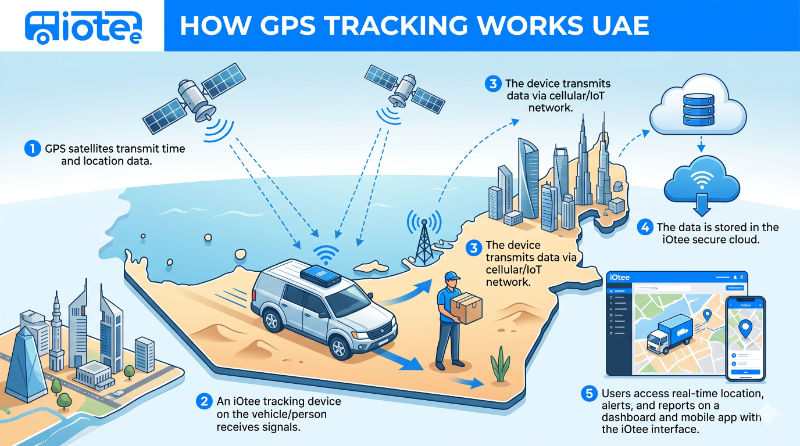
Delivery bike GPS tracking means a small, waterproof tracker wired into each motorbike that reports where the bike is, how fast it's going, when the ignition is on and whether someone is tampering with it. In Dubai it's about to stop being optional. The RTA has said delivery companies will have to fit monitoring devices to their motorcycles and connect them to its platform from the second half of 2027.
Delivery bikes are everywhere in the UAE now, and so are the crashes. Dubai Police recorded 854 accidents caused by delivery rider violations in 2024 and 962 in 2025, and riders picked up 78,386 violations in the first nine months of 2025 alone. Both Dubai and Abu Dhabi have since banned delivery bikes from their fastest lanes and roads.
This guide is for the people who run those bikes: restaurant groups with their own riders, rider-supply agencies and courier firms. It covers the rules riders already work under, what Dubai's monitoring system is likely to mean, the hardware that survives a summer on a motorbike, and how to use the data on theft, speed and heat. For vans and the wider last-mile operation, our last-mile delivery fleet management guide covers it, so we won't repeat it here. If you'd rather see the product first, the delivery bike tracking page shows how IOTee sets it up.
The Rules UAE Delivery Riders Already Work Under
Dubai: No Fast Lanes Since November 2025
Since 1 November 2025, delivery bikes in Dubai have been barred from the two left-hand lanes on roads with five or more lanes, and from the left-hand lane on roads with three or four. Roads with two lanes or fewer have no restriction. The RTA and Dubai Police announcement set fines of AED 500 for a first lane offence and AED 700 for a second, with the rider's permit suspended on a third.
Speed has its own scale. A rider doing more than 100 km/h on a road with a limit of 100 km/h or above is fined AED 200, then AED 300, then AED 400. The same announcement said companies whose riders keep to the right lanes would be recognised under the Delivery Sector Excellence Award, which tells you the RTA is watching operators as well as riders.
Our UAE traffic fines calculator is handy when you're working out what a month of violations is costing your fleet.
Abu Dhabi: Delivery Bikes Banned From 120 km/h Roads
Abu Dhabi went further. From 15 May 2026, the Integrated Transport Centre banned delivery motorcycles from roads with speed limits of 120 km/h and above, plus the Sheikh Zayed bin Sultan Street stretch between Sheikh Zayed Bridge and Sheikh Zayed Tunnel. The reason is blunt. Those highways accounted for 22 per cent of delivery rider deaths while carrying less than five per cent of the distance riders cover each day.
On roads limited to 100 km/h, riders have to stay in the right-hand lanes. The ITC also says it's working with delivery companies on moving rider stations and cutting trip distances, which is a polite way of saying zone design is now partly your problem. If your Abu Dhabi riders used to take the E10 or the E11 between Mussafah and the island, those runs need new routes.
Permits, Training and Kit in Dubai
Dubai has required more than a motorcycle licence since 2021. Riders need an occupational permit from the RTA, which means occupational health and safety training, an annual medical test and police clearance. The same rules called for standard helmets, reflective vests and a delivery box fixed to the bike in place of a backpack.
Those 2021 rules also set engine size and load limits, and the RTA has updated its delivery services manual since, so check the current version before you buy bikes or boxes. None of this involves GPS yet. It does mean a Dubai rider fleet is already a licensed, inspected activity, and the tracking requirement lands on top of that.
Dubai's Smart Monitoring System for Delivery Motorcycles
What the RTA Has Announced for 2027
In November 2026 the RTA described a system made up of a digital platform, IoT monitoring devices and cameras fitted to delivery motorcycles. According to Khaleej Times, it records speed, sudden acceleration, harsh braking, riding patterns and routes. Fitting the devices and connecting to the platform is voluntary until the end of June 2027. After that it becomes mandatory for delivery companies operating in Dubai.
The RTA says companies will get live information on their own riders and can use it to plan training, while the authority builds a database of delivery operations to guide inspections and future rules. In plain terms, the regulator will see much of what you see.
What Isn't Public Yet, and What to Do Before Then
A lot isn't known. The RTA hasn't published a list of approved devices, a technical spec for the cameras, the penalty for not connecting, or how a company that already tracks its bikes plugs into the new platform. We haven't found an equivalent requirement in Abu Dhabi or the northern emirates either.
So be wary of anyone selling a box as 'RTA approved for 2027'. Ask which approval, and get the answer in writing. Our view is that tracking your bikes now is still worth doing, because the theft, speeding and heat problems exist today. Buy hardwired trackers on a platform that exports its data cleanly, and keep the paperwork for each install (bike plate, device serial, fitting date). That record will help whatever the final connection process looks like.
Motorbike Tracker Hardware Is a Different Problem From Vans
Waterproofing: IP67 or Don't Bother
A tracker in a van sits behind the dashboard, dry and shaded. On a motorbike there is nowhere like that. The unit lives under the seat or behind a side panel, and it gets rain in winter, fine sand on every windy day, and a pressure washer whenever the bike is cleaned.
Ask for an IP67 rating, which means dust-tight and able to survive brief immersion. IP65 handles splashes and low-pressure jets, and that's usually not enough once someone hoses the bike down after a sandstorm. The trackers IOTee fits on delivery bikes are IP67-rated, and the connectors and wiring need the same care as the box itself. A sealed unit with an exposed, taped-up power joint fails at the joint.
Hardwired or Battery-Powered Units
For a working fleet, hardwire it. A unit fed from the bike's 12 V system reports all shift, never needs charging and can tell you when the ignition goes on and when the power is cut. A battery-only tracker you charge every few days sounds convenient until a rider forgets, and they will.
Battery units still earn a place as a second, hidden device on expensive bikes, because a thief who finds and cuts the main tracker usually stops looking. Two things to check on any hardwired unit. Its sleep current matters more on a motorbike than a car, because a small bike battery sitting through a long Eid weekend has much less to give. And the device should have an internal battery that sends a power-cut alert when its supply is disconnected. That alert is the one that tells you a theft is in progress.
Vibration, Heat and Where to Mount It
Single-cylinder delivery bikes shake. Over months, that vibration loosens push-on connectors and cracks cheap solder joints, which shows up as a tracker that drops offline every afternoon and nobody can explain. Crimped or soldered connections, a fuse close to the battery and cable ties every few centimetres fix most of it.
Heat is the other enemy. Air temperatures in July and August get close to 50 °C, and the space under a seat near the engine runs hotter. Mount the unit as far from the exhaust and engine as the frame allows, and check the device's rated operating temperature against that. Keep the GPS antenna under plastic with a view of the sky. Under a metal delivery box or a steel bracket, accuracy drops and the bike appears to wander across the road on the map.
Bike Theft, Tamper Alerts and Remote Immobilisers
Why Motorbikes Need Different Theft Alerts
Nobody needs a key to steal a delivery bike. Two people can lift one into the back of a pickup, so a tracker that only reports when the ignition is on misses the theft entirely. The alerts that matter on a bike are movement with the ignition off, a sudden tilt or tow pattern, external power disconnected, and leaving a geofence outside shift hours.
Set those alerts to go to someone who's awake. A tow alert at 3am that lands in a shared inbox until 9am is just a record of where the bike was. With position updates every 10 seconds and accuracy of about 5 m, a live location you can pass to the police is worth a lot more. Our car GPS tracker anti-theft and recovery guide walks through the recovery steps, and they apply to bikes too.
Use the Immobiliser Only When the Bike Has Stopped
A remote immobiliser relay can stop a stolen bike restarting. On a motorbike, cutting the engine while it's moving is far more dangerous than in a car, because the rider can be thrown or hit from behind in traffic. Set it up so the command only takes effect when the bike is stationary with the ignition off.
Keep it for confirmed theft. Don't use it to discipline a rider who's late back to the hub. Hide the main tracker away from the obvious spots under the seat, photograph where each one is fitted, and keep those photos with the bike's file.
Rider Safety Monitoring: Speed, Braking and Lanes
Speed Alerts That Match the Fines
Start with speed, because that's where the fines and the deaths are. Set an alert at 100 km/h for Dubai riders, since that's the threshold in the RTA's speed fines, and review every trip that crosses it. In Abu Dhabi, the useful alert is location-based. Draw geofences over the 120 km/h roads and the Sheikh Zayed Street stretch where delivery bikes are banned, so you hear when a rider takes a shortcut onto one.
Harsh braking and harsh acceleration come next. On a bike, a run of hard stops on the same route usually means a rider is tailgating or filtering hard between lanes. Our driver behaviour monitoring module turns those events into a score for each rider, so you're looking at a ranked list rather than raw logs.
What GPS Can't Tell You About Lane Use
Be honest about one limit. At about 5 m accuracy, GPS can't reliably tell you which lane a bike was in on a five-lane road. A trace that seems to sit in the fast lane may be one lane over, and a rider will rightly argue the point.
That's probably why the RTA's system includes cameras. If lane discipline is your biggest fine category, a forward-facing camera will settle more arguments than any amount of GPS data. For the vans in a mixed fleet, a speed limiter is the simplest fix for speeding. On bikes, coaching and alerts are what you've got.
Turning Scores Into Coaching
Scores only help if someone acts on them. A weekly ten-minute chat with the bottom five riders, with their own trips on screen, works better than a warning letter. Don't sack someone over one harsh-braking event, because sometimes braking hard is the right call when a car pulls out.
Our free driver scorecard generator builds a scorecard from a CSV export if you want to try this before buying anything. The driver behaviour monitoring guide covers scoring and coaching in more depth.
Track Every Delivery Bike From One Map
IP67 hardwired trackers, theft and tow alerts, speed and harsh-braking scores for each rider, and geofences for the roads your riders shouldn't use, set up by IOTee for UAE delivery fleets.
Summer Heat and the Midday Break for Delivery Riders
What the Midday Break Means for Riders
The UAE midday break runs from 15 June to 15 September, with outdoor work in direct sunlight banned between 12:30pm and 3pm. Delivery riders are treated a little differently. MoHRE says riders can't be compelled to work during those hours if they don't want to, and deliveries on foot are banned in that window.
Riders who do work during the break have limits too. Khaleej Times reports that platforms must assign no more than three orders at a time and keep total delivery time under 60 minutes. There are more than 12,000 air-conditioned rest stations across the UAE, and in 2026 the RTA added 23 temporary rest areas for riders at metro and bus stations. Platforms are expected to make sure riders know where they are and to supply water and cooling equipment.
Using Trip Data to Check Heat Rules Are Followed
A tracker gives you a record of who rode when. Pull the trips that started between 12:30pm and 3pm each day in summer, and you can see which riders worked the break, how long each run took and whether anyone was out far longer than 60 minutes. That record protects you as much as the rider if MoHRE inspects.
Put geofences around the rest stations your riders use most, and you can also see whether people are actually stopping. The RTA's own summer campaign leans on water and rest breaks, and delivery motorcycle deaths in Dubai fell from 35 in 2024 to 33 in 2025, which is progress but not much. Our UAE midday break planner helps you lay out shifts around the restricted hours.
What Delivery Companies Owe Their Riders, and the Privacy Side
Put Your Rules in a Written Policy
Most of the obligations above sit with the company: permits and training in Dubai, lane and road rules in both big emirates, heat rules from MoHRE, and from 2027 the monitoring requirement in Dubai. Riders can't follow a policy nobody wrote down.
A short rider policy should cover speed, banned roads, helmet and kit, what happens in a crash, midday break rules and how tracking data is used. Our fleet policy generator gives you a starting draft you can edit. If your fleet is mostly bikes but you also run vans or chilled trucks, the food and beverage delivery fleet page covers the mixed setup.
Telling Riders the Bike Is Tracked
Tell riders the bike is tracked, what it records, who sees it and why. Put it in the contract and the policy. Track the bike during shifts, and think hard before you look at data from outside working hours on a bike the rider takes home.
Riders on their own bikes are a different case from riders on company bikes, and tracking a privately owned vehicle needs the owner's clear consent. We aren't lawyers, so check the wording with yours. Our guide on whether GPS tracking of employees is legal in the UAE sets out the main points under UAE labour and data protection law.
Costs and Rolling Out Tracking Across a Bike Fleet
What It Costs for a 40-Bike Fleet
IOTee's published GPS Standard price is AED 500 per bike in the first year and AED 400 a year after that. For a 40-bike fleet, that's AED 20,000 in year one and AED 16,000 a year from then on. Hardware warranty is one year.
Set that against one stolen bike, a month of AED 500 lane fines across several riders, or a single serious crash, and the sums usually work. Your numbers will depend on bike values and how many riders you have. The GPS tracking quote builder works out the cost for your fleet size, and our vehicle GPS tracker prices page covers device types and installation across the emirates.
Questions to Ask a Bike Tracking Vendor
Before you sign for a whole fleet, get clear answers to these:
- Is the tracker IP67, and what is its rated operating temperature?
- Is it hardwired, and does it send a power-cut alert when the supply is disconnected?
- Does it alert on movement or towing with the ignition off?
- Can the immobiliser engage only when the bike is stationary?
- Can I export trips and events by rider and date range?
- How will you connect to the RTA's delivery monitoring platform once the requirements are published?
- What's the hardware warranty, and who reinstalls a unit after a crash?
Live tracking matters more on bikes than on most vehicles, because theft and crashes both need a fast response. Our real-time vs passive GPS tracking comparison explains why log-and-download devices don't suit a rider fleet. Fit the bikes that do the most kilometres first, then the rest, and you'll have a working system well before Dubai's deadline.