What Fleet Management Means for a UAE Small Business in 2026
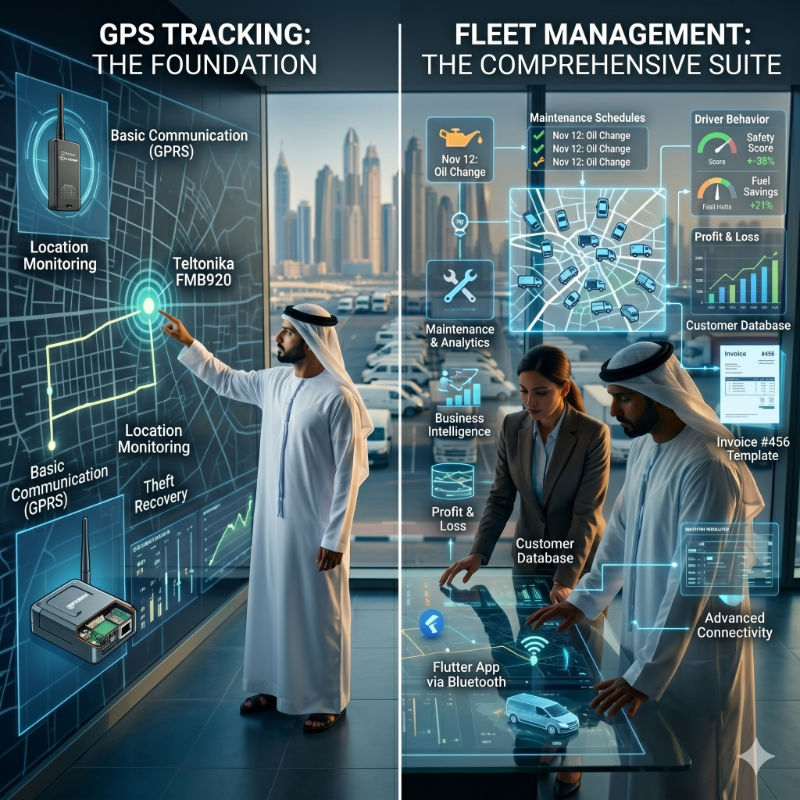
For a small business, fleet management means measuring four things all the time (where the vehicles are, fuel, how people drive, and maintenance) on a monthly per-vehicle subscription, so you stop running them on trust and receipts. You don't need a software project, a new department or a fleet manager. A typical UAE SME with 12 vehicles gets installed in a day, and an operations manager looks after it in about 20 minutes a week on the dashboard.
That matters because most small business owners assume fleet management starts at 100 trucks. It doesn't. The sums start working much earlier than people think, because a small fleet has no slack. One vehicle standing idle for a week is 8% of a 12-vehicle fleet's capacity, and a written-off van hits you like a capital purchase instead of a line item.
The numbers start to work at about five vehicles. Under that, an owner can honestly keep the whole operation in their head. Over it, the gap between what the owner thinks is happening and what's really happening on the road gets wider every month, and everything in that gap costs money.
We wrote this for UAE businesses running 5 to 50 vehicles: delivery and courier firms, MEP and maintenance contractors, small logistics companies, catering and F&B suppliers, car rental operators, landscaping and cleaning companies. If your operation is bigger or runs from several depots, our complete UAE fleet management guide is the better starting point.
Why UAE SMEs Can No Longer Run a Fleet on WhatsApp and Spreadsheets
The Three Costs That Move Fastest When Nobody Is Watching
Fuel is the first cost to move, and it moves with the market whether you're watching or not. The UAE Fuel Price Committee resets pump prices on the last day of every month, and the changes aren't small. Diesel rose to AED 3.80 per litre in August 2026, up from AED 3.60 in July, while Special 95 went from AED 3.29 to AED 3.49 over the same month. Take a ten-van fleet burning 1,200 litres a month. A AED 0.20 rise adds roughly AED 240 a month you never budgeted for, and that's before anyone has siphoned a single litre.
That monthly repricing is why controlling fuel by receipts doesn't work for SMEs. A receipt shows what was paid. It can't show whether the fuel went into your van, whether the tank was already half full, or whether the van did 60 km of personal driving on Friday. Fuel monitoring fills that gap by matching tank level against location and engine hours. A refuel that doesn't line up with a rise in the tank turns into an alert instead of a hunch.
Unauthorised use is the second cost, and you basically can't see it without location history. Weekend trips, personal errands during a shift, an extra stop on the way back from a drop. Each one is small. Added together they're fuel, tyres, service intervals and accident risk that the business pays for and never bills anyone for.
Then there's time. Overtime disputes, arguments with customers about arrival times, and the twenty minutes a day an owner spends ringing drivers to ask where they are. None of it shows up as a line in the P&L, which is exactly why it carries on. A timestamped location record settles all three without anyone having to argue.
Accident Exposure Is Rising, and a Small Fleet Feels It Hardest
UAE road accident figures went the wrong way last year, and fast. Ministry of Interior data reported by Gulf News shows 6,014 major road accidents in 2025, a 23% rise on the 4,898 recorded in 2024, and the number of people injured or killed rose 20% to 7,947. The same analysis puts about 60% of major crashes down to four behaviours: sudden deviation, distracted driving, tailgating and general negligence.
Telematics picks up and scores every one of those. Harsh lane changes, phone use, following distance and harsh braking are exactly what a driver behaviour monitoring system is there to show you. And it shows you every week, while you can still coach the driver, instead of in the insurance report after the crash.
For a small fleet the maths is harsh. A 200-vehicle operator absorbs an at-fault collision as a statistic. For a 10-vehicle SME it means 10% of the fleet off the road, an excess to pay, a loaded premium at renewal and maybe a customer contract in doubt. At this size fleet safety belongs on the balance sheet. Nobody should file it under corporate social responsibility.
SMEs Are the UAE Economy, and the Least Digitised Part of the Fleet Market
It's easy to underestimate how many businesses this covers. The UAE Ministry of Economy and Tourism counts roughly 395,000 micro enterprises, 150,000 small enterprises and 13,000 medium enterprises, and the SME sector contributes 63.5% of non-oil GDP. A very big share of the commercial vehicles you see around Dubai, Sharjah and Abu Dhabi belong to companies in that bracket.
Enterprise fleet platforms, though, are designed and priced for the other end of the market. That's left most UAE SMEs choosing between an oversized system they can't justify and nothing at all. In 2026 that's a false choice. Per-vehicle pricing, self-service dashboards and same-day installation have brought the entry point down so far that cost has stopped being the deciding question. What decides it now is whether the owner will actually act on what the data shows.
What a Small Fleet Actually Needs, and What It Can Safely Skip
The Four Non-Negotiables for a 5-30 Vehicle Fleet
Forget the long feature lists. For an SME, four capabilities bring in nearly all the return, and a system that does those four properly beats one that does thirty things half well.
Start with live location and trip history. You want live GPS tracking with at least 90 days of history kept. The live position answers dispatch questions. The history answers disputes, and disputes are where the money is.
Fuel monitoring comes next. On vans and cars, consumption can be worked out from engine data and distance. Trucks, tankers and plant need a tank sensor. Our fuel theft prevention guide explains which method suits which vehicle.
Third is driver behaviour scoring. Harsh braking, harsh acceleration, cornering, speeding and idling get rolled into a weekly score for each driver, and that score is what turns coaching into a habit instead of a row.
The fourth, maintenance scheduling, is the dullest and often pays back the most. Service intervals follow real odometer readings and engine hours instead of a wall calendar. Fleet maintenance scheduling matters on a small fleet because one missed service turns into a breakdown that takes 10% of your capacity out in the middle of the week.
One more feature is worth it for some SMEs, though not all: geofencing. If you've got a depot, fixed customer sites, or a rule about vehicles leaving an area after hours, geofence alerts enforce that rule automatically, so you aren't finding out about breaches weeks later.
What You Can Defer Until You Pass 50 Vehicles
Small businesses often overbuy and then blame the system for being complicated. These features are genuinely useful for big fleets and mostly a distraction for small ones.
- ERP and accounting integrations. Under 50 vehicles, a monthly CSV export into your accountant's process is quicker to set up and breaks less often than an API link.
- Custom dashboards and BI reporting. The standard weekly report has everything a 12-vehicle fleet will act on. Build custom views later, once you know which numbers you actually look at.
- Multi-camera AI systems. A dash camera makes sense for accident liability at any size, but multi-angle AI coaching camera setups belong in enterprise safety programmes. Put a front-facing camera on your riskiest vehicles first.
- Dedicated 24/7 monitoring desks. Phone alerts cover what an SME needs. A monitoring desk suits fleets that always have someone on shift.
Not sure if you need a full fleet platform or plain vehicle tracking? Our comparison of fleet management versus GPS tracking shows where the line sits.
What It Costs a UAE SME, and Where the Money Comes Back
The Real Monthly Cost Structure Per Vehicle
In the UAE, fleet tracking is priced per vehicle per month, and that subscription is the figure to compare. The hardware price tells you very little. Your bill has three parts: the tracking device, the M2M SIM and data that connects it, and the platform subscription. Installation is usually a one-off charge per vehicle. Plenty of providers fold the hardware into the subscription over the contract term, so comparing headline device prices gets you nowhere.
What really moves an SME quote is the number of vehicles, whether you need fuel-level sensors, whether cameras are included, and how long the contract runs. For current UAE price ranges by tier, our fleet management software cost guide breaks it all down. We've kept those figures out of this guide on purpose, because they change.
Compare the subscription against the leakage you measure, and forget comparing one quote with another. A quote is only expensive next to what it gets back for you, and a small fleet with no visibility has never measured what it's losing. So the first month of data is worth more than any sales proposal.
Four Payback Lines an SME Can Actually Measure
Vendors love to quote fleet-wide savings percentages. Ignore them. Measure these four on your own vehicles, because you can check each one against your own records within a quarter.
- Fuel and idling. Record litres per 100 km for each vehicle before rollout, then compare after eight weeks of driver scoring. Less idling is usually the first saving you'll see, and our fleet savings calculator will estimate the range for your vehicle count and monthly mileage.
- Insurance. UAE insurers have given premium relief on tracked vehicles for years. Khaleej Times reported discounts in the 5-10% range for fleets fitting electronic tracking devices. Ask your broker straight out at renewal and take your driver-score report along, because it's a negotiating document.
- Overtime and disputed hours. For one payroll cycle, check the hours people claimed against engine-on and geofence timestamps. For most SMEs this one reconciliation is the quickest and cleanest saving on the list.
- Unplanned maintenance. Count breakdowns and missed services for the six months before rollout, then for the six months after you switch to odometer-based scheduling. Small fleets usually find one or two avoidable failures a year, and each one costs more than a year's subscription on several vehicles.
If customers have started asking about sustainability in their tenders, the same trip data runs a fleet CO2 emissions calculator with no extra hardware.
Built for Small Fleets, Not Scaled Down From Enterprise
Per-vehicle pricing, same-day installation anywhere in the UAE, and a dashboard your operations manager can run in twenty minutes a week.
Compliance: What a UAE Small Business Must Have, by Emirate
There Is No Single UAE-Wide Mandate, and That Is the Trap
GPS tracking rules in the UAE are set emirate by emirate and by vehicle category. There's no single national rule. A small business running vans in Dubai faces different requirements from the same business running the same vans in Sharjah, and the rules can change depending on what the vehicle carries as well as what kind of vehicle it is.
In Dubai, SecurePath is the tracking and data-feed programme run by SIRA together with the RTA. It covers defined commercial vehicle categories, including rental fleets, logistics operators, hazardous-material and fuel transport, and heavy trucks. Where it applies, it's enforced at the point that hurts an SME most, which is registration renewal. Abu Dhabi runs Asateel under ITC, with its own list of approved devices.
In practice that means the device you buy has to be on the approved list for your emirate and vehicle category. A technically excellent tracker without certification won't get your vehicle through registration. Our SecurePath, SIRA and Asateel compliance guide covers each programme in detail, and the free UAE GPS compliance checker tells you which rules apply to your vehicle type and emirate in about a minute.
Getting Ahead of Compliance Is a Commercial Advantage, Not a Cost
Small businesses tend to leave compliance until last. In the UAE contracting market it's more and more often the first filter. Free zone operators, main contractors, ADNOC-tier clients and government tenders regularly ask for tracking capability, site access logs or driver safety records as a qualification step, before anyone talks about price.
An SME with 12 months of trip history, geofenced site logs and driver scores can answer those questions in an afternoon. One without them is either disqualified or scrambling. The data that saves you fuel is the same data that gets you onto a tender shortlist. It's rare for a cost control to pay off twice like that.
A 30-Day Rollout Plan for an Owner With No Fleet Manager
Week 1 and 2: Install, Baseline, and Say Nothing Yet
Don't act on the first week of data. You need a baseline before you can have a benchmark, so the first two weeks are only for measuring. Fit the whole fleet at once instead of piloting on three vehicles. A partial rollout gives you partial data and invites the complaint that the sample wasn't fair.
Over those two weeks, note four numbers for each vehicle: litres per 100 km, daily idling minutes, first engine-on and last engine-off, and total distance. Don't set targets. Don't confront anyone about a weekend trip. Don't change any process. You're finding out what normal looks like, and normal is only honest before people know they're being measured.
At the same time, tell your team plainly that the vehicles are being tracked and why. Quietly fitting trackers without saying anything is the most common way an SME rollout fails. It turns a cost-control tool into a breach of trust, and the pushback that follows costs more than the fuel you save. Call it what it is: protecting the company's assets, settling disputes and keeping overtime fair, with the same rules on every vehicle.
Week 3 and 4: Publish the Rules, Then Actually Enforce Them
Now turn the baseline into written rules. Three at most. Usually that's an idling limit, a rule on out-of-hours use enforced by a depot geofence, and a minimum driver score. Write them down, in Arabic and English if that's what your team reads, and say what happens when people meet them and when they don't.
Enforcement is where most SME rollouts quietly die. If the system flags a violation and nobody follows it up, the team learns to ignore it within a month, and from then on the subscription buys you nothing. Pick one fixed slot every week (fifteen minutes is plenty) to go through the weekly report and have one conversation with whoever's at the bottom of the scores.
Put recognition alongside enforcement. A weekly driver ranking with something small for whoever tops it changes behaviour faster than penalties and costs less. Drivers who know their score is visible and measured fairly tend to manage it themselves, and that's the result you're really paying for.
Choosing a Provider When You Have No Fleet Team to Vet One
Eight Questions That Separate a Provider From a Box Reseller
Ask these before you look at any price. The answers sort the market out quickly.
- Is the device on the approved list for my emirate and vehicle category, and can you show me the certification?
- What's the total monthly cost per vehicle including SIM, platform and support, with nothing billed separately later?
- What happens when the contract ends? Do I own the hardware, and can I keep my historical data?
- Who does the install, how long is each vehicle off the road, and can you install at my site?
- How fast does support respond, and is it available in Arabic?
- Can I see a live demo dashboard with real vehicles instead of a slide deck?
- How long do you keep trip history, and can I export it?
- If I add or remove vehicles partway through the contract, how does billing change?
A provider who answers all eight without dodging has done this for small fleets before. Our 2026 UAE GPS tracking buyer's guide goes further into judging hardware and vendors.
The UAE-Specific Requirements Nobody Puts on the Brochure
Generic global specs fall down here for purely local reasons, and an SME that buys on price usually finds out in July.
- Heat rating. A parked cabin in a UAE summer gets hotter than a device built for temperate markets is specified for. Get the operating temperature range in writing, and treat anything under +85°C as unsuitable.
- Dual-carrier SIM. Coverage on one network drops out in certain corridors and industrial areas. An M2M SIM with Etisalat and du failover keeps reporting where single-carrier devices go dark.
- Cross-emirate and GCC roaming. If your vans go into Oman or Saudi Arabia, check that roaming is included and won't be billed as an extra.
- Arabic and English interface. If your drivers and supervisors work in Arabic, an English-only dashboard and app will get used by exactly one person in your company.
- Local installation and support. Remote support for a device fitted to a van in Al Quoz isn't worth much. Make sure there's a UAE-based team that will come out to the vehicle.
For a wider look at how tracking behaves in UAE conditions, see our UAE GPS tracking overview.
The Four Mistakes UAE SMEs Make in Their First Year
Buying Hardware Instead of Buying an Outcome
The cheapest tracker on the market is the most expensive fleet decision an SME can make. Low-cost devices sold with no platform, no certification and no local support fix the purchasing problem and none of the operational ones. When the device dies in August, or fails registration, you pay for a replacement on top of what you already spent.
The related mistake is buying a platform for the fleet you hope to have in three years' time. Buy for the fleet you've got now, on terms that let you add vehicles without renegotiating. At this size, growth is a billing question. The architecture doesn't need to change.
The third mistake is treating fuel control as optional on vehicles where fuel is the biggest running cost. For a courier fleet of small vans, consumption analytics is enough. Anything with a large tank (trucks, tippers, generators, plant) is different. Estimated consumption won't catch siphoning there, and you need a tank-level sensor.
Rolling Out Silently, and Then Not Looking at the Data
The two things that really kill SME deployments are about people, and neither is technical. Fitting trackers in silence turns a legitimate business tool into a surveillance system that staff discover by accident, and that guarantees resistance from the people whose cooperation you need. Tell the team first, in writing, and explain the rules that will apply equally to everyone.
Not looking at the data is the quieter way to fail. A dashboard nobody opens is a subscription that buys you a false sense of control. The businesses that get a return don't necessarily have the best platform. They have someone who spends fifteen minutes every Sunday looking at four numbers and having one conversation.
If your vehicles also carry tools, equipment or trailers, bring those under asset tracking before you add more features to the vehicles you already cover. Seeing everything you own is worth more than seeing extra detail on what you can already see.
Start With a Baseline, Not a Contract
Tell us how many vehicles you run and what they carry, and we'll show you what a UAE small fleet like yours typically recovers in its first quarter.