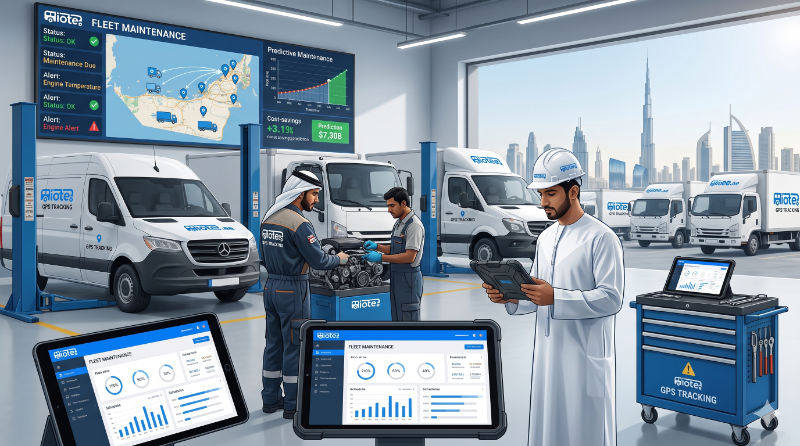
Why Fleet Management UAE Is a 2026 Imperative, Not a Nice-to-Have
For UAE fleet operators in 2026, fleet management has crossed the line from competitive advantage to operational necessity. The combination of rising fuel costs (diesel at AED 2.67/L, petrol AED 2.44-2.63/L), tightening RTA and Abu Dhabi DoT compliance requirements, customer expectations for real-time visibility, and the arrival of AI-powered telematics has made manual fleet operations economically unviable.
Industry data from across Dubai, Abu Dhabi, Sharjah, and the Northern Emirates shows that UAE fleets without a modern fleet management system typically lose 18-32% of their annual operating budget to a combination of fuel theft, idle time, suboptimal routing, accident-related downtime, missed maintenance windows, and administrative overhead. For a 50-vehicle fleet, that translates to AED 600,000 to AED 1.4 million per year evaporating through invisible inefficiency.
The operators winning the 2026 UAE market — whether logistics, construction, oil and gas, government, healthcare, retail distribution, or rental — share a common pattern: they treat their vehicles as a measured, instrumented, optimized asset class, not a cost center to be tolerated. A modern fleet management system in UAE typically delivers:
- 25-35% reduction in total fuel costs
- 30-45% reduction in unscheduled maintenance and breakdowns
- 40-60% reduction in unauthorized vehicle use
- 20-30% improvement in route productivity (deliveries per shift)
- 15-25% reduction in insurance premiums via accident reduction
- ROI between 4 and 10 months for fleets of 10+ vehicles
This 2026 guide is the complete reference for UAE fleet decision-makers. We cover what fleet management actually is, the six pillars that separate a real platform from a glorified GPS tracker, the UAE-specific requirements generic global systems get wrong, how to map solutions to your fleet size and industry, what UAE fleets really save in AED terms, and the 12-point checklist to vet any vendor before you sign. By the end you will have everything needed to either build the internal business case or shortlist the right partner — including how IOTee's fleet management platform is engineered specifically for the UAE environment.
What Is a Fleet Management System? (A Clear UAE-Specific Definition)
The Anatomy of Modern Fleet Management
A fleet management system is an integrated platform — combining hardware, cellular connectivity, cloud software, and AI analytics — that gives fleet managers complete visibility and active control over every vehicle, driver, and asset across their operation. It does not just track where vehicles are; it governs how they are used, how much they cost, and how safely and productively they operate.
A complete UAE fleet management platform consists of five integrated layers:
1. The Hardware Layer (In-Vehicle Sensors)
• GPS / GNSS trackers capturing position, speed, heading, altitude, and odometer data — typically updated every 10-30 seconds
• CAN bus / OBD-II adapters reading engine RPM, throttle, fault codes, fuel level, ignition state, and onboard diagnostics from the vehicle's ECU
• Driver ID readers (RFID, iButton, or facial recognition) tying every trip to a specific driver
• Fuel level sensors (capacitive or ultrasonic) for ±0.5% accurate tank measurement
• Accelerometers and gyroscopes detecting harsh acceleration, braking, cornering, and impact events
• Multi-channel cameras (dash cams, side, rear, and interior driver-monitoring cameras) for video evidence and AI-driven safety
• Temperature sensors for cold-chain and pharmaceutical fleets
2. The Connectivity Layer (Cellular and Cloud)
• M2M cellular SIM cards transmitting telemetry continuously over 4G/LTE-M, with automatic failover between Etisalat and du for nationwide coverage
• Low-latency uplink (sub-3-second alert delivery) for real-time use cases
• Edge buffering during dead zones, automatic upload on reconnection
IOTee's purpose-built M2M SIM cards are engineered specifically for UAE fleet telemetry — generic consumer SIMs fail at scale.
3. The Software Layer (The Platform)
• Web and mobile dashboards with role-based access for operations, maintenance, finance, HR, and executives
• Real-time map view with vehicle status, driver assignment, and live alerts
• Historical trip replay, route playback, and incident reconstruction
• Customizable rules engine (geofences, speed limits, idle thresholds, hours-of-service)
• Reports library and scheduled exports (PDF, Excel, CSV)
• REST APIs for ERP, accounting, fuel card, and HR integrations
4. The Intelligence Layer (AI and Analytics)
• AI-driven driver behavior scoring with coaching recommendations
• Predictive maintenance models flagging components before failure
• Route optimization algorithms accounting for live traffic, RTA Salik gates, and time-of-day patterns
• Anomaly detection for theft, fraud, and policy violations
• Benchmarking across vehicles, drivers, depots, regions, and emirates
5. The Compliance and Reporting Layer
• RTA-compliant reporting formats for Dubai, Abu Dhabi, and Sharjah operators
• Tender-grade audit trails for government contract bidders
• VAT-compliant fuel and expense exports for UAE finance teams
• Driver hours-of-service logs for transport-and-logistics operators
• Tamper-proof timestamps and chain-of-custody records
A basic GPS tracker stops at layers 1 and 2 — it tells you where vehicles are. A real fleet management platform — like IOTee's fleet management system — covers all five layers, transforming raw vehicle data into operational and financial intelligence.
Fleet Management vs Vehicle Tracking vs Telematics: Clearing Up UAE Buyer Confusion
UAE buyers routinely conflate three distinct categories. Getting the terminology right is the first step to buying the right system at the right tier.
Vehicle Tracking (Entry Tier)
• Pure GPS location and basic trip history
• Speed alerts and simple geofences
• Mostly historical, lightly real-time
• Best for: 1-5 vehicles, asset recovery use cases
Telematics (Operational Tier)
• GPS plus vehicle data (engine, fuel, diagnostics)
• Driver behavior basics (harsh events, speeding)
• Reporting and basic dashboards
• Best for: 5-20 vehicles, operational visibility
Fleet Management (Strategic Tier)
• Telematics plus active platform: maintenance scheduling, driver coaching, fuel control, compliance reporting, financial dashboards, ERP integrations, multi-depot operations
• AI/ML layer for prediction and optimization
• Cross-functional usage (ops, finance, HR, executive)
• Best for: 15+ vehicles, any operator with multi-stakeholder accountability
The simple rule: tracking tells you what happened. Telematics tells you what happened in detail. Fleet management tells you what happened, why it happened, what to do next, and how much it costs — and then automates the response. UAE fleets that buy 'tracking' when they need 'fleet management' end up bolting on three or four extra systems within 18 months at three times the cost of buying right the first time.
The Six Pillars of Modern Fleet Management for UAE Operators
Pillar 1: Real-Time Vehicle Tracking and Visibility
Every modern fleet management deployment starts here. Real-time visibility is the foundation on which every other capability is built.
What 'real-time' actually means in UAE conditions:
• Position update frequency: 10-30 seconds when moving, 60-300 seconds when stationary (battery-conscious for trailers and assets)
• Alert latency: under 3 seconds from event to dashboard or push notification
• Coverage: 99.5%+ of UAE road network, including remote routes (Liwa, Hatta, Sweihan, Madinat Zayed, RAK mountain regions)
• Cellular failover: automatic Etisalat/du switching for cross-emirate routes
What you do with real-time visibility:
• Live dispatch decisions for delivery and service fleets
• Geofence-based alerts (entered customer site, left depot, crossed emirate boundary)
• Customer-facing ETA accuracy for B2B/B2C delivery operations
• Theft and unauthorized-use detection with under-3-minute response time
• Salik gate transit verification and reconciliation
IOTee's real-time GPS tracking platform is the visibility layer that feeds every other module — without accurate real-time positioning, every analytics output downstream is suspect.
Pillar 2: Fuel Management (The Largest Cost Lever)
Fuel is 30-40% of total UAE fleet operating cost — making fuel management the single largest financial lever in your platform. A serious fleet management system treats fuel as a first-class workflow, not an afterthought.
What fuel management within the platform must do:
• ±0.5% accurate fuel level monitoring via in-tank sensors
• Automatic refuel detection with GPS station verification (was the truck actually at ENOC, ADNOC, EPPCO, or Emarat?)
• Theft and siphoning detection with sub-3-minute alerts
• Fuel card integration and reconciliation (matching card transaction against measured fill)
• Per-vehicle, per-driver, and per-route consumption analytics
• Idle-fuel tracking (UAE traffic + summer AC = significant invisible burn)
This is so consequential that we wrote a complete UAE fuel management buyer's guide and a reduce fuel consumption guide that go deep on this single pillar. For most UAE fleets, fuel module ROI alone justifies the entire platform investment.
IOTee offers three integrated tiers: fuel tracking for visibility, fuel control for active enforcement, and fleet fuel management for enterprise multi-depot operations.
Pillar 3: Driver Behavior, Safety, and Coaching
Two drivers on identical vehicles on identical UAE routes can produce a 30-60% gap in fuel efficiency, a 5x gap in accident risk, and a 3x gap in insurance claims. Driver behavior is the second-largest cost lever after fuel — and the most under-managed.
Modern driver behavior modules combine:
• Telemetry-based event detection (harsh acceleration, braking, cornering, speeding above posted UAE limits)
• AI-powered video analysis from forward and driver-facing cameras (drowsiness, distraction, phone use, seatbelt detection)
• Composite driver score (0-100) normalized for route, vehicle type, and load
• Automated coaching workflows with video evidence
• Gamification — leaderboards, recognition for top performers, structured improvement for the bottom 10%
• Insurance integration — many UAE insurers now offer 10-20% premium reductions for fleets with proven driver scoring
The combination of in-cabin driver monitoring cameras plus telematics-based scoring is the gold standard. UAE fleets running both consistently report 40-60% accident frequency reduction within 12 months — translating directly to lower insurance, fewer write-offs, less downtime, and reduced legal exposure under UAE traffic law.
For the comprehensive technology breakdown, see our vehicle dashboard camera UAE guide and the multi-camera dash cam guide.
Pillar 4: Maintenance Management and Predictive Servicing
An unscheduled breakdown in 50°C UAE summer heat is not just an inconvenience — it is a safety incident, a SLA breach, and a six-figure annualized cost on a mid-size fleet. Modern fleet management replaces the reactive 'service when something fails' model with predictive maintenance driven by telemetry data.
What predictive maintenance modules deliver:
• Automatic service scheduling by mileage, engine hours, time, or fuel consumption
• ECU fault code (DTC) ingestion with severity ranking
• Component-level predictive models (battery, brakes, tires, injectors, alternator, AC compressor) trained on UAE-specific failure patterns
• Service history per vehicle with full audit trail
• Workshop and parts-supplier integrations
• Tire management with pressure monitoring (critical at UAE summer temperatures — under-inflated tires fail catastrophically above 60°C asphalt)
• Cost-per-kilometer and total-cost-of-ownership tracking per vehicle
The payoff: UAE fleets running predictive maintenance see 30-45% reduction in unscheduled breakdowns, 15-25% extension in vehicle life, and 20-30% reduction in maintenance spend. IOTee's fleet maintenance module and tire management are integrated into the same platform that runs your tracking and fuel — one source of truth, no double entry.
Pillar 5: Compliance, Reporting, and Government Integration
UAE fleet compliance has tightened sharply through 2024-2026. Operators must meet — and prove they meet — requirements from RTA Dubai, Abu Dhabi DoT, Sharjah RTA, Federal Transport Authority, and (for cross-border) Saudi Mawasalat under the GCC framework. A modern fleet management platform handles this automatically.
UAE compliance capabilities to demand:
• RTA-compliant reporting: Dubai RTA permit holders and Abu Dhabi public transport operators have specific reporting templates — your platform should generate them on demand
• SecurePath / Asateel-style mandatory tracking compliance for vehicle classes and zones that require it (see our SecurePath/Asateel compliance guide)
• Driver hours-of-service logs with tamper-proof timestamps for transport, logistics, and oil-and-gas operators
• Tender-grade audit trails for fleets bidding on government and semi-government contracts (ADNOC, Emirates Global Aluminium, RTA, Emaar, DEWA, ADDC, Etihad Rail support fleets)
• Salik gate transit logs matching toll charges to vehicle activity
• Federal Decree-Law No. 45 of 2021 data protection compliance for driver personal data
• VAT-compliant fuel and expense exports for UAE finance and audit
• Customs and border logging for Saudi, Oman, and other GCC routes
Fleets that try to retrofit compliance after contract loss find it costs 3-5x more than building it in from day one. Government and enterprise tenders increasingly require platform-generated audit reports as a precondition to even being shortlisted — making compliance capability a revenue determinant, not a cost item.
Pillar 6: Analytics, BI, and Financial Intelligence
The first five pillars generate enormous data volumes — but data without analytics is noise. The intelligence layer is what converts telemetry into board-level decisions.
What world-class fleet analytics looks like:
• Operational KPIs: vehicle utilization, deliveries per shift, on-time-arrival rate, idle time per vehicle, average trip duration
• Financial KPIs: cost per kilometer, cost per delivery, cost per ton-kilometer (logistics), revenue per asset, gross margin per route
• Risk KPIs: accident rate per million km, near-miss frequency, driver score distribution, claims frequency and severity
• Sustainability KPIs: CO₂ per km, idle emissions, fuel efficiency trend, EV-readiness scoring
• Customer KPIs: SLA adherence, ETA accuracy, proof-of-delivery cycle time
The analytics deliverables UAE finance teams demand:
• Variance analysis (budget vs actual) with automated explanations
• Department-level cost-center allocation and chargebacks
• VAT-compliant exports to QuickBooks, Zoho Books, Tally, Oracle, and SAP
• Tender bid support — true cost-per-kilometer for accurate pricing
• Insurance renewal data packs (driver scores, accident history, mileage)
• Board-level monthly fleet performance dashboard
Without this layer, fleet management remains an operations tool. With it, fleet becomes a CFO conversation — which is how you unlock the budget for expansion, premium hardware tiers, and platform-wide rollouts.
UAE-Specific Requirements: Why Generic Global Fleet Systems Fail Here
What to Demand from a Fleet Management System in UAE Conditions
A platform engineered for European, North American, or South Asian conditions almost always struggles in the UAE. The local environment imposes seven distinct requirements that generic systems rarely meet out of the box.
Requirement 1: Heat-Rated Hardware (Operational at 70°C+ Cabin Temperatures)
Dubai and Abu Dhabi summer cabin temperatures exceed 75°C for several months per year. Underbody and engine-bay temperatures are higher still. Devices rated for 60°C operating ceilings fail in their first summer. Demand:
• Operating range -20°C to +85°C minimum (industrial grade)
• IP67 or IP68 sealed enclosures
• UV-stable cable insulation (UV degrades non-stable cabling within 12-18 months in UAE)
• Documented MTBF at high ambient temperatures
• Lithium chemistry rated for high temperature (standard Li-ion swells and fails)
Requirement 2: Dual-Network Cellular with Automatic Failover
No single UAE carrier covers every kilometer of every route. Cross-emirate routes (Dubai-Al Ain via Sweihan, Abu Dhabi-Liwa, RAK mountain regions, Hatta, coastal Fujairah) have known dead zones on individual networks. Demand multi-IMSI SIMs with automatic Etisalat/du failover — not a 'fallback' setting that requires manual switching.
Requirement 3: Bilingual Arabic/English (Beyond Translation)
Real Arabic UI is more than text translation:
• Right-to-left layout that genuinely works (not just `dir="rtl"`)
• Arabic numerals with Hindi-Arabic option for government reports
• Hijri calendar support for compliance and HR workflows
• Arabic driver-facing app for the substantial Arabic-first driver workforce
• Government reports in Arabic when required
Requirement 4: UAE Tax, VAT, and Fuel Card Native Integration
- 5% VAT on fuel and service invoices flowing automatically to accounting
- ADNOC, ENOC, EPPCO, Emarat, Euromax fuel card APIs
- Salik toll gate reconciliation
- Darb (Abu Dhabi toll) integration for fleets crossing emirate boundaries
Requirement 5: Multi-Emirate Geofencing and Rule Sets
UAE fleets routinely operate across multiple emirates with different rules per jurisdiction: shift hours, overnight parking permits, restricted zones, RTA permit boundaries, free zone access (JAFZA, KIZAD, RAKEZ, DAFZA, DMCC, DSO). The platform must support emirate-specific rule layers, not a one-size geofence policy.
Requirement 6: Government and RTA Reporting Templates
Out-of-the-box compliance with RTA Dubai, Abu Dhabi DoT, Sharjah RTA, Federal Transport Authority, and SecurePath/Asateel reporting formats. Custom-building these reports later costs 5-10x what including them upfront does.
Requirement 7: Dust Ingress Protection (Beyond Standard IP)
UAE micro-dust is finer than typical desert dust. Standard IP65 connectors fail in 18 months from dust ingress alone — particularly common on construction and oil-and-gas fleets in Western Region, Mussafah, and ICAD industrial areas. Demand IP67 minimum on all exposed connectors and field-validated dust resistance.
These seven requirements are not nice-to-haves — they are the difference between a platform that demos beautifully and one that operates reliably for five-plus years in your fleet.
Fleet Management Solutions Mapped to Fleet Size and Industry
Which IOTee Solution Fits Your Fleet Profile?
No single configuration fits every UAE fleet. Sizing the platform to your actual operation — not over-buying enterprise features for a 20-vehicle fleet, not under-buying tracking when you need full management — is the single biggest determinant of ROI.
Small Fleets (5-20 vehicles): Tracking + Fuel Foundation
*Typical profile*: SME logistics, local delivery, service vans, plumbing/HVAC contractors, small rental operators.
*Recommended stack*: Real-time GPS tracking + fuel tracking + basic driver behavior + dash cameras for accident protection.
*Why*: Theft detection, consumption visibility, basic accountability — 80% of the value for 35-40% of enterprise platform cost. Most small UAE fleets see ROI in 4-6 months. Leave room to add maintenance and full fleet management later as you scale.
Mid-Size Fleets (20-75 vehicles): Integrated Platform
*Typical profile*: Regional logistics, food and beverage distribution, rental and leasing, construction support fleets, corporate executive fleets.
*Recommended stack*: Fleet management platform with all six pillars active, maintenance module, driver behavior monitoring, vehicle camera systems, and geofencing.
*Why*: At this scale, fuel, maintenance, drivers, and compliance are interdependent. Three siloed point tools cost more and produce less than one integrated platform. ROI typically 5-9 months.
Large Fleets (75-300+ vehicles): Enterprise Multi-Depot
*Typical profile*: Enterprise logistics, waste management, oil and gas service fleets, large rental and leasing companies, government contractor fleets, retail distribution networks.
*Recommended stack*: Full fleet management platform with multi-depot, multi-emirate, multi-department support; fuel control at depot dispensers; fleet fuel management for enterprise reporting; full driver and camera coverage; ERP integrations.
*Why*: Department chargebacks, tender compliance, VAT-accurate accounting, and board-level financial reporting all become hard requirements. The ROI case shifts from operational savings to risk mitigation, audit readiness, and competitive bid positioning.
Industry-Specific Configurations
- Logistics and transport — long-haul + cross-border modules, driver hours-of-service, multi-emirate compliance, transport and logistics fleet solutions
- Construction — construction transport, heavy equipment tracking, fuel control at site bowsers, geofenced site access, dust-tolerant hardware
- Government — full audit trail, tender-grade reporting, per-department chargebacks, government fleet solutions
- Oil and gas — intrinsically-safe sensor variants, hazardous-zone rated hardware, depot dispensing control
- Healthcare and emergency — priority routing, response-time SLAs, emergency response fleet UAE
- Cold chain — temperature monitoring, cold chain tracking, reefer fuel oversight
- School transport — school bus tracking UAE with parent app, RTA-compliant safety reporting, child onboarding/offboarding alerts
- Rental and leasing — rental car fleet UAE with booking-period geofencing, mileage limits, fuel-level capture at handover
- Waste management — waste management fleet UAE with route adherence, missed-collection detection
- Food and beverage delivery — food and beverage delivery fleet UAE with temperature plus delivery proof-of-service
The right question is rarely 'which product' — it is 'which combination, configured how, rolled out in what order'. That conversation is worth having with our team before you commit, because the first 90 days of rollout shape the next five years of value.
Run Your Entire Fleet from One Dashboard
GPS tracking, fuel, maintenance and driver analytics in one platform — from AED 500 per vehicle per year.
The Financial Case: What UAE Fleets Actually Save
A Concrete 50-Vehicle Mid-Size UAE Fleet Model
Let's model a representative Dubai-based mixed delivery fleet: 50 light commercial vehicles, 120 km/day average, 26 working days/month, 11 km/L average consumption, 15 driver-attributed roles.
Annual baseline (before fleet management):
| Cost Category | Annual AED |
|---|---|
| Fuel (50 × 120km × 26d × 12mo ÷ 11 × 2.67) | 446,400 |
| Maintenance (AED 8,000/vehicle/year) | 400,000 |
| Insurance (AED 6,000/vehicle/year) | 300,000 |
| Salik / Darb tolls | 90,000 |
| Accident-related downtime/repairs | 180,000 |
| Administrative overhead (manual reports, reconciliation) | 120,000 |
| Total annual baseline | AED 1,536,400 |
Estimated hidden losses across the baseline:
• Fuel theft and waste: 18% of fuel = AED 80,352
• Unscheduled breakdowns: 30% of maintenance = AED 120,000
• Avoidable accidents: 40% of accident cost = AED 72,000
• Unauthorized use, idle fuel, route inefficiency: AED 75,000
• Manual admin time savings opportunity: AED 60,000
Total recoverable opportunity: ~AED 407,000 per year
After full fleet management deployment (Year 1, conservative):
| Improvement Lever | Conservative Recovery | Annual AED |
|---|---|---|
| Fuel savings (theft + idle + behavior + routing) | 28% of fuel cost | 124,992 |
| Maintenance savings (predictive + extended life) | 22% of maintenance | 88,000 |
| Insurance reduction (driver scoring + camera evidence) | 15% of insurance | 45,000 |
| Accident frequency reduction | 35% of accident cost | 63,000 |
| Admin automation | 50% of admin overhead | 60,000 |
| Total Year 1 savings (conservative) | | ~AED 380,992 |
System investment (typical UAE pricing for 50-vehicle mid-tier deployment):
• Hardware + installation: AED 1,500-2,500/vehicle = AED 75,000-125,000 one-time
• Software + connectivity: AED 70-130/vehicle/month = AED 42,000-78,000 annual
• Cameras + driver monitoring (selective coverage): AED 1,800-2,800/vehicle on covered subset = AED 36,000-56,000 one-time
Year 1 net position:
• Total savings: ~AED 381,000
• Total investment: ~AED 130,000-180,000 (hardware + cameras) + ~AED 60,000 (software year 1) = AED 190,000-240,000
• Year 1 net benefit: AED 140,000-190,000
• Break-even: month 6-9
Year 2 onwards: Hardware capital is paid off — savings of AED 380,000+/year flow mostly to the bottom line against AED 60,000-80,000 in software, connectivity, and replacement hardware. Net annual benefit: AED 300,000+ per year, ongoing.
For enterprise fleets (200+ vehicles), the absolute numbers scale linearly while the percentage ROI typically improves due to platform leverage. For small fleets (under 20), the percentage savings are similar but absolute investment payback is faster (4-6 months) due to simpler configurations.
This is why UAE fleets in 2026 do not ask 'should we deploy fleet management' — they ask 'why have we not deployed it yet'.
How to Choose a Fleet Management Provider in UAE: 12-Point Vendor Checklist
The Disqualification-Grade Checklist Every UAE Fleet Should Use
Use this checklist when evaluating any fleet management vendor in the UAE. Any single failure on items 1-6 should disqualify a vendor immediately — these are non-negotiables for UAE conditions.
Hardware and Reliability
1. Hardware rated for UAE heat — operating range -20°C to +85°C, IP67 minimum, documented field reliability through at least two UAE summers
2. Independent calibration certificates for fuel sensors at ±0.5% accuracy
3. Reference UAE customers at your scale — minimum three named, with three or more years of field data
Connectivity and Coverage
4. Dual-network cellular with automatic Etisalat/du failover, not manual
5. Documented uptime SLA of 99.5% or higher with credit-back terms
6. Sub-3-second alert latency demonstrated in UAE deployment, not data sheet
Software, Compliance, and Integration
7. All six pillars in one platform — tracking, fuel, driver, maintenance, compliance, analytics — not stitched together from acquisitions
8. True bilingual Arabic/English — UI, driver app, reports, and government formats
9. RTA, Abu Dhabi DoT, Sharjah RTA, SecurePath / Asateel report templates ready out-of-the-box
10. Open APIs and data portability — REST/GraphQL APIs, standard exports, no proprietary lock-in
Service, Support, and Commercial
11. Local UAE installation, support, and account management team — not remote-only or contracted-out
12. 24/7 support in Arabic and English with documented response time SLAs
Commercial terms to negotiate before signing:
• Pilot deployment (5-10 vehicles, 60-90 days) at a reasonable price before any volume commitment
• Hardware ownership clarity — you own the hardware at end-of-contract, not lease-back
• Data portability written into the contract — your fuel, GPS, driver, and maintenance data is exportable in standard formats at any time, free of charge
• No multi-year hardware lock-ins with onerous early-termination fees
• Documented upgrade path for sensors and platform versions
• Volume pricing tiers disclosed upfront
Red flags to walk away from:
• Hardware that requires proprietary software you can never replace
• Opaque per-feature pricing that scales unpredictably
• 'Lifetime' licenses with hidden expiration clauses
• Vendors who cannot name three UAE reference customers at your scale, in your industry
• Subcontracted installation teams without traceability
• Refusal to support a structured pilot
• Demos that only work on internet-perfect conditions and never run on real UAE roads
Implementation: The 90-Day UAE Fleet Management Rollout Playbook
From Signed Contract to Full Value in 12 Weeks
The biggest mistake UAE fleets make is treating fleet management like a hardware procurement. It is a change-management project that happens to involve hardware. Treat it that way and you double the ROI.
Weeks 1-2: Baseline and Design
• Capture 60-90 days of pre-system data (fuel cards, maintenance records, accident logs, customer SLA data)
• Document current 'dark spots' — where do you suspect theft, waste, breakdown risk, or driver issues?
• Define explicit success metrics with target ranges: fuel L/100km, idle %, on-time-arrival %, accidents/M-km, cost-per-km
• Configure tenant, users, roles, geofences, and alert recipients
• Identify the executive sponsor — without one, projects stall at month four
Weeks 3-5: Pilot Installation (5-10 vehicles)
• Install hardware on a representative vehicle mix (different makes, ages, routes, drivers)
• Calibrate fuel tanks vehicle-by-vehicle (critical — never accept generic calibration)
• Validate sensor accuracy with controlled drain tests
• Tune alert thresholds to your fleet's normal variance
• Train operations and dispatch teams on dashboard and response workflows
• Brief drivers transparently — announce monitoring, set 'amnesty' boundary date, communicate the why
Weeks 6-8: Full Fleet Rollout
• Staggered installation, maximum 6-8 vehicles per day per installation team
• Each vehicle validated end-to-end before returning to operations
• Driver onboarding sessions in Arabic and English
• Day-1 amnesty policy: announce that monitoring starts on date X, all pre-date behavior is forgiven, post-date is policy
• HR and legal briefings — written disclosure, signed acknowledgments per UAE Federal Decree-Law No. 45 of 2021
Weeks 9-11: Coaching and Optimization
• First driver behavior reports generated
• Bottom 10% drivers receive individual coaching with video evidence
• Top 10% drivers receive recognition (gamification active)
• Maintenance schedules transitioned from time-based to usage-based
• Fuel theft alerts tuned with real-world noise
• First fuel card reconciliation cycle completed
Week 12: Business Review and Scale
• First full month-over-month comparison vs baseline
• Finance-facing ROI report generated and presented to executive sponsor
• Decision points: expand to remaining depots, add fuel control or cameras, integrate ERP, scope EV transition planning
• Insurance renewal data pack prepared for next renewal cycle
UAE fleets that follow this playbook consistently hit 20%+ savings by month 4 and 30%+ by month 9. Fleets that skip change management and treat rollout as a hardware project typically achieve half those savings for the same investment — and frequently kill the project before it pays back.
Go deeper: Our vehicle GPS tracking hub covers devices, pricing and installation for cars and fleets across the UAE.
Frequently Asked Questions: Fleet Management UAE
How much does a fleet management system cost in UAE?
Total cost depends on fleet size, capability tier, and service level. Typical 2026 UAE pricing:
- Hardware + installation per vehicle (one-time): AED 1,200-1,800 for tracking-tier; AED 1,800-2,800 for full telematics with driver behavior; AED 2,800-4,500 for advanced configurations including AI cameras and depot-grade fuel control
- Software + connectivity per vehicle/month: AED 50-90 for tracking-tier; AED 90-160 for full fleet management; AED 160-260 for enterprise multi-depot platforms
- Enterprise setup and integration fees: AED 15,000-60,000 depending on ERP, accounting, and HR integrations
For a 50-vehicle mid-size fleet, expect a year-one total investment of AED 180,000-260,000 and ongoing annual costs of AED 60,000-100,000. Most UAE fleets recover this within 6-9 months through fuel, maintenance, and insurance savings combined.
What is the difference between fleet management and GPS tracking?
GPS tracking is one component of fleet management. GPS tracking answers 'where is the vehicle' using location data. Fleet management is a complete operational platform that uses GPS as one of several data sources — combining it with fuel sensors, driver behavior, vehicle diagnostics, maintenance schedules, compliance reporting, and financial analytics — to actively manage the entire fleet operation.
Think of GPS tracking as a single dashboard gauge and fleet management as the entire flight deck. UAE fleets that buy GPS tracking when they need fleet management end up bolting on three or four extra systems within 18 months at far higher total cost than buying right the first time. For a complete breakdown, see our Fleet Management vs GPS Tracking guide.
Is fleet management mandatory in UAE?
Comprehensive fleet management is not universally mandatory, but specific GPS tracking and reporting is mandatory for several vehicle classes and zones in the UAE:
- SecurePath / Asateel mandatory tracking compliance for designated commercial and government-related vehicle classes
- RTA Dubai requires real-time tracking on permitted commercial transport, taxi, and limousine fleets
- Abu Dhabi DoT and Integrated Transport Centre require tracking on public bus, school bus, and contracted transport fleets
- Sharjah RTA has parallel requirements for licensed commercial vehicles
- School transport — RTA-licensed school buses must run approved tracking with parent notification capability
- Hazardous goods, fuel transport, and certain construction operations have sector-specific tracking requirements
A modern fleet management platform satisfies these mandates as a baseline and unlocks the broader operational and financial value on top. For a deep dive, see our SecurePath/Asateel mandatory tracking compliance guide.
Can a fleet management system integrate with ADNOC, ENOC, EPPCO and Emarat fuel cards?
Yes. Modern UAE fleet management systems ingest fuel card transaction feeds via API from all major UAE fuel card issuers — ADNOC, ENOC, EPPCO, Emarat, Euromax, and corporate providers. The platform automatically reconciles each card transaction against the actual refuel event detected by the on-vehicle fuel sensor. Discrepancies — the card was charged for 65L but the sensor measured only 48L added — are flagged as potential receipt fraud. This single integration typically eliminates 50-80% of fuel card abuse within the first quarter.
How long does fleet management installation take in UAE?
Standard installation per vehicle takes 1-3 hours depending on configuration (tracker only, tracker + fuel sensor, full configuration with cameras and CAN-bus integration). A 50-vehicle rollout completes in 5-8 working days of installation time, typically spread across 2-3 weeks to minimize operational disruption. Including baseline, pilot, full rollout, and coaching phases, a 50-vehicle deployment fits comfortably in a 90-day window. Larger fleets (200+ vehicles) typically run 4-6 month rollouts in phased waves by depot, region, or vehicle class.
Is it legal to monitor drivers and vehicles in UAE?
Yes — monitoring company-owned vehicles, fuel consumption, and driving behavior is legal and widely practiced across the UAE. Compliance under UAE Federal Decree-Law No. 45 of 2021 (personal data protection) requires:
1. Written disclosure in the employee handbook or employment contract
2. Signed driver acknowledgment of the monitoring scope and purpose
3. Purpose limitation — data used only for operational, safety, and compliance purposes, not personal surveillance outside work hours
4. Data retention controls — defined retention periods, secure deletion processes
5. Privacy zones — off-hours and personal-use data masking when applicable
Reputable platforms ship with built-in privacy and data-protection controls so compliance is configured at deployment, not improvised later.
Can I start small and scale up?
Yes — and for most UAE fleets, this is the smartest path. Modern platforms (including IOTee's) are modular: start with real-time GPS tracking plus fuel tracking, prove the ROI, then layer in maintenance, driver behavior monitoring, cameras, fuel control, and finally enterprise fleet fuel management as you grow. Same hardware, same data, same platform — just expanding software tiers. This protects your initial investment while letting capability scale without rip-and-replace.
Which UAE emirates does IOTee cover?
IOTee operates fleet management deployments across all seven emirates of the UAE — Dubai vehicle tracking, Abu Dhabi fleet management, Sharjah GPS solutions, Ajman fleet management, Ras Al Khaimah GPS tracking, Fujairah vehicle tracking, and Umm Al Quwain fleet solutions — plus extended GCC coverage including Oman (Muscat, Sohar, Sur, Salalah, Nizwa). Local installation, support, and account management teams are based in the UAE.
What happens to fleet data if we change providers?
Your fleet data is a strategic operational asset — treat it as such. Before signing any fleet management contract, demand written confirmation that:
- All historical telemetry, fuel, driver, and maintenance data is exportable at any time in standard formats (CSV, JSON, Parquet, SQL dump)
- Data export is free and unlimited, not per-record or per-month
- No vendor lock-in clauses prevent migration
- Hardware unlocking and re-flashing procedures are documented
- APIs remain accessible during contract notice period
Reputable UAE providers — IOTee included — treat data portability as standard. Vendors who resist this conversation should not make your shortlist.
Does fleet management work for EV and hybrid fleets?
Yes. Modern fleet management platforms support EV, hybrid, and ICE vehicles in the same unified dashboard. EV-specific capabilities include state-of-charge monitoring, charging session tracking, range prediction, charger geofencing, regenerative-braking efficiency analysis, and battery health trend analytics. As UAE fleets transition to EV through 2026-2030 — driven by Dubai's Green Mobility Strategy and Abu Dhabi's sustainability mandates — a platform that handles mixed-energy fleets is essential. Avoid ICE-only systems that will need replacement within three years.
Next Steps: Building Your Fleet Management Business Case
From Reading to Rolling Out
If you have read this far, you are past the question of whether to deploy fleet management. The remaining question is how to build the internal case and which configuration matches your operation.
Three-step recommendation:
Step 1: Quantify your current fleet operating baseline. Pull 90 days of fuel card statements, maintenance invoices, accident logs, and customer SLA data. Calculate cost-per-kilometer and identify your top three loss categories. Most UAE fleets find 18-32% of operating spend is recoverable — that is your savings pool.
Step 2: Read the deep-dive companion guides. This pillar guide is intentionally broad. For technology layer specifics, read the GPS tracking buyer's guide and the fuel management complete guide. For vehicle and driver safety, see the vehicle dashboard camera UAE guide and the why UAE needs car tracker dash camera deep dive.
Step 3: Run a structured pilot. Pick 8-15 representative vehicles, run a 60-90 day pilot against the same routes and drivers, measure the delta against your baseline, then scale with confidence. Any vendor serious about UAE market share will support a structured pilot on transparent commercial terms.
IOTee partners with fleets across Dubai, Abu Dhabi, Sharjah, Ajman, Ras Al Khaimah, Fujairah, Umm Al Quwain, and across Oman — from 10-vehicle SME operators to 500+ vehicle enterprise fleets and government contract holders. Every deployment starts with a scoping conversation matched to your operational profile, not a pre-packaged sales pitch. Whether you need a foundation tier of GPS tracking and fuel tracking, a full integrated fleet management platform covering all six pillars, or an enterprise fleet fuel management deployment with multi-depot support, the configuration should be shaped around your operation — not the other way around.
The UAE fleets that will dominate the next five years are the ones that stop treating their vehicles as a cost center and start treating them as a measured, instrumented, optimized asset class. This guide is the map. The next move is yours.