What Is a Fleet Maintenance System?
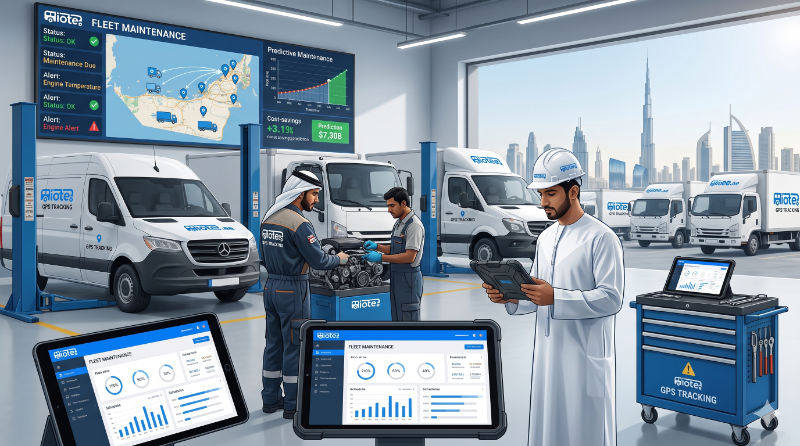
A fleet maintenance system is software, usually paired with telematics hardware, that plans, schedules, tracks and records every service and repair across your fleet. Servicing happens on a plan built from real usage data. You stop waiting for something to break.
For each vehicle, it answers four questions without anyone having to chase them:
- What service is due (oil change, brake inspection, tyre rotation, RTA/Mulkiya renewal)?
- When is it due: by date, odometer reading or engine hours?
- Who's responsible, and what will it cost?
- What's the full history of every repair, part and dirham spent on that asset?
UAE fleets have it harder than most. 50°C heat, dust and heavy daily use wear vehicles out fast, so moving from reactive to systematic maintenance pays back better here than almost any other operational change you could make. Think about one unplanned breakdown on Sheikh Zayed Road. You pay for the tow, the downtime, the missed deliveries and a driver sitting idle, and the repair bill is usually bigger than if the fault had been caught early. The preventive service that would have avoided it costs far less.
Reactive vs Preventive vs Predictive Maintenance: The Three Approaches
Understanding the Maintenance Maturity Ladder
Picture maintenance as a ladder with three rungs. Every fleet is standing on one of them, and knowing which tells you what to fix first.
The bottom rung is reactive, or run-to-failure. You fix vehicles when they break. It feels cheap because you only spend money when something fails, but overall it's the most expensive way to run a fleet. Breakdowns come unplanned and at the worst possible moment, downtime is as long as it gets, and small faults grow into big ones. Most fleets without a system end up here by default.
Next is preventive maintenance, based on time or usage. You service on a fixed schedule, say every 5,000 km or every three months, whichever comes first, whatever the vehicle's condition. This is the baseline any fleet maintenance system gives you. It stops most breakdowns and it's easy to plan and budget for. The only downside is that you'll sometimes replace a part that still had life in it.
The top rung is predictive, or condition-based. Here you service on the vehicle's actual condition, read from telematics and engine sensor data. Fault codes, battery voltage, harsh-braking patterns and component wear signals trigger maintenance at the moment it's needed. It's the most efficient approach, and it's where modern UAE fleets are heading, helped along by real-time GPS tracking and telematics.
A good system supports all three rungs. You climb as your data gets better.
How Does a Fleet Maintenance System Work?
From Vehicle Data to Service Action
Under the hood, a modern fleet maintenance system ties together three things: your vehicles, your maintenance rules and your workshop. It runs in a loop.
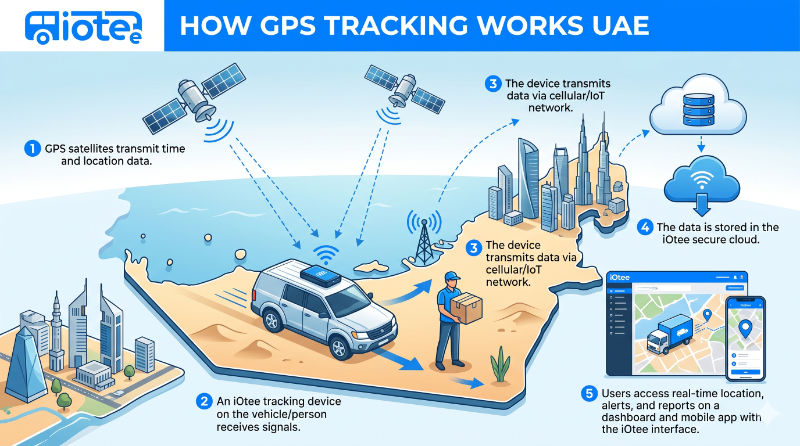
It starts with data. The telematics device in each vehicle keeps reporting mileage, engine hours and ignition cycles. Hardwired units that read the CAN bus also send diagnostic trouble codes (DTCs), battery health, coolant temperature and more. It's the same hardware used for GPS tracking. Maintenance is just one more job for that data.
Then rules check it. You set the service schedules, such as "oil change every 10,000 km", "brake inspection every 6 months" or "tyre rotation every 8,000 km", and the system compares each vehicle's live data against them.
When a vehicle gets close to a threshold, a work order appears. The system raises an alert, creates and assigns the job, and tells the fleet manager and the workshop before the service goes overdue.
Finally, everything gets logged. Each finished job records parts, labour, cost, vendor and date against that vehicle's permanent history. Over months that builds a cost-per-vehicle and cost-per-kilometre picture, which is what you need when deciding whether to repair or replace.
Nothing slips. Every service is planned, and every asset has a full audit trail.
What Does a Fleet Maintenance System Track?
The Core Modules of Fleet Maintenance Software
A full UAE fleet maintenance system usually includes:
- Preventive maintenance scheduling: automatic PM reminders by date, mileage or engine hours.
- Work order management: create, assign, track and close repair jobs.
- Service history: a per-vehicle logbook of every repair, part and cost.
- Parts and inventory: stock of filters, brake pads and tyres, with auto-reorder at minimum levels.
- Vendor and workshop management: in-house and outside garages, with cost comparison.
- Inspections (DVIR): digital driver vehicle inspection reports, so drivers can flag defects from a mobile app before and after trips.
- Compliance and document tracking: Mulkiya (registration) renewals, insurance expiry, RTA inspections and driver licence expiry, with alerts ahead of each deadline.
- Tyre management: wear, pressure, rotation and cost per tyre. See tyre management.
- Fuel integration: fuel use linked to maintenance, because a sudden drop in efficiency often points to a mechanical fault. See our fuel management guide.
- Cost analytics and reporting: total cost of ownership, cost per km, downtime, and maintenance spend by vehicle and category.
Why Telematics Makes Fleet Maintenance Smarter
Automatic Mileage, Fault Codes, and Driver Behaviour
The biggest step up from a spreadsheet or a standalone maintenance app is hooking maintenance into live telematics data. Three things change when you do.
Mileage updates itself. PM schedules kept in spreadsheets fail because nobody updates the odometer reliably. With telematics, mileage and engine hours come in automatically, so "every 10,000 km" fires at the actual 10,000 km instead of whenever someone gets round to logging it.
The vehicle reports its own faults. Diagnostic trouble codes (DTCs) go straight into the system. A check-engine condition, an emissions fault or a battery on its way out can raise a work order the moment it shows up. What might have been a roadside breakdown becomes a booked garage visit.
And driving style tells you about wear. Driver behaviour data such as harsh braking, hard acceleration and excessive idling lines up closely with brake, tyre and engine wear. The system can flag hard-driven vehicles for an earlier inspection, and you can coach the drivers doing the damage.
This is how a fleet moves from preventive to predictive maintenance. It's also why we'd always run maintenance and tracking on one platform. Two disconnected tools lose most of the benefit.
What Are the Benefits of a Fleet Maintenance System?
The Business Case, in Numbers
Maintenance is one of the three biggest fleet costs, alongside fuel and depreciation, so getting it right shows up in your profit. Fleets that put a structured maintenance system in place usually get:
- Less downtime, because servicing is planned for off-hours instead of breakdowns happening mid-route. More available vehicles means more revenue per asset.
- Lower repair bills. A worn brake pad caught early costs a fraction of replacing pads, discs and callipers after they fail.
- Longer asset life. Well-kept vehicles last longer and resell for more, which improves total cost of ownership.
- Fewer roadside breakdowns, fewer towing bills, fewer missed SLAs and fewer stranded drivers.
- Better safety and compliance. Brakes, tyres and lights in good order cut accident risk and keep you in line with RTA inspection requirements.
- No missed renewals, since automatic alerts mean Mulkiya, insurance and inspection deadlines don't slip past (and you avoid the fines).
- Decisions based on data. Cost-per-km history tells you exactly when a vehicle has turned into a money pit and should go.
For the wider financial picture of running a fleet platform, read our fleet management software cost guide.
Stop Breakdowns Before They Happen
Preventive maintenance scheduling, service alerts and cost tracking for UAE fleets.
Fleet Maintenance Challenges Unique to the UAE
Heat, Dust, and Intensive Use
Maintenance here is harder than in cooler markets, and it matters more.
Start with the heat. Summer temperatures above 50°C punish batteries, cooling systems, tyres and air-conditioning. Battery and coolant failures jump in summer, and blowouts rise when hot asphalt meets high tyre pressure. Tighten your schedules before summer arrives and keep them tight until it ends.
Then there's dust. Fine desert sand clogs air and cabin filters much faster than standard intervals assume, so air-filter and AC-filter intervals usually need shortening for the UAE.
Mileage piles up fast too. Delivery, logistics, taxi and rental fleets cover so many kilometres that they hit service thresholds before a manual schedule catches up.
On top of all that comes the paperwork: RTA periodic inspections, Mulkiya renewals and SecurePath/Asateel obligations. Those deadlines need tracking right next to the mechanical work.
So a system set up for the UAE uses shorter filter intervals, summer-aware schedules and built-in compliance tracking. Generic global defaults don't fit. If you run heavy equipment, our construction fleet management guide covers the off-road and construction side.
How Much Does a Fleet Maintenance System Cost in the UAE?
Pricing and Return on Investment
You usually get fleet maintenance as part of a fleet management or telematics platform. It's rarely billed on its own. In the UAE, the numbers look roughly like this:
- Hardware (telematics device plus installation): AED 800–1,500 per vehicle for a hardwired unit that reads engine and diagnostic data. Basic GPS-only units cost less but can't feed predictive maintenance.
- Monthly platform fee: AED 50–120 per vehicle, normally covering the tracking, maintenance, fuel and driver modules together.
- Standalone maintenance/CMMS software with no telematics: AED 20–60 per vehicle per month. You lose the automatic mileage and fault-code feed that keeps the system reliable, though.
What about ROI? Maintenance and downtime savings usually cover the platform cost several times over. Dodging one major unplanned breakdown (an engine, a transmission) or one multi-vehicle compliance fine often pays for a year of the system on a small fleet. Once you add the fuel and accident savings from the same platform, most UAE fleets see payback in well under a year.
The maintenance module runs on the same hardware as tracking. That means your real buying decision is which overall platform to choose, and our GPS tracking systems buyer's guide can help with that.
How to Choose a Fleet Maintenance System
What to Look For in the UAE
If you're comparing fleet maintenance software for a UAE operation, look for these:
- Telematics integration: automatic odometer and engine-hour capture, plus engine fault-code (DTC) intake. Without it you're back to manual data entry, and that always slips.
- Flexible PM scheduling by date, mileage and engine hours, with room to set UAE-specific intervals (shorter filter changes, summer schedules).
- Compliance tracking with Mulkiya, insurance, RTA inspection and licence-expiry alerts built in.
- Mobile DVIR, so drivers can send digital inspection reports and flag defects from a phone, in Arabic or English.
- Work order and vendor management covering in-house and outside workshops, with parts and labour costs.
- Cost analytics: cost per km, total cost of ownership, and repair-or-replace reporting.
- One integrated platform where maintenance, GPS tracking, fuel and driver behaviour sit together, from one vendor who's accountable for all of it.
- A bilingual interface and local support: Arabic/English UI, local installation and UAE-based service.
IOTee includes maintenance in an integrated fleet management platform. The same hardware behind our GPS tracking software feeds preventive and predictive maintenance, so you run one system instead of five.
Related: see how GPS tracking for vehicles works in the UAE, with device types, pricing from AED 500/year, and coverage across all seven emirates.
Frequently Asked Questions
What is a fleet maintenance system?
It's software, usually combined with a telematics device in each vehicle, that plans, schedules and records all the servicing and repairs across a fleet. It keeps track of what service is due and when (by date, mileage or engine hours), creates and manages work orders, and holds a full cost and repair history for every vehicle. The point is to stop fixing things only when they break and move to planned maintenance based on data, which cuts downtime and lifetime cost.
What is the difference between preventive and predictive maintenance?
Preventive maintenance runs on fixed intervals, every 5,000 km or every three months, whatever condition the vehicle is in. It stops most breakdowns and it's easy to plan. Predictive maintenance uses live telematics and engine sensor data (fault codes, battery health, wear signals) to service a vehicle based on its real condition, exactly when it's needed. Predictive is more efficient because you avoid servicing too early and you avoid surprise failures. It does need telematics hardware that reads engine data.
How does telematics improve fleet maintenance?
Telematics gives the maintenance system live data. Mileage and engine hours update on their own, so schedules fire at the real threshold instead of when someone remembers to log it. Engine fault codes stream in, so problems raise work orders before they turn into breakdowns. Driver behaviour data such as harsh braking and idling flags hard-driven vehicles for an earlier inspection. That's what makes predictive maintenance possible and scheduling dependable, and it's why maintenance and GPS tracking belong on one integrated platform.
How much does fleet maintenance software cost in the UAE?
Most fleets get maintenance inside a fleet management platform. Expect roughly AED 800-1,500 per vehicle for the hardwired telematics device and installation, then AED 50-120 per vehicle per month for a platform that covers tracking, maintenance, fuel and driver modules. Standalone maintenance software without telematics costs about AED 20-60 per vehicle per month, but you lose the automatic mileage and fault-code feed. Savings from less downtime and fewer breakdowns typically pay back the cost in under a year.
Why is fleet maintenance more demanding in the UAE?
Conditions here are harsher than in most markets. Summer heat above 50°C strains batteries, cooling systems and tyres, so failures and blowouts go up. Fine desert dust clogs air and cabin filters much faster than standard intervals expect, which means changing filters more often. Delivery, taxi, rental and logistics fleets also pile on mileage quickly. Then there's the paperwork: RTA inspections, Mulkiya renewals and SecurePath/Asateel compliance. A maintenance system for the UAE should use shorter, summer-aware intervals and have compliance tracking built in.
Can a fleet maintenance system track registration and insurance renewals?
Yes. A good system tracks document deadlines as well as mechanical servicing: vehicle registration (Mulkiya) renewals, insurance expiry, RTA periodic inspection dates and driver licence expiry. It sends alerts well ahead of each deadline, so renewals don't get missed and you avoid the fines and the risk of a vehicle being taken off the road. For UAE fleets, this compliance tracking is often the feature that pays off first.
Do I need separate software for maintenance and GPS tracking?
No, and we'd advise against it. Maintenance works best on the same telematics data as GPS tracking. The device that reports a vehicle's location also reports its mileage, engine hours and fault codes, and those drive the maintenance schedule. One integrated platform gives you automatic data flow, a single dashboard and one vendor to hold accountable. Splitting maintenance and tracking across separate tools forces manual data entry and leaves gaps. Pick a platform that does both.
From Reactive to Reliable
Putting a Fleet Maintenance System to Work
A fleet maintenance system takes maintenance from surprise breakdowns and runaway bills to something planned and predictable. The idea is simple. Connect each vehicle's live data to clear service rules, let the system raise work orders before parts fail, and record every dirham so you always know your true cost per vehicle.
In the UAE, with the heat, the dust, the heavy use and the compliance load, the argument is even stronger. Fleets that do well treat maintenance as something they manage every week. They don't wait for the emergency.
IOTee builds maintenance into an integrated fleet management platform for UAE operators of any size. The same hardware that runs tracking, tyre management and driver behaviour monitoring drives preventive and predictive maintenance too. For the bigger picture, read our complete UAE fleet management guide. Or get in touch and we'll match a system to your fleet, your routes and your compliance needs.